Most side-by-side website comparisons are too narrow.
They compare keyword rankings and call it SEO. Or they compare screenshots and call it strategy. Or they run two audit tools, stare at two scores, and pretend the higher number explains why one site is winning.
That is not enough anymore.
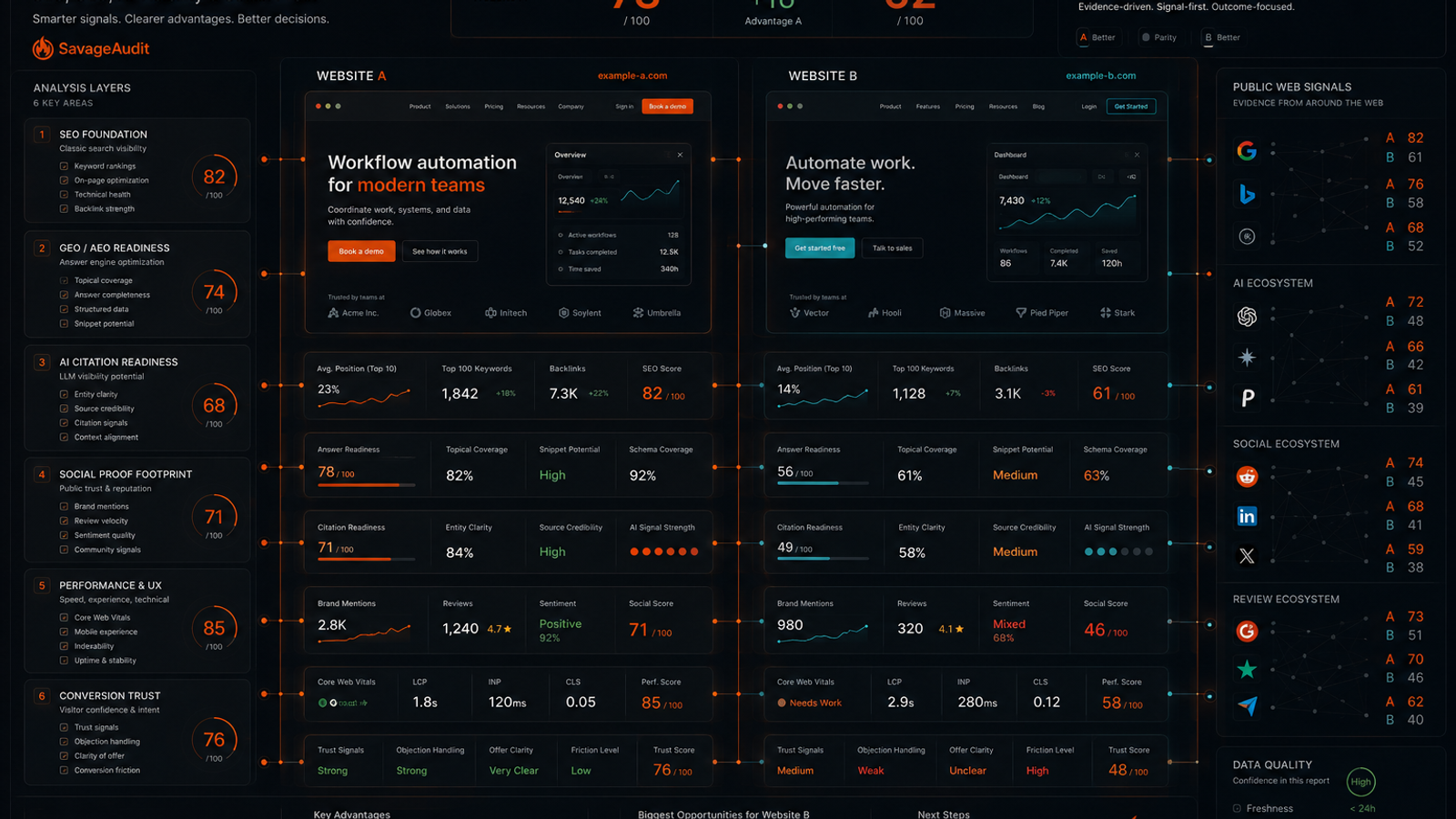
If you want to compare two websites properly, you need to compare the whole discovery and trust path: classic SEO, rankings, technical performance, GEO and AEO readiness, AI visibility, online presence, social proof, and what happens after the click.
That is the difference between a shallow website comparison and a useful one.
If you only need the classic SEO workflow, start with how to compare two websites for SEO. If you want the product surface for a live side-by-side review, use SavageAudit's compare websites. This article is the broader framework for comparing two sites when search, AI answers, public evidence, and conversion trust all matter.
Why comparing two websites by SEO score is not enough
An SEO score can be useful. It is also easy to over-trust.
A site can have cleaner metadata and still lose because its public proof is thin. A page can rank for a keyword and still fail because the answer is buried. A competitor can look weaker on speed and still win because its product category, proof, and buyer path are clearer.
That is why a useful website SEO comparison needs more than one number.
You are trying to answer several different questions:
- Which site is more visible in search?
- Which page better matches the search intent?
- Which site is easier for AI systems to extract, cite, and trust?
- Which brand has stronger public proof outside the page?
- Which page gives the visitor a clearer next step?
- Which problems are page-level issues, and which are site-level issues?
Those questions overlap, but they are not the same.
If the comparison collapses everything into one score, the team loses the reason behind the verdict.
Start with page-role parity
Before you compare two websites side by side, make sure you are comparing equivalent pages.
Homepage to homepage.
Pricing page to pricing page.
Product page to product page.
Blog post to blog post.
Demo page to demo page.
A comparison gets messy when one side is a polished commercial page and the other side is a generic homepage, a support doc, or a blog post doing a different job.
Check:
- Are both URLs solving the same buyer or search job?
- Would the same visitor reasonably land on both pages?
- Are both pages targeting the same stage of intent?
- Is one page doing a site-level job while the other is doing a page-level job?
- Are you comparing the live page users see, not a staged redesign or internal mockup?
This matters even more when comparing website rankings.
If one competitor ranks because it has a dedicated page for a narrow query and your site only has a broad homepage, the issue is not just "they rank better." The issue is page-role mismatch.
Compare website rankings without confusing page-level and site-level visibility
Ranking comparisons are useful when they are grouped correctly.
Start by separating page-level rankings from site-level visibility.
Page-level visibility asks: does this exact URL rank for the terms it should own?
Site-level visibility asks: does the overall domain have enough supporting pages to cover the topic cluster?
Those two signals can disagree.
A competitor might beat you at site level because it has stronger supporting content, even if the specific page you are comparing is not impressive. Your page might be stronger on copy and UX, but the competitor's domain may have more pages answering adjacent buyer questions.
Check:
- Which exact URLs rank for the shared target terms?
- Are rankings coming from homepage, product pages, comparison pages, or blog posts?
- Does one site have broader long-tail coverage?
- Does one site have stronger internal links from educational content to commercial pages?
- Are you comparing rankings for the same country, device, and search intent?
When you compare website rankings, do not stop at "who ranks higher."
Ask why that URL is the one Google is choosing.
Sometimes the answer is metadata. Sometimes it is content depth. Sometimes it is internal links. Sometimes it is that the other site built a better page for the query and you are trying to make the wrong page compete.
Compare on-page SEO and technical performance
Once page-role parity is clear, compare the on-page layer.
This is the closest thing to a classic website SEO comparison.
Check:
- title tag specificity
- meta description usefulness
- H1 clarity
- heading structure
- crawlability and indexability
- canonical correctness
- internal links and anchor context
- schema where it matches visible content
- page speed and perceived load quality
- mobile readability
- layout stability
- intrusive popups or overlays
Do not turn this into a box-ticking exercise.
The real question is whether each page is easier to understand, crawl, scan, and act on.
A fast page with vague copy is still weak. A detailed page that is slow, unstable, and hard to read on mobile is also weak. A page with perfect metadata but no believable proof will struggle after the click.
For SavageAudit, this is why the core website audit categories matter. SEO is one category, but performance, UX, copy, design, and conversion all affect whether search traffic turns into business value.
Compare GEO and AEO readiness
GEO and AEO comparisons are different from classic ranking comparisons.
Classic SEO asks whether a page can rank and earn clicks. GEO and AEO ask whether a page can be understood, extracted, summarized, and used as a source when search behaves more like an answer layer.
Do not compare GEO readiness by looking for one magic file or one schema type.
Compare the actual answer-readiness of the pages.
Check:
- Does each page answer a clear question directly?
- Are definitions, steps, comparisons, and trade-offs easy to extract?
- Does the page explain its methodology or criteria?
- Are claims backed by examples, screenshots, data, or public references?
- Are important terms used consistently across the site?
- Does the page connect to supporting resources through internal links?
- Does the brand have clear entity signals across About, Contact, author, legal, and profile pages?
Use this table to separate the layers.
| Layer | What it compares | Weak signal | Strong signal |
|---|---|---|---|
| Classic SEO | Rankings, page targeting, crawlability, metadata, internal links | Page is indexable but vague or poorly matched to intent | Page has clear targeting, clean structure, and useful search coverage |
| GEO/AEO | Answer-readiness, extractability, definitions, methodology, structured explanations | Page makes claims but hides the answer in brand copy | Page answers concrete questions in clean, reusable sections |
| AI visibility | Citability, entity clarity, evidence density, supporting content paths | Brand and claims are hard to verify or connect | Page is easy to attribute, quote, and support with public evidence |
| Social proof | Public trust footprint, reviews, profiles, testimonials, third-party signals | Proof exists only as generic on-page claims | Proof appears on-page and across credible public surfaces |
This is the part most side-by-side SEO tools miss.
They can compare headings and metadata. They often cannot tell you which site is more likely to survive as a cited, trusted, answer-ready source.
Compare AI visibility and citation readiness
An AI visibility audit should not ask only, "Are we mentioned by AI tools?"
That is an outcome.
The better comparison starts with the inputs that make a page easier to cite.
Check:
- Can the page be understood without surrounding brand context?
- Does it include concise answer blocks that stand alone?
- Are the strongest claims specific enough to quote?
- Does the page show who published it and why the source is credible?
- Are examples and proof close to the claims they support?
- Does the site have supporting pages for adjacent questions?
- Are product, company, author, and category names consistent?
If two sites are close in classic SEO, AI visibility can become the tie-breaker.
One site may have better answer blocks. The other may have better public proof. One may explain trade-offs clearly. The other may sound like every generic SaaS page in the category.
For a deeper review of that layer, use SavageAudit's AI visibility audit. In a side-by-side comparison, the goal is simpler: decide which site gives search and AI systems cleaner material to understand, trust, and surface.
Compare online presence and social proof
A website does not build trust alone.
Visitors check the page, then the brand. Search systems and AI systems also operate in a wider public context. If one site has a stronger public footprint, cleaner profiles, more credible mentions, and better proof consistency, that can affect the whole comparison.
Check:
- Are social profiles complete, current, and consistent?
- Do public profiles describe the company the same way the website does?
- Are reviews, testimonials, or customer references visible and believable?
- Does the brand appear in relevant directories, communities, or third-party mentions?
- Are founders, authors, or company pages easy to connect to the brand?
- Is proof repeated consistently across the website and public surfaces?
This is not the same as a social media audit.
A social media audit usually looks at posting, engagement, channel activity, and audience fit. An online presence audit looks at whether the public web makes the brand easier or harder to trust.
That is why SavageAudit separates the internet and social presence audit from the core page audit. A page can be well written and still feel weak if the public proof around the brand is thin.
Compare conversion trust after the click
Search visibility does not matter if the page wastes the visit.
After comparing rankings, SEO, AI visibility, and social proof, compare the conversion path.
Check:
- Is the offer clear within the first screen?
- Is the product category obvious?
- Does the page show what happens next?
- Is the CTA matched to the visitor's intent?
- Is proof close to the CTA?
- Does the page answer the main objections before asking for commitment?
- Does mobile layout preserve the same clarity?
- Are forms, booking links, pricing paths, or signup flows working cleanly?
This is where many website comparison reports become useful.
They stop being abstract and start becoming a fix list.
Maybe your competitor does not outrank you because their SEO is magical. Maybe their page is just easier to understand, easier to quote, easier to trust, and easier to act on.
That is a more useful diagnosis.
How to read a side-by-side website comparison report
A side-by-side website comparison report should not only declare a winner.
It should show where the separation happens.
Use a scorecard like this:
| Area | What to compare | Site A | Site B | Next action |
|---|---|---|---|---|
| Rankings | Shared query visibility by page role | Weak, moderate, strong | Weak, moderate, strong | Fix page targeting or supporting content gaps |
| On-page SEO | Title, H1, metadata, internal links, schema | Weak, moderate, strong | Weak, moderate, strong | Rewrite structure and internal anchors |
| Performance | Speed, stability, mobile interaction quality | Weak, moderate, strong | Weak, moderate, strong | Compress heavy assets and simplify friction |
| GEO/AEO | Extractable answers, definitions, methodology | Weak, moderate, strong | Weak, moderate, strong | Add answer-ready sections and clearer criteria |
| AI visibility | Citability, entity clarity, evidence density | Weak, moderate, strong | Weak, moderate, strong | Add proof, attribution, and supporting pages |
| Online presence | Public profiles, reviews, third-party proof | Weak, moderate, strong | Weak, moderate, strong | Repair footprint and proof consistency |
| Conversion trust | Offer clarity, proof near CTA, objection handling | Weak, moderate, strong | Weak, moderate, strong | Tighten CTA path and proof placement |
The "next action" column is the part that matters.
Without it, a website comparison is just a report. With it, the comparison becomes an operating document.
What to fix first when your competitor wins
If the competitor wins, do not copy their site.
Copying usually imports the wrong lesson.
Instead, identify the type of gap.
If they win on rankings:
- build or repair the page that should own the query
- strengthen supporting content
- improve internal links into the commercial page
- clean title, H1, and metadata alignment
If they win on GEO or AEO readiness:
- add clearer definitions
- make comparison sections more structured
- explain methodology
- write answer blocks that can stand alone
- link to supporting pages for subtopics
If they win on AI visibility:
- make claims more specific
- add evidence near the claim
- strengthen entity and author signals
- create pages that answer adjacent questions
- make public proof easier to verify
If they win on online presence:
- repair inconsistent profile descriptions
- update social and directory profiles
- add credible testimonials or examples
- connect public proof back to the website
If they win on conversion trust:
- clarify the above-the-fold offer
- move proof closer to the CTA
- reduce form or signup friction
- explain what happens after the click
- fix mobile sections that collapse badly
The right fix is rarely "make our page look more like theirs."
The right fix is usually more precise: match the page to the search job, make the answer easier to extract, make the proof easier to trust, and make the next step easier to take.
That is how a side-by-side website comparison becomes useful instead of political.
If you want to run the comparison on real URLs, start with compare websites. If AI search and citation readiness are the main concern, start with the AI visibility audit. If the page looks fine but the public brand footprint is weak, run an online presence audit before blaming the homepage again.
Common questions
How do I compare two websites for SEO?
Compare equivalent pages first, then review rankings, page targeting, title tags, headings, internal links, crawlability, technical performance, mobile usability, content depth, and conversion support. Do not compare a homepage against a competitor's dedicated product or comparison page.
What is the difference between website SEO comparison and AI visibility comparison?
Website SEO comparison focuses on rankings, crawlability, metadata, page targeting, internal links, and search intent. AI visibility comparison focuses on whether the page is extractable, citable, attributable, evidence-backed, and easy for answer engines to trust.
What should a side-by-side SEO comparison tool include?
A useful side-by-side SEO comparison tool should compare rankings, metadata, headings, technical performance, internal links, content depth, GEO/AEO readiness, AI visibility, social proof, and conversion trust. One score is not enough to explain the gap.
How do I compare website audit results?
Group the audit results by category, then separate page-level issues from site-level issues. Compare rankings, SEO, performance, AI visibility, online presence, and conversion trust separately before deciding what to fix first.
Why does online presence matter in a website comparison?
Online presence matters because buyers and search systems do not judge the website in isolation. Public profiles, reviews, third-party mentions, testimonials, and social proof can make one site feel more credible even when the page design looks similar.
