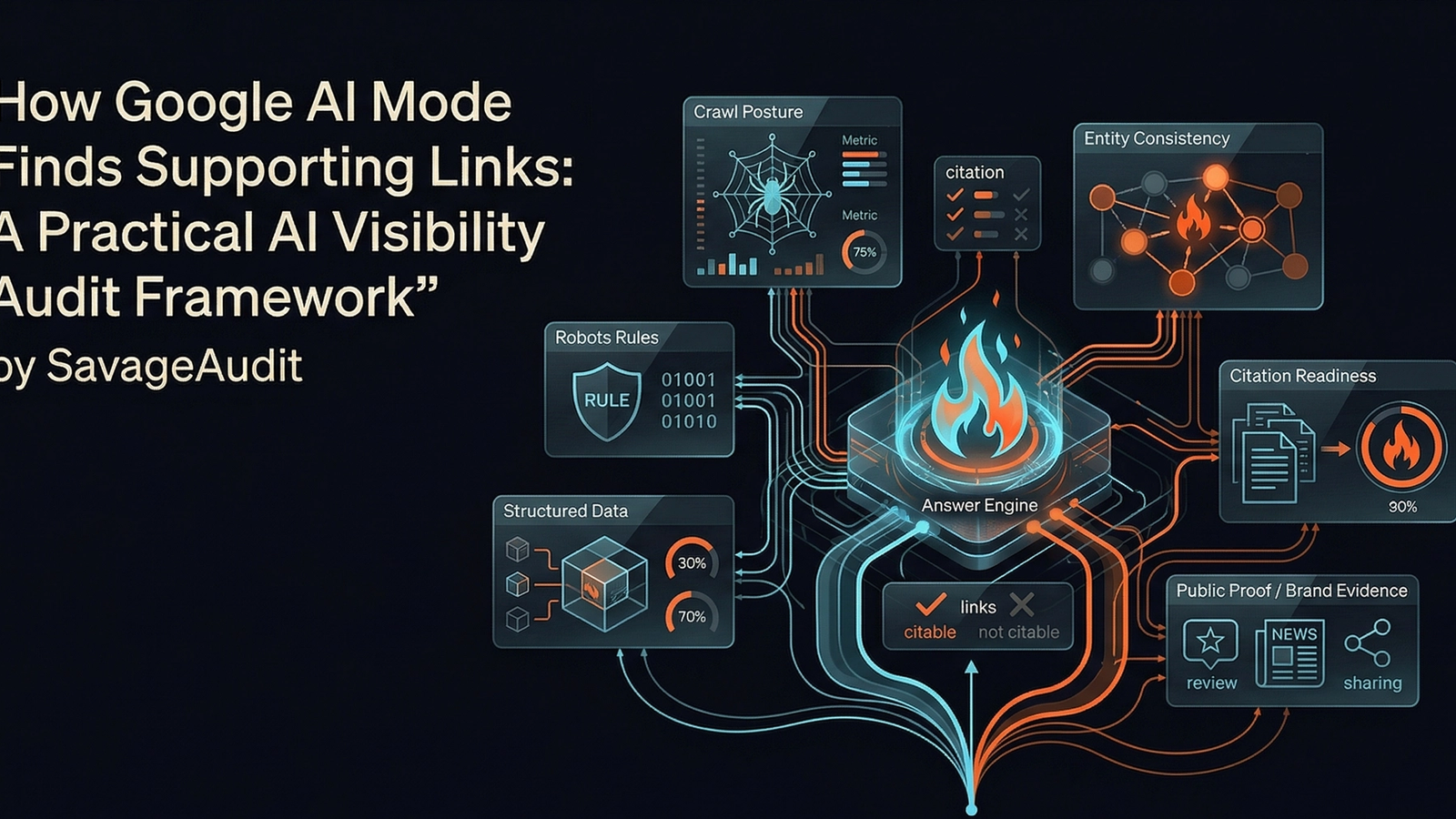
Google AI Mode doesn't use secret tricks; it relies on core search fundamentals amplified by a 'query fan-out' process. This process breaks a single user query into multiple sub-queries, retrieving a wide set of supporting pages. To be cited, a page must be highly legible across these retrieval paths. Visibility depends on excelling at the basics: flawless crawlability, clear snippet and text extractability, strong entity signals, high evidence density with verifiable proof, and a logical internal linking structure that maps out supporting content. Weaknesses in any of these areas, which might be minor in classic search, become critical...
If you're asking how to get your site featured in Google AI Mode, you're already solving the wrong problem.
Most teams obsess over secret AI tricks, hidden schema, or new machine-readable files that will magically get a page cited. Google's documentation contradicts them. AI features still run on core search foundations, but with a twist: AI Mode uses query fan-out to retrieve a wider set of supporting pages than a normal search.
The real question isn't "How do I hack AI Mode?" It's "Does my site stay legible when one user question explodes into many retrieval paths?" For the official line, see Google's guidance on AI features and your website and the product explanation in AI Mode in Google Search: Updates from Google I/O 2024.
To score that legibility, start with SavageAudit's AI visibility audit. In short: AI Mode surfaces pages that are crawlable, snippet-eligible, tightly scoped, text-rich, supported by public evidence, and easy to connect to a clear entity.
What Google has actually said
Google has been more explicit about AI search than most teams realize.
The official documentation states that AI Overviews and AI Mode surface relevant links, that the same SEO best practices apply, and that no extra technical requirements or special optimizations are needed. The same guide also mandates that pages must be indexable and eligible to show snippets. In plain English, if your content is weak in classic search fundamentals, AI Mode won't rescue it. It will amplify the consequences. See AI features and your website, Google Search Essentials, and the in-depth guide to how Search works.
Critically, Google also says AI Mode uses query fan-out, breaking one complex prompt into multiple subtopic searches behind the scenes. Most teams miss this part. Your page isn't just competing for one broad head term. It might be retrieved through a narrower question, a supporting comparison, a definition query, or an evidence query created during that fan-out process. See AI Mode in Google Search: Updates from Google I/O 2024.
| Google guidance | What it means in practice |
|---|---|
| AI Mode and AI Overviews surface relevant links | Your page has to be retrievable as a useful source, not just rank somewhere. |
| Query fan-out expands a question into subtopics | Narrow supporting pages often matter more than one giant, generic page. |
| No special AI-mode-only optimization is required | Stop wasting time on fake AI SEO rituals. |
| Pages must be indexable and snippet-eligible | Blocked, thin, or snippet-restricted content loses surface area fast. |
| Existing SEO best practices still apply | Crawlability, internal links, text clarity, structured data, and page quality still do the heavy lifting. |
Why supporting links are won before the final answer is assembled
In classic SEO, teams fixate on ranking one page for one query. In AI Mode, the retrieval path is broader. A strong page can still lose if it fails one of the smaller tests that happen during fan-out.
For example, a homepage might rank for a brand term but fail to become a supporting link for a high-intent AI Mode question because it doesn't answer a concrete subtopic cleanly. A long product page might rank for a category term but get skipped because the useful answer is buried under vague claims and weak headings with no extractable proof. A well-written thought-leadership page might still get ignored if the brand entity behind it is thin across the public web.
An AI visibility audit, therefore, can't stop at "Are we indexed?" It has to ask whether the site survives decomposition.
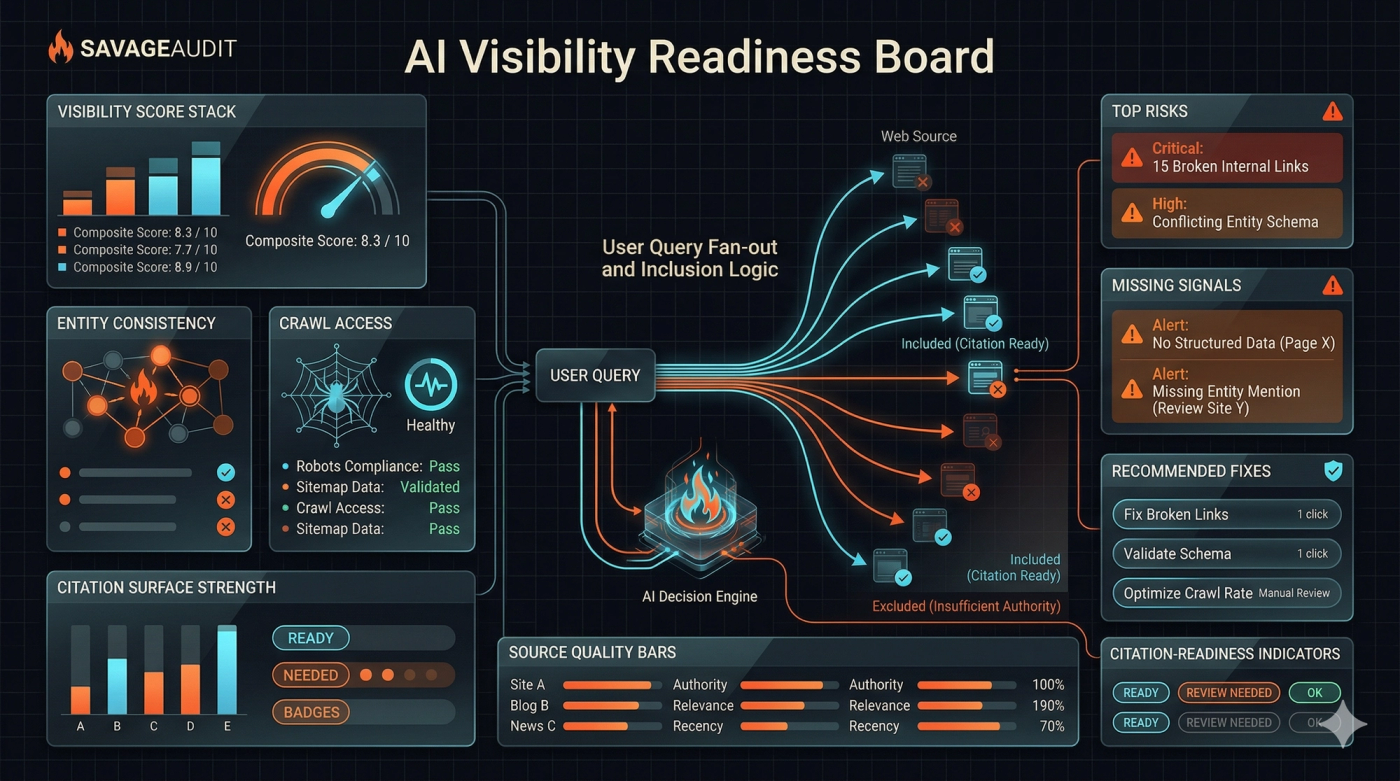
The practical AI visibility audit framework
We use this framework to pressure-test whether a page can become a supporting link in AI search.
1. Crawl posture
Start with whether Google can reach and process the page reliably.
This sounds basic because it is. But basic failures still kill AI visibility first. Google explicitly recommends ensuring robots.txt, CDN rules, and hosting infrastructure allow crawling. Internal links must also make content easy to discover. See AI features and your website.
Check:
- Is the page indexable and not blocked by robots, auth walls, or accidental noindex rules?
- Are core text sections rendered in HTML, not hidden behind fragile client-side behavior?
- Does the page receive internal links from relevant category, feature, and blog pages?
- Can Google discover supporting assets like images and videos if they matter to the answer?
If this layer is weak, stop here. Fix it before pretending the problem is "AI search."
2. Snippet and extractability readiness
Google's rule is simple: pages must be eligible to show snippets. This rule matters because AI Mode will not cite pages it cannot safely or clearly extract from.
Check:
- Are the strongest claims present as visible text, not just inside images or interactive widgets?
- Does each section answer one clear question with one clear scope?
- Are headings specific enough to stand alone when retrieval narrows to a subtopic?
- Do paragraphs get to the point fast, or do they drown the answer in brand filler?
Bad extractability usually looks like this:
- Vague hero copy
- Giant paragraphs with no scannable structure
- Proof hidden three scrolls down
- FAQ sections written like marketing scripts instead of actual answers
If a model has to work too hard to find the usable sentence, another page wins.
3. Entity clarity
AI Mode doesn't just retrieve text. It has to understand who is speaking.
Structured data helps Google connect your page content to your company as a real-world entity, reducing ambiguity and increasing confidence. Schema alone doesn't get you cited, but clean entity signals do. See intro to structured data.
Check:
- Is the brand name written consistently across the site?
- Are company, product, and author identities cleanly separated?
- Do About, Contact, product, legal, and profile pages reinforce the same entity?
- Is structured data present where appropriate, and does it match visible content?
SavageAudit's internet and social presence audit is critical here. If the open web has weak or inconsistent public signals about your brand, AI systems have less confidence connecting your content to a trustworthy source.
4. Evidence density
A surprising amount of AI visibility loss is really just a lack of proof.
Pay attention to the word "reliably" in Google's guidance for AI features. It’s not marketing fluff; it’s a technical signal. A page with claims but no evidence is harder to trust as a supporting source than a page with examples, specific numbers, concrete comparisons, or public references.
Check:
- Are important claims backed by data, examples, screenshots, or named references?
- Do comparison pages explain trade-offs instead of just declaring victory?
- Do category pages include definitions, methodology, and real constraints?
- Is there any independent public footprint reinforcing the same claims?
For this reason, thin SaaS copy struggles in AI search. It isn't just generic. It's unsupported.
5. Answer-surface coverage
Query fan-out rewards coverage across subtopics, not just one polished pillar page.
Teams often publish one giant page and expect it to do everything: educate, convert, rank, define terms, compare options, and capture AI citations. Usually, it does none of that well.
Instead, map your coverage like this:
- Core commercial page
- Supporting explainer
- Methodology page
- Comparison page
- Proof or research page
For SavageAudit, this is why the site has separate commercial surfaces like the AI visibility audit, website audit categories, and full-site audit. The blog handles research and supporting education instead of trying to impersonate a landing page.
6. Internal routing for fan-out paths
You win supporting links by making pages easy to contextualize.
If your internal linking only points everything back to the homepage, you are starving the retrieval graph. Google explicitly recommends making content easier to discover through internal links. See AI features and your website.
Check:
- Does the main commercial page link to supporting educational pages?
- Do blog posts link back to the relevant commercial surface?
- Do related pages connect adjacent intents instead of living in silos?
- Can a crawler understand which page is the best answer for each narrow topic?
Internal linking is not an SEO housekeeping task anymore. It's how you tell a retrieval system where supporting evidence lives.
7. People-first usefulness
The boring answer is still the right answer.
Google's people-first content guidance remains the cleanest filter for AI visibility work. If a page exists mainly to harvest search demand without adding real value, it may still get indexed, but it's a weak candidate for citation and support. See Creating helpful, reliable, people-first content and the SEO Starter Guide.
Check:
- Would the page still be useful if search traffic disappeared tomorrow?
- Is the page written by someone with real experience or just assembled from generic summaries?
- Does it answer the next obvious question, not just the first one?
- Does it include original framing, examples, data, or methodology?
If the answer is no, the page may survive basic indexing but will fail higher-trust retrieval.
What an AI-Mode-ready page usually looks like
The pattern isn't mysterious.
| Weak page | Strong page |
|---|---|
| Broad headline with no concrete scope | Specific headline tied to one clear user question |
| Claim-heavy copy with no proof | Claims backed by examples, numbers, or references |
| Generic sections like "Why choose us" | Sections that answer distinct subtopics directly |
| One page trying to cover everything | Clear page roles across commercial, educational, and proof content |
| Inconsistent brand/entity signals | Consistent brand naming and supporting public footprint |
| Poor internal linking | Obvious links between page clusters and evidence sources |
A simple audit workflow for teams
To turn this into work instead of theory, use this order.
- Pick one page that should plausibly appear as a supporting link for a real AI search question.
- Write down the likely fan-out subquestions behind that prompt.
- Score the page for crawlability, extractability, entity clarity, evidence density, and internal routing.
- Identify the missing support pages instead of forcing everything into one URL.
- Tighten the proof layer and visible answer blocks first.
- Re-check how the page connects to adjacent pages in the same topic cluster.
If you want that compressed into one workflow, use SavageAudit's AI visibility audit for the AI-search layer and website audit categories for the broader six-category review.
The real mistake teams make
They treat AI Mode like a new channel with new magic rules.
The reality is classic search fundamentals, plus stricter pressure on structure, clarity, and support. Query fan-out means weak pages get exposed faster because the system has more ways to bypass them.
So if you're asking why Google AI Mode isn't citing your website, don't start with speculative hacks. Start with a harder question: when Google breaks a user question into smaller retrieval jobs, do you still have the best page in the room?
That is the whole game.
Common questions
Does Google AI Mode need special schema or a new AI metadata file?
No. Google's documentation says there are no extra technical requirements or special optimizations required specifically for AI Overviews or AI Mode. Core SEO, snippet eligibility, and technical accessibility still matter most.
Why can a page rank in normal search and still fail to show up as a supporting link in AI Mode?
Because AI Mode can use query fan-out. A page may be relevant to a broad query but still lose narrower supporting retrieval jobs if it lacks clear answer blocks, proof, entity clarity, or internal discovery paths.
What is the first thing to fix if our site is weak in AI search visibility?
Fix crawlability and extractability first. If Google cannot reliably access the page, process the visible text, or use the page as a valid snippet source, the higher-level AI visibility work is mostly theatre.
Is AI visibility different from SEO?
It is different in emphasis, not in foundations. AI visibility puts more pressure on citability, extractable answers, entity consistency, and evidence density, but it still sits on top of standard search requirements.
Keep the diagnosis moving
Run your own public presence audit
See how your website, search footprint, AI visibility, social proof, and conversion trust look from the outside.