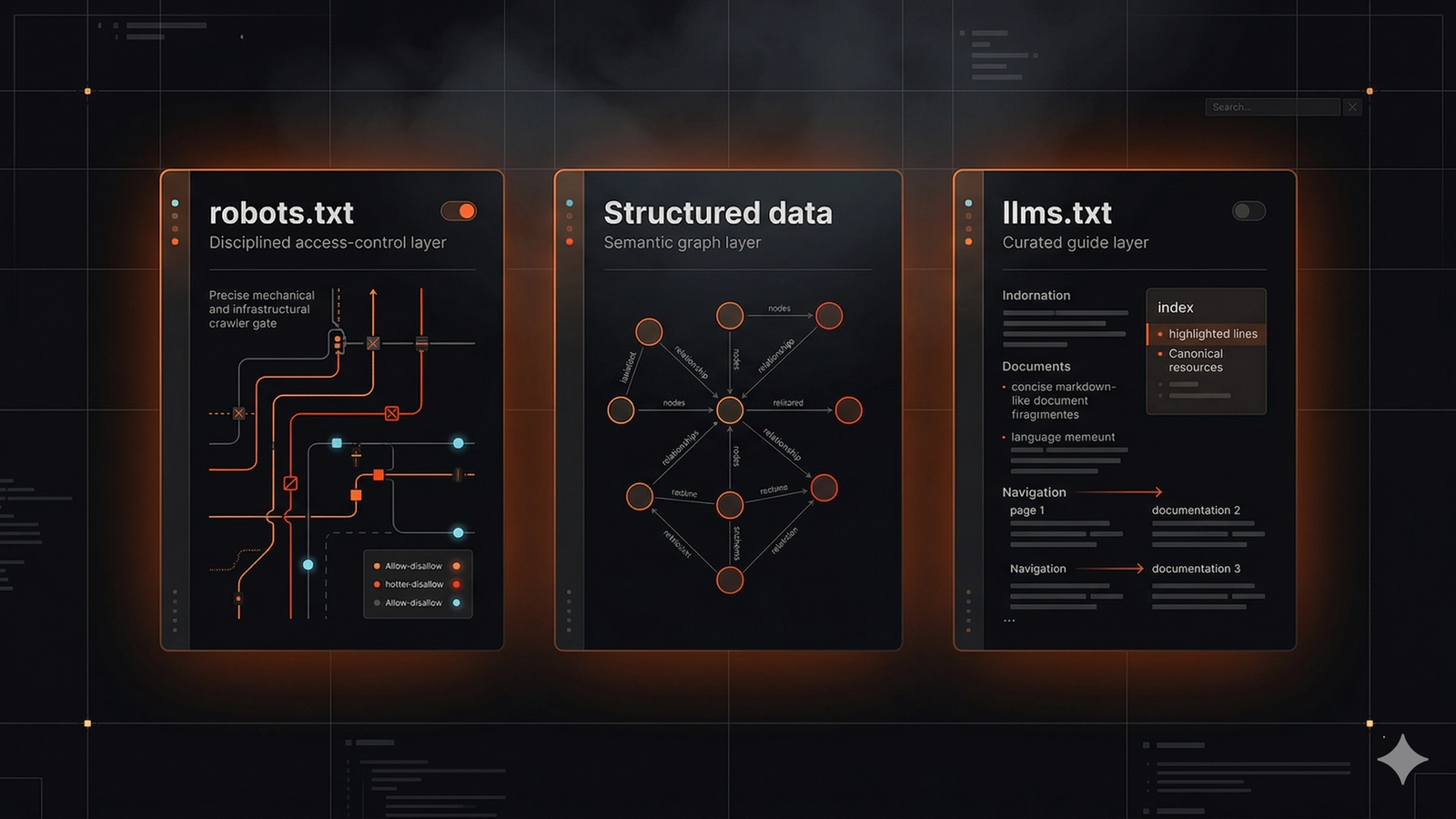
Robots.txt controls crawler access, structured data adds machine-readable meaning to content, and llms.txt is an optional guidance file for AI systems that choose to read it. They are not substitutes. For AI discovery, prioritize technical fundamentals: crawlability, snippet eligibility, clean page structure, and entity clarity via structured data. These foundational layers have a far greater impact on how AI systems find and use your content than the proposed llms.txt file. Treat llms.txt as a finishing touch for large documentation sites, not a primary visibility lever.
If your team is shipping llms.txt because it feels like the AI-era version of robots.txt, stop for a minute.
These three things do not solve the same problem.
robots.txt controls crawler access. Structured data helps machines interpret entities and page meaning. llms.txt is a proposed convenience file that can point language models to useful documentation and reference pages—if they choose to read it. That is a very different job from crawl control or semantic markup. See AI features and your website, Google Search Essentials, intro to structured data, and the proposed llms.txt specification.
The big mistake is treating them like substitutes.
Google's own documentation is the cleanest anchor here: AI features don't require a special AI-only technical setup. Pages still need to be crawlable, indexable, and snippet-eligible. That means most AI discovery wins still come from classic technical hygiene plus clearer page structure. If you want the broader audit layer, that is exactly what SavageAudit's AI visibility audit is built to pressure-test.
The short answer
Here is the clean version.
| Layer | Primary job | What it helps with | What it does not do |
|---|---|---|---|
| `robots.txt` | Controls crawler access at the path level | Allows or blocks crawling of files, directories, and sections | It does not explain meaning, quality, or preferred citations |
| Structured data | Adds machine-readable context to page content | Helps systems understand entities, relationships, and page types | It does not grant automatic rankings or AI citations |
| `llms.txt` | Offers a curated map of important docs for AI systems that choose to read it | Can reduce friction on large docs-heavy sites | It does not replace crawlability, indexability, or strong page content |
If your site has crawl issues, poor extractability, thin content, or weak entity signals, llms.txt will not rescue it.
robots.txt: The Access Controller
robots.txt is still the access-control layer people most often misunderstand.
Its job is simple: tell compliant crawlers which paths they may or may not crawl. It matters because blocked sections cannot become usable discovery surfaces for search systems that honor those rules. If you accidentally block product directories, comparison pages, or supporting resources, you reduce the content available for search features and AI retrieval.
This matters even more when AI systems rely on underlying search infrastructure or the public web graph to discover source material.
What robots.txt is good for:
- Keeping low-value crawl traps out of the crawl budget
- Blocking private or duplicate path patterns when appropriate
- Making sure assets and pages needed for rendering are not accidentally denied
What robots.txt is not good for:
- Asking to be cited more often
- Describing what your company does
- Highlighting the best explanation page for a concept
- Proving trust, originality, or expertise
If your AI discovery strategy starts and ends with robots.txt, you are solving the wrong layer.
Structured Data: The Meaning Layer
Structured data is about machine-readable meaning, not permission.
Google's documentation is explicit that structured data helps Google understand page content and information about entities more generally. This is useful because AI retrieval systems work better when the page clearly expresses what it is, who published it, and how key entities relate to each other. See intro to structured data.
Structured data helps systems clarify that a page is an article, FAQ, product, organization, or breadcrumb path. It reinforces brand, author, and company identity. It makes page relationships cleaner for systems that parse entities.
But teams regularly over-attribute what it can do.
Structured data does not turn vague marketing copy into a trustworthy answer. It does not override weak visible content. It does not make a thin comparison page magically become the best source for a nuanced question. It is an amplifier for clarity, not a substitute for it.
Think of it this way: structured data helps machines interpret the page you already wrote. It does not write a better page for you.
llms.txt: The Optional Cheat Sheet
llms.txt is best understood as an optional guidance file, not a discovery guarantee.
The proposed format gives site owners a place to list important documentation, canonical resources, and concise summaries for language models or assistants that choose to fetch the file. On a large docs site, that can be useful. On an API platform, a standards site, or a research-heavy knowledge base, it can reduce ambiguity about which pages matter most.
But many teams are treating llms.txt like a new ranking primitive when there is no strong evidence for it. Google's documentation does not list llms.txt as a requirement for AI features, and recent third-party analysis has found low adoption with no consistent proof of citation lift. See AI features and your website and LLMs.txt Does Not Boost AI Citations, New Analysis Finds.
So is llms.txt useless? No. But its value depends entirely on its place in the order of operations.
Why Teams Get This Wrong
The confusion is rooted in a flawed assumption: that every new machine-readable file is a shortcut to discovery. Teams chase the novel llms.txt because it feels like a competitive edge, assuming AI systems need a separate standard from search fundamentals.
The actual retrieval chain is less glamorous.
If a page is blocked, weak, vague, snippet-restricted, or unsupported by evidence, that weakness shows up whether or not you publish a helpful text file at the root of the site. The boring fundamentals still decide the game. Stop asking "Which one should I use?" Ask: "Which problem are we actually solving?"
What Actually Helps AI Discovery in 2026
The year in the title is a placeholder for the near future. The principles below are based on the durable fundamentals of information retrieval, not speculation.
1. Crawlability, indexability, and snippet eligibility
Google says AI features depend on the same fundamental requirements as broader Search visibility. Pages need to be crawlable and eligible to show snippets. See AI features and your website.
This requires verifying:
- No accidental
noindexor blocked paths on key pages - No broken canonicals pointing authority elsewhere
- No fragile render-only text hidden behind brittle client-side execution
- No snippet restrictions that kneecap the page's usefulness as an answer source
This is basic, but basic failures cause disproportionate damage.
2. Extractable page structure
AI discovery isn't about finding a page. It's about being able to use it.
A usable page has:
- A heading that describes a narrow question clearly.
- A paragraph that answers that question immediately.
- Proof that is visible in text, not buried in screenshots alone.
- Internal links that connect the page to adjacent concepts and evidence.
If a model or search system has to excavate the useful answer from vague copy, your page loses to a cleaner source.
3. Entity clarity
Machines need to understand who is speaking, not just what is being said.
Your company name, product names, author identity, About page, Contact page, legal pages, and structured data should reinforce the same entity story. If your brand is inconsistent across the site and the wider web, retrieval confidence drops.
That is one reason SavageAudit pairs the technical layer with an internet and social presence audit. AI discovery is not just a file problem. It is also a public-presence problem.
4. Evidence density
Citable content is specific content.
The strongest pages have:
- Concrete examples
- Clear comparisons
- Named methods
- Screenshots or product references backed by visible text
- Real constraints instead of generic claims
If a page says "we are the best" but cannot show how, the technical wrapper around it is irrelevant.
5. Internal routing across topic clusters
AI systems don't just land on homepages and sales pages.
They often surface supporting pages that answer narrower subquestions. Your site architecture needs to route crawlers and readers toward those pages cleanly. Comparison pages, methodology pages, glossaries, and FAQ hubs are often the primary sources for these high-intent queries.
If your internal linking is weak, the site becomes harder to interpret as a connected knowledge graph.
So where does llms.txt fit?
After those layers. Not before them.
When llms.txt is worth implementing
There are real cases where it makes sense. llms.txt is usually worth the effort when:
- Your site has a large developer docs surface.
- Your product has API references, SDK guides, and fragmented help content.
- Your team wants one obvious machine-readable starting point for canonical resources.
- You can maintain the file as the docs set evolves.
In those cases, the file can act like a curated map for a sprawling, repetitive, or hard-to-traverse documentation library. But even then, the file must point to pages that are already good.
If the destination pages are weak, the map is just a faster route to weak material.
When llms.txt is a distraction
It is usually a distraction when:
- Your homepage still has vague messaging.
- Your key pages are not well linked internally.
- Your brand signals are inconsistent across the site.
- Your structured data is missing on pages where it is obviously appropriate.
- Your content library is tiny and easy to navigate already.
- Your team has no process to maintain the file after launch.
For most startups and service sites, the first hour spent on llms.txt is less valuable than the first hour spent tightening titles, fixing crawl rules, improving answer blocks, or strengthening proof.
The Priority Stack: A Pre-Flight Check
Before you touch llms.txt, run your strategy against this priority stack. If you can't check off the first four layers, the work on layer six is a waste of time.
| Priority | Focus | Why it comes first |
|---|---|---|
| 1 | Crawlability and snippet eligibility | No access means no discovery surface |
| 2 | Strong page structure and visible answers | Retrieval systems need usable answer blocks |
| 3 | Structured data on the right page types | Helps interpretation and entity clarity |
| 4 | Internal linking and topic coverage | Improves discovery paths and supporting-link depth |
| 5 | Public entity consistency | Reinforces trust in who is speaking |
| 6 | `llms.txt` | Optional guidance layer after the real work is done |
That order is much closer to how real visibility gains are won.
What to do next
When you audit your site for AI discovery, stop asking "Should we add llms.txt?"
Instead, diagnose your site against the priority stack. Are you accessible? Is your content extractable? Is your entity story clear? Are your ideas connected?
If you want help diagnosing that sequence, start with SavageAudit's AI visibility audit. If your public footprint is thin or inconsistent, the better starting point is our internet and social presence audit.
llms.txt may be worth adding later. But it’s a finishing touch, not a foundation. Don't use it to hide a fundamentally broken site.
Common questions
Does Google require `llms.txt` for AI Overviews or AI Mode?
No. Google's current documentation says AI features do not require special AI-only technical setup beyond normal Search requirements.
Can `llms.txt` replace `robots.txt`?
No. robots.txt governs crawler access. llms.txt is an optional guide file for systems that choose to read it. They solve different problems.
Does structured data guarantee better AI citations?
No. Structured data can improve machine understanding, but it does not override weak content, weak trust signals, or weak page structure.
If I only do one thing for AI discovery this quarter, what should it be?
Improve the pages you actually want cited. Make them crawlable, snippet-eligible, clearly structured, well linked, and supported by specific evidence.
Keep the diagnosis moving
Run your own public presence audit
See how your website, search footprint, AI visibility, social proof, and conversion trust look from the outside.