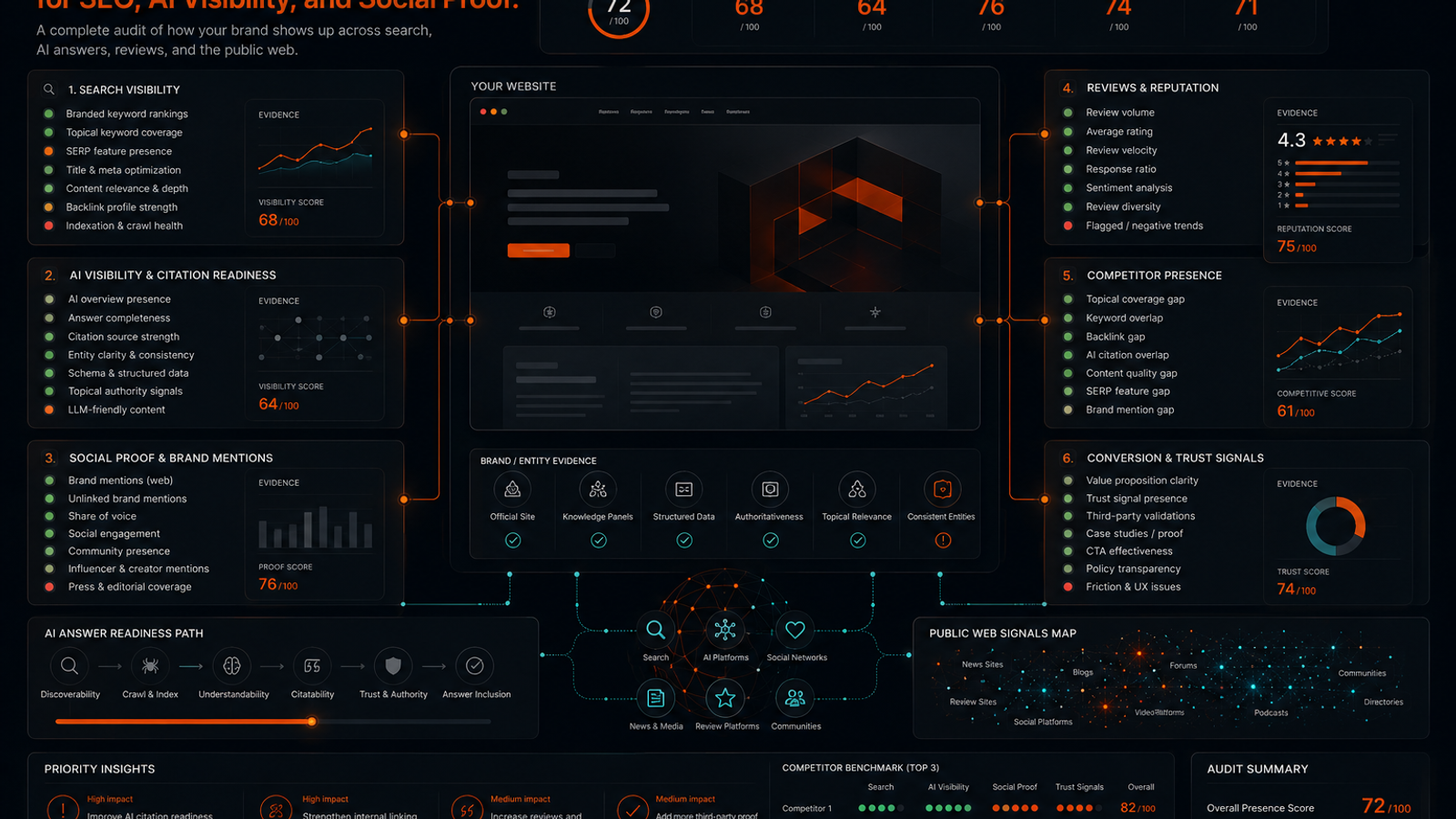
A modern online presence audit checks if your brand is visible, understandable, and trustworthy where buyers form opinions. It unifies three layers: search visibility (SEO), AI visibility (AEO), and trust visibility (social proof). Old audits focused on social profiles and directories. This checklist covers the full public record: your website, search results, AI summaries, social profiles, reviews, and competitor context. It provides a step-by-step process to audit website clarity, search and AI visibility, social proof, competitor signals, and conversion trust, ensuring your brand's claims are supported by public evidence.
Most online presence audits are stuck in 2018.
They check for social profiles, a few directory listings, and a Google Business Profile. That’s a start, but it’s not enough.
Buyers don’t judge your brand from one place anymore. Before they ever talk to you, they see your website, search results, AI summaries, social profiles, review snippets, founder mentions, and comparison pages. They see the whole public record.
A modern online presence audit has to connect three layers at once: search visibility, AI visibility, and trust visibility.
This article provides the operating checklist for teams that want to audit the full outside view of a brand, not just count social handles.
What an online presence audit actually checks
An online presence audit checks whether your brand is visible, understandable, and trustworthy across the places buyers use to form an opinion.
Think of this as a unified checklist for your digital presence, social visibility, and website trust. While those sound like separate projects, buyers experience them as a single, public credibility layer.
That layer includes your website, search results, AI answer surfaces, social profiles, public mentions, reviews, competitor context, and the conversion path after someone lands on your site.
The mistake is treating those as separate projects.
SEO determines if people can find the brand. AI visibility determines if machines can understand and cite the brand. Social proof determines if the public web supports the brand's claims. Conversion trust determines if the site turns that attention into action.
If one layer is weak, the others have to work harder.
Why a social media audit is too narrow
A social media audit asks whether your profiles are active, consistent, branded, and useful.
That’s a useful exercise, but it answers a narrow slice of the real question.
The stronger question is: when a buyer checks the public web, does the company look real, current, relevant, and credible?
That question includes social media, but it also covers:
- Search snippets
- Brand query results
- Review surfaces
- Founder and company entity signals
- AI answer visibility
- Comparison pages
- Public mentions
- Website trust pages
- Case studies and proof
- Content that explains the category clearly
If the website claims authority but the public web is silent, the buyer feels the gap. If the company looks active on social but the website is vague, the buyer feels that too.
An online presence audit should catch those mismatches before they cost you pipeline.
The modern online presence audit stack
Use this map before you start scoring.
| Layer | What to check | What weak looks like | What strong looks like |
|---|---|---|---|
| Website clarity | Homepage, core pages, positioning, CTAs | Vague claims, unclear buyer, generic copy | Clear category, buyer, proof, and next step |
| Search visibility | Indexability, title tags, snippets, brand queries | Brand search results are generic or confusing | Search results make the brand easy to understand |
| AI visibility | Crawlability, answer-readiness, entity clarity | AI tools struggle to describe or cite the brand | Pages are easy to extract, summarize, and support |
| Social proof | Reviews, testimonials, mentions, social footprint | Big claims with little public evidence | Claims are supported by visible proof |
| Competitor context | Where competitors appear and how they explain value | Competitors look clearer or more credible | Your brand has a defensible public position |
| Conversion trust | Proof, friction, risk reducers, offer clarity | Visitors hesitate after landing | The next step feels obvious and low-risk |
This complexity is why one-score website graders fail. A site can have decent technical SEO and still look weak in the wider market.
Step 1: Audit the owned website first
Your website anchors your online presence. If it can’t explain the company clearly, the rest of your online presence has to compensate.
Start with the pages buyers are most likely to check:
- Homepage
- Pricing page
- Product or service pages
- Demo, trial, or contact page
- Case studies or proof pages
- Blog or resource pages
- About, privacy, terms, and trust pages
For each page, ask:
- Can a new visitor tell what the company does in ten seconds?
- Is the target buyer obvious?
- Is the category clear?
- Is the offer specific enough to remember?
- Does the page show proof before asking for commitment?
- Does the CTA match the sales motion?
- Does the content support search and AI extraction?
If the answer is no, don't start with more social posts. Fix the page that all those posts send people to.
SavageAudit's website audit categories are useful here because they separate the problem into performance, SEO, design, copy, UX, and conversion. That keeps the audit from turning into one person's opinion about "brand feel."
Step 2: Check search visibility and brand results
Search often provides the first outside proof layer.
Run the obvious checks:
- Search the exact brand name
- Search the brand name plus product category
- Search the founder name plus company name
- Search the core problem the company solves
- Search competitor names and compare the result quality
- Check whether important pages are indexed
- Review title tags and meta descriptions for clarity
- Check whether snippets match what the company wants to be known for
Google's Search Essentials are still the technical baseline: pages need to be accessible, useful, and not blocked from crawling or indexing. Google's SEO Starter Guide is a useful sanity check for teams that need to master the fundamentals.
The goal isn't to chase every keyword. It's to ensure the brand is legible when someone actually goes looking for it.
Weak search visibility often looks like this:
- The homepage result says almost nothing specific
- The brand is outranked by random profiles or stale mentions
- Product pages are not indexed
- The blog ranks for awareness terms but not buyer-intent terms
- Competitors own the comparison and category queries
- Snippets do not explain the offer clearly
This creates an online presence problem, not just an SEO problem.
Step 3: Audit AI visibility and answer-readiness
AI visibility now belongs in the online presence audit because buyers increasingly ask AI tools before they click vendor sites.
This doesn't mean you need a magic AI file or a pile of fake AI keywords. Google's own guidance on AI features and your website confirms this: AI-powered overviews rely on the same core search foundations. Pages must be crawlable, indexable, and eligible for snippets to be considered for AI surfaces.
For a practical AI visibility audit, check whether your site gives answer engines enough clean material to work with.
Ask:
- Can the homepage define the company in one clear paragraph?
- Do product pages explain who the product is for?
- Do pages answer common buyer questions directly?
- Are claims supported by proof, examples, or specifics?
- Are important entities named consistently?
- Is structured data used where it actually matches visible content?
- Are pages text-rich enough to quote, not just visual?
- Do FAQs answer real questions instead of repeating sales copy?
Google's structured data introduction is useful here, but structured data is not a replacement for clear content. It helps machines understand the page. It does not make weak content worth citing.
The practical test is simple:
If an AI answer had to describe your company in two sentences, would your own website give it enough clean, specific, supported material?
If not, the online presence audit should flag that as a visibility leak.
Step 4: Audit social proof and public evidence
Social proof extends beyond testimonials on your homepage.
It's the evidence a buyer can find without trusting your own copy first.
Check:
- Customer testimonials
- Case studies
- Review profiles
- Social media activity
- Founder or team visibility
- Product screenshots or demos
- Community mentions
- Podcast, newsletter, or media mentions
- GitHub, Product Hunt, G2, Capterra, Trustpilot, or industry-specific profiles where relevant
- Public changelogs, docs, or release notes
The goal isn't to be everywhere—that just creates noise.
The goal is to make sure your claims have support somewhere outside the hero section.
For example, if the website says "trusted by modern SaaS teams," the audit should ask:
- Which teams?
- Where is the proof?
- Is the proof recent?
- Is the proof specific?
- Does the proof match the buyer the page is targeting?
Thin proof is a trust leak. It doesn't always stop traffic. It stops action.
Step 5: Audit reviews and reputation signals
The importance of reviews varies by business. A local service company, SaaS product, agency, ecommerce brand, and developer tool all need different proof surfaces.
But every company needs to know what a skeptical buyer finds.
Check:
- Are review surfaces present where buyers expect them?
- Are reviews recent enough to feel alive?
- Do reviews describe the same value the website claims?
- Are negative reviews addressed or ignored?
- Are testimonials too vague to be useful?
- Does the website overclaim compared with public reputation?
This step is where many online presence audits get uncomfortable.
The company may have a polished website, but the public proof may be stale, thin, or inconsistent. That doesn't mean the business is bad. It means the buyer lacks enough outside evidence to trust the claim quickly.
SavageAudit's online presence audit is useful because it frames this as evidence density, not vanity. A small company doesn't need a giant footprint. It needs the right footprint for its market and sales motion.
Step 6: Compare competitor presence without turning it into a design fight
Competitor comparison belongs inside an online presence audit, but it shouldn't take over the whole project.
The question isn't "which website looks cooler?"
The question is "which brand gives the buyer more reason to trust it across search, AI answers, public proof, and the website itself?"
Use SavageAudit's compare websites workflow when you need a structured side-by-side read. For this audit, compare only the public presence signals:
| Signal | Your site | Competitor | Gap to explain |
|---|---|---|---|
| Brand search result clarity | Does the result explain the company? | Is their result clearer? | Rewrite title, meta, homepage intro |
| AI answer-readiness | Can pages answer direct questions? | Do they have better extractable content? | Add definitions, FAQs, proof blocks |
| Social proof | Is there visible evidence? | Do they show stronger proof? | Add testimonials, case studies, public mentions |
| Review footprint | Are reviews discoverable and current? | Do they look more trusted? | Build the right review surface |
| Conversion trust | Does the site reduce risk? | Do they make action easier? | Fix CTA, proof order, pricing clarity |
This keeps the comparison useful. You aren't copying the competitor. You are finding the evidence gap that makes them easier to choose.
Step 7: Audit conversion trust after the click
Online presence doesn't end at discovery.
If a buyer finds you through search, AI, a review, or a social mention, the website still has to convert that attention.
Check the landing experience:
- Does the page match the promise from the source?
- Is the first screen clear?
- Is proof close to the claim?
- Are CTAs consistent?
- Is pricing, trial, demo, or contact logic easy to understand?
- Are forms asking for too much too early?
- Is there a trust page, privacy policy, or security context when needed?
- Does the mobile version preserve the same clarity?
Here, SEO, AI visibility, social proof, and CRO converge.
Traffic without trust is waste. Visibility without conversion is noise. A modern online presence audit should show where the journey breaks after someone finally lands.
Online presence audit scorecard
This scorecard makes the audit concrete.
| Category | Score from 1-5 | What to look for |
|---|---|---|
| Website clarity | Clarity of category, buyer, offer, proof, CTA | |
| Search visibility | Indexation, snippet clarity, brand SERP quality | |
| AI visibility | Answer-readiness, entity clarity, crawlable text | |
| Social proof | Density of testimonials, case studies, public mentions | |
| Reviews and reputation | Recency and relevance of reviews on key platforms | |
| Competitor context | Awareness of competitor evidence gaps | |
| Conversion trust | Low-friction CTAs, proof proximity, risk reduction |
Do not average the score and call it done.
Read the pattern.
A low search score means people may not find you. A low AI visibility score means answer engines may not understand or cite you. A low social proof score means people may not believe you. A low conversion trust score means they may find and believe you, then still avoid the next step.
Those are different problems. They need different fixes.
What to fix first
Fix the layer closest to revenue first, unless a technical block is preventing discovery.
Follow this order:
- Fix crawl, indexing, and major technical visibility problems.
- Clarify the homepage and core money pages.
- Add proof near the claims that need belief.
- Improve answer-ready sections for SEO, GEO, and AI visibility.
- Strengthen the review, social, and public evidence footprint.
- Compare the top competitor and close the most obvious trust gap.
- Re-audit after the changes so the team can see whether the leak actually moved.
Trying to improve everything at once is the wrong move.
A better approach finds the weakest trust layer and reinforces it, making it harder for a buyer to doubt you.
When to run an online presence audit
Run this audit when the website is not the only suspect.
Good moments:
- Before a redesign
- Before launching paid traffic
- Before a major SEO push
- Before pitching a new market
- Before launching a new SaaS product
- When competitors look more credible
- When AI tools describe competitors better than you
- When traffic exists but conversion feels weak
If the problem might live across the website, public web, social proof, and AI visibility, a normal page audit is too narrow.
Start with the online presence. Then decide which page, profile, proof asset, or visibility layer deserves the first fix.
Common questions
What is an online presence audit?
An online presence audit reviews how visible, understandable, and trustworthy a brand appears across its website, search results, AI answer surfaces, social profiles, reviews, public mentions, and conversion path.
How is an online presence audit different from an SEO audit?
An SEO audit focuses on search visibility, crawlability, rankings, content, and technical search issues. An online presence audit includes SEO, but also checks AI visibility, social proof, reviews, public evidence, competitor perception, and conversion trust.
Does an online presence audit include social media?
Yes, but social media is only one layer. A useful audit also checks the website, search snippets, brand results, reviews, mentions, AI answer-readiness, competitor signals, and trust leaks after the click.
Can an online presence audit help with AI visibility?
Yes. AI visibility depends on crawlable pages, clear entity signals, direct answers, useful proof, and content that can be extracted or cited. An online presence audit can show whether your public footprint gives AI systems enough reliable context.
When should a SaaS team run an online presence audit?
Run it before a redesign, SEO push, paid campaign, product launch, or competitor comparison. It is especially useful when traffic exists but buyers still do not seem to trust, understand, or choose the company.
Keep the diagnosis moving
Run your own public presence audit
See how your website, search footprint, AI visibility, social proof, and conversion trust look from the outside.