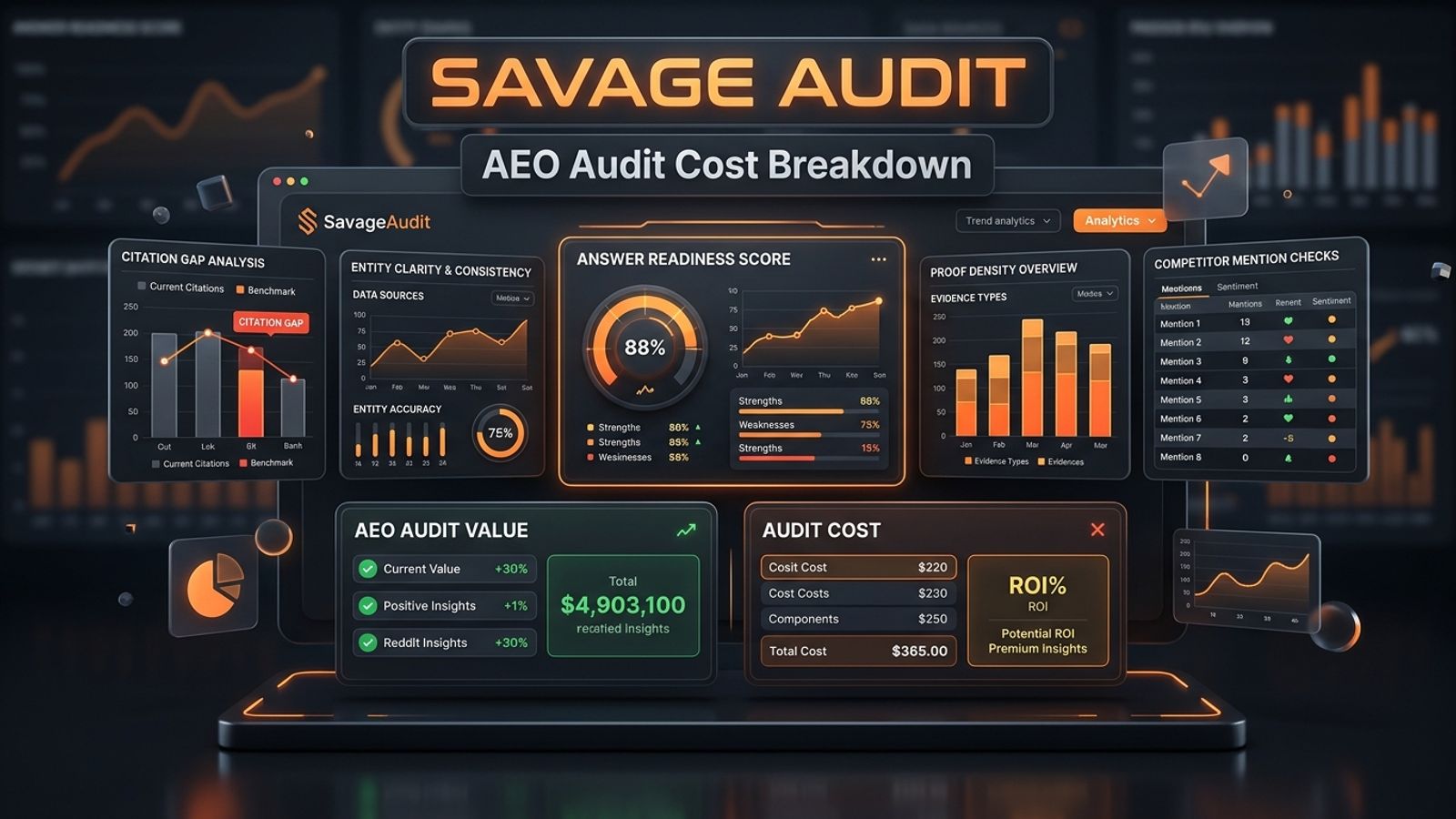
A fair AEO audit cost depends entirely on scope, depth, and deliverables. You cannot compare a free automated scan with a full-site diagnostic or an ongoing agency program. A real AEO audit must evaluate answer readiness, entity clarity, citation gaps, content freshness, proof density, competitor mentions, and crawl/index eligibility. Free audits are useful for basic triage, while paid software like SavageAudit Pro ($9/month) adds deeper diagnostics, full-detail results, PDFs, and repeatable workflows.
Buyers evaluating an AEO audit cost usually make a critical mistake right out of the gate: they compare vastly different deliverables as if they are the exact same product. A lightweight automated scan and a deep consulting engagement are not competing for the same job.
When you pay for an answer engine audit, you need to know exactly what you are getting besides a PDF full of recycled search warnings and a few AI buzzwords. A generic scan that tells you your meta descriptions are weak and your headings are messy is a basic technical review wearing a modern costume.
A real AEO audit must evaluate whether AI search and answer engines can understand your brand, trust your claims, extract your answers, connect your entity signals, and actually cite your pages when buyers ask commercially useful questions. Anything less is just paying for theater.
Quick Answer: What Should an AEO Audit Cost?
A fair cost depends entirely on scope, evidence, and prioritization. You simply cannot compare a one-page automated scan, a full-site diagnostic, a competitor visibility review, and a hands-on implementation strategy. Costs naturally scale based on the number of pages reviewed, the depth of technical and entity analysis, competitor coverage, and whether ongoing implementation is part of the deal.
To anchor this practically, look at how modern software handles pricing. SavageAudit provides audits across SEO, AI visibility/GEO/AEO, website performance, UX, copy, social proof, and conversion. Its pricing model includes Free account access for basic triage. From there, users can move to Pro monthly access for deeper analysis—including page audits, full-site audits, compare runs, full-detail results, and PDFs—with token add-ons to extend usage, alongside an Agency tier marked coming soon.
The buying decision comes down to intent. Paying for a quick software-driven diagnosis requires a fraction of the budget of a deeper automated workflow or an ongoing agency implementation program. You should price them accordingly.
Distinguishing the Layers: SEO Audit vs Website Audit
Vendors often blur the lines between different types of audits because confusion makes upselling much easier. Understanding the distinct boundaries between these disciplines will keep your budget intact and ensure you hire the right tool or team for the job.
The SEO Audit Baseline
An SEO audit is fundamentally about checking whether search engines can discover, understand, index, and present your pages. According to Google’s SEO Starter Guide, the core objective of SEO is helping search engines process your content while making it easier for users to find your site. This foundation relies on helpful, reliable, people-first content supported by clear title links, useful snippets, and a logical linking structure for discovery and credibility.
A proper SEO audit reviews crawlability, indexation, internal linking, structured data, and search intent alignment. An answer engine audit does not replace this layer; it sits directly on top of it. A page that cannot be crawled or indexed has zero chance of being cited by an AI.
The Broader Website Audit
A website audit expands beyond technical search hygiene to look at the entire user experience. It evaluates performance, UX, design, copy, trust, and conversion. Visibility without conversion is just expensive trivia, which is why the best website audit tools integrate technical SEO with user-centric metrics.
SavageAudit’s performance checks, for example, use Lighthouse metrics like LCP, CLS, FCP, and TBT, while its other categories inspect visual hierarchy, CTA strength, navigation friction, and trust signals. Finding out your site can be cited by an AI is practically useless if the landing page is slow, vague, or actively pushes buyers away.
The Answer Engine Audit Layer
An answer engine audit asks a much sharper question: Can AI systems confidently use your brand as a source? While traditional SEO asks if search engines can find a page, AEO asks if answer systems can extract, trust, attribute, and cite that page.
Dedicated tools measure this differently than traditional crawlers. SavageAudit’s AI visibility audit focuses on citation-readiness rather than traditional rankings alone. It evaluates entity clarity, sameAs signals, and the proof required to enable extraction. While a thorough audit can identify your readiness and highlight gaps, it cannot guarantee inclusion in Google AI Overviews, ChatGPT, or Perplexity. Anyone promising guaranteed AI citations is selling fantasy.
What Are the Differences Between Free and Paid SEO Audits?
Free audits are highly useful for spotting smoke, but they will not put out the fire. A solid free tool helps you identify obvious blockers by telling you if a page is crawlable, if the title signals are decent, if there are glaring performance or UX problems, and if the brand is clearly explained. SavageAudit’s Free plan provides exactly this kind of starter access, allowing for basic triage before you commit serious budget to a problem.
Paid audits add the necessary depth, context, and prioritization required to actually fix a website. They move beyond a simple list of errors into a strategic breakdown of the blockers preventing crawlability, extraction, and conversion. A proper paid workflow groups findings into actionable sequences. Buying a paid report that just gives you a longer version of a free scan with a customized logo means you paid for page count instead of insight.
What a Real AEO Audit Should Include
An effective AI visibility audit requires a highly specific set of checks. To be taken seriously, the deliverable must include answer readiness, entity clarity, citation gaps, content freshness, proof density, competitor mentions, crawl/index/snippet eligibility, and prioritized fixes. Instead of a disjointed checklist, these elements should be evaluated across three core categories.
1. Technical Eligibility and Freshness
You have to start with the boring technical foundation. For Google AI features like AI Overviews and AI Mode, Google explicitly states that a page must be indexed and eligible for a snippet in Google Search to appear as a supporting link. They also point site owners back to standard requirements: allow crawling, avoid robots.txt blocks, provide textual content, and align structured data with visible text.
Your audit must check canonical issues, crawl paths, and snippet eligibility before worrying about prompt optimization. It also needs to evaluate content freshness. Freshness ensures your important pages do not look abandoned or contradict each other. An audit must review whether product pages reflect current features, pricing pages match current plans, and help docs align with marketing claims. Contradictory information across your own domain actively sabotages your ability to be cited.
2. Content Extraction and Entity Trust
Once the technical baseline is clear, the audit must evaluate how easily machines can extract your facts. This starts with answer readiness—meaning your pages directly address the questions buyers and AI systems are likely to ask. This requires clear definitions, short answer blocks, comparison sections, and sourceable claims. Many B2B sites fail this check because they write like abstract pitch decks instead of concrete answer sources.
Entity clarity is just as critical. Answer engines need to know exactly what your brand is, what it does, and which public signals confirm that identity. The audit should inspect brand description consistency, organization schema, sameAs links, and the clarity of your About page. This ties directly into proof density, which measures the ratio of concrete claims to supporting evidence. A weak page makes vague assertions, while a strong page provides exact details, verifiable metrics, and named use cases.
Finally, this phase must review your external footprint through citation gaps and competitor mentions. AEO relies heavily on public evidence. A citation gap review identifies missing third-party mentions, reviews, and partner references. You also need to know which competitors appear for target questions and which sources mention them but ignore you.
3. Business Impact and Prioritized Fixes
A deep audit crosses disciplines to connect visibility to revenue. A thin scan might note that your answer blocks need improvement, but a useful business audit points out that your page loads slowly, your hero copy is vague, your CTA is buried, and your forms create friction.
Crucially, a paid audit should never hand you a massive list of issues sorted alphabetically. It must group recommendations by critical blockers, quick wins, content fixes, technical fixes, and conversion opportunities. You are paying for the vendor or the software to exercise judgment and sequence the work logically.
What Actually Drives the Cost?
You should never evaluate costs by the invoice number alone. Look closely at the mechanics of the work being delivered.
Scanning a single homepage requires almost no resources, but running a representative crawl across 25 core pages—including the homepage, pricing, blog, and major templates—creates a comprehensive site-level report that demands more processing power and analyst time. The depth of the AI visibility review also heavily influences the price. A surface audit checks headings and schema, while a serious review evaluates answer-ready sections, citation-ready blocks, entity clarity, and public anchors.
Deliverables and reporting format matter just as much. A lightweight scorecard is cheap to produce. Full-detail results, PDFs, tracking, and client-ready workflows hold significantly more value. Finally, separate the deliverables before you compare prices. Diagnosis, strategy, technical implementation, content production, and ongoing monitoring are entirely distinct phases. An audit that includes a 90-day implementation roadmap will naturally cost much more than a standalone diagnostic report.
SaaS Pricing: Fitting the Tool to the Need
Starting with software eliminates the friction of discovery calls and opaque custom quotes. SavageAudit’s pricing structure demonstrates how costs should scale directly with the depth of work required.
The Free tier gives you starter access for quick sanity checks. It is designed for those moments when you need a first look at SEO, UX, copy, or performance issues, or when you need to quickly show a stakeholder that a site has visible problems.
When you need comprehensive diagnostics, Pro monthly access costs $9/month. This unlocks the full arsenal, including page audits, full-site audits, compare runs, full-detail results, PDFs, and tracking. It is built for founders, marketers, and SEO teams who need deep analysis across SEO, GEO/AEO, website quality, and conversion without bloated agency fees.
To prevent unnatural plan upgrades, token add-ons allow users to extend usage when they hit a limit. Finally, for agencies that need repeatable client delivery, white-label reports, bulk URL uploads, team seats, and API access, an Agency tier is marked as coming soon.
A Practical Budget Sequence
Jumping straight into a massive AEO retainer without knowing your baseline is a great way to burn cash. You should follow a logical sequence to protect your budget.
Start with free triage to check the obvious issues. Verify if key pages are crawlable, indexable, and free of glaring performance or UX problems. Use Google’s Search and AI feature guidance for the technical baseline, and use a free audit tool for a quick read on design and copy.
Next, run a deeper paid audit workflow. Before hiring consultants, get better diagnostic coverage. Using a tool to generate full-site audits and client-ready outputs uncovers structural problems before you spend budget on strategy meetings. Once you have the data, distribute the prioritized fixes to the right owners. Developers handle crawl and structured data, content teams build answer-ready sections, and product teams clarify feature details.
Only consider ongoing services after these foundational blockers are cleared. An ongoing retainer makes sense if you need multi-engine visibility tracking, continuous schema maintenance, or dedicated analyst support, but buying those services while your site blocks crawlers is entirely counterproductive.
Red Flags: What Not to Pay For
Protect your budget by watching for common audit traps. A vendor handing over a commodity crawler export with an "AEO" sticker slapped on the cover is wasting your money. Audits that skip Google indexing or snippet eligibility reviews miss the absolute baseline requirement for AI Overviews.
Be highly skeptical of vendors who cannot explain entity signals, brand ambiguity, or sameAs consistency. AEO relies heavily on being answerable and citeable. An audit that ignores proof density, competitor mentions, and external trust signals is fundamentally incomplete. Furthermore, a vendor who refuses to prioritize the fixes or clarify the exact scope of pages and templates included in the price should be avoided entirely.
Buyer Checklist: Ask This Before Approving Budget
Before signing off on an AEO audit cost, force the vendor or evaluate the software against a strict set of criteria. You need to know exactly which specific pages and templates are included in the scope. The audit must explicitly check crawlability, indexability, and snippet eligibility, while also assessing answer-ready content and entity clarity.
Demand to know if the deliverable identifies citation gaps, evaluates proof density, and reviews content freshness. The best website audit tool or service will also compare competitors, connect technical visibility findings to website performance and conversion, and prioritize recommended fixes by business impact. Finally, clarify exactly what outputs you receive—whether that means full-detail results, PDFs, or client-ready reports—and whether implementation support is included or if the engagement is strictly a diagnostic exercise.
Bottom Line
Do not buy an answer engine audit just because the acronym is trending on LinkedIn. Buy it because you need to know if AI systems can actually understand, trust, and cite your brand. You need to uncover whether your pages are extractable, if your marketing claims are backed by solid proof, and why competitors might be getting mentioned while you remain invisible. If an audit fails to answer these core questions and prioritize the necessary fixes for your team, you are paying for data you cannot use.
Common questions
What is a fair AEO audit cost?
A fair cost depends heavily on the scope of work. A single-page scan, a full-site diagnostic, and an ongoing implementation program are distinct products. Always evaluate the number of pages, the depth of entity and technical review, and the reporting format before comparing price tags.
Is a free AEO audit enough?
A free audit is highly useful for spotting obvious technical blockers and deciding whether deeper work is justified. However, it is rarely enough if you need full-site analysis, competitor gap identification, historical tracking, PDFs, or a prioritized implementation plan.
What should a paid AEO audit include?
A paid audit must move beyond basic SEO. It should include answer readiness, entity clarity, citation gaps, content freshness, proof density, competitor mentions, crawl/index/snippet eligibility, and clearly prioritized fixes.
How is an AEO audit different from an SEO audit?
An SEO audit checks whether search engines can discover, understand, index, and present your content. An AEO audit determines whether AI search and answer engines can accurately extract, trust, attribute, and cite your content in response to user queries.
Does Google require special technical setup for AI Overviews or AI Mode?
Google states there are no extra technical requirements beyond existing Search guidance for appearing as a supporting link in AI features. However, pages must be indexed, eligible for snippets, and completely free of crawling blockers.
Keep the diagnosis moving
Run your own public presence audit
See how your website, search footprint, AI visibility, social proof, and conversion trust look from the outside.