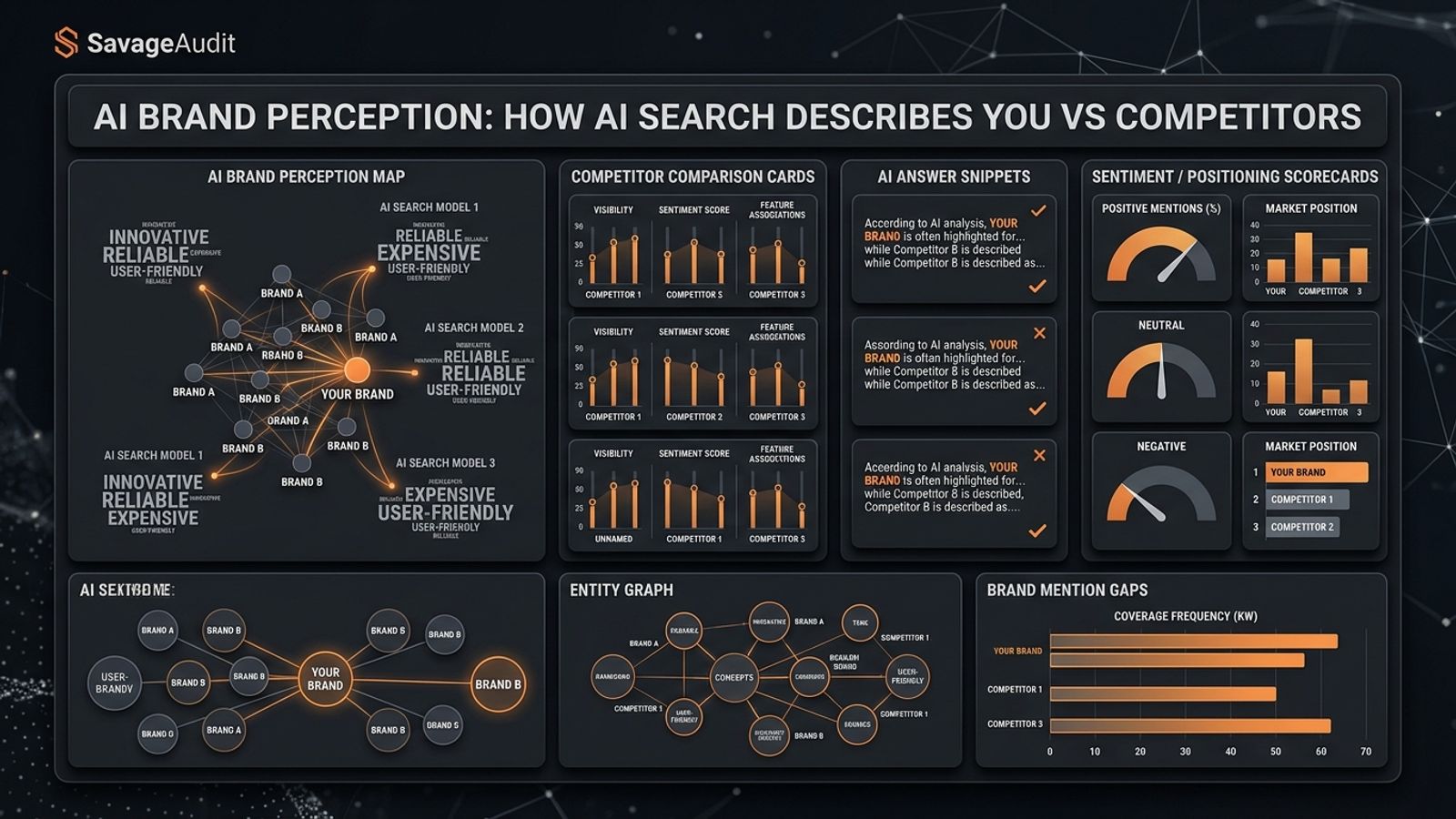
An AI brand perception audit evaluates how AI search engines, answer engines, and LLMs describe, categorize, and compare your brand against competitors. It goes beyond simple visibility to analyze category clarity, differentiation, proof footprint, and citation readiness. By mapping prompts to buyer intent and auditing the underlying public evidence—like site copy, technical accessibility, and extractable facts—teams can identify narrative gaps and fix weak positioning signals before scoping deeper SEO or brand engagements.
If you only audit rankings, you are auditing yesterday’s problem.
The current threat is sharper: AI search can summarize your brand, compare you against competitors, recommend someone else entirely, or omit the one thing that makes you worth buying.
This is why agencies, SEO teams, founders, and product marketers need an AI brand perception audit before scoping a full SEO, GEO, content, or brand narrative engagement. Instead of guessing based on a few panicked prompts, you need a practical readout of what AI search may say, cite, flatten, misread, or ignore based on point-in-time prompt tests and public visibility signals.
The audit answers one blunt question: When AI search describes your brand next to competitors, does it sound like your strategy, or like a confused intern scraped your homepage once?
What Is an AI Brand Perception Audit?
An AI brand perception audit reviews the visibility and positioning signals that shape how AI search systems, answer engines, and LLM-assisted search experiences describe a brand.
It goes beyond simple visibility to uncover how your brand is categorized, what attributes are attached to it, which competitors surface instead, and whether the answer makes you sound premium, generic, risky, or irrelevant.
Google’s AI Overviews and AI Mode matter here. Google describes them as AI-powered search experiences for complex questions, comparisons, and exploration, noting they may use query fan-out to explore related subtopics and sources. While that claim is specific to Google and doesn’t automatically describe every AI product, the takeaway remains the same. You are no longer optimizing one page for one keyword. You are auditing the entire evidence cloud around your brand.
Why This Audit Belongs Before the Engagement Scope
Most AI visibility engagements are scoped too late. A client asks for "brand performance ai search" or "benchmarking brand visibility in ai answers," and the agency jumps straight to building comparison pages, adding schema, or rewriting service pages. Some of that might be useful, but much of it is expensive theater if you don't know what is actually broken.
An AI brand perception audit provides the first-pass diagnosis. It tells you if the brand is invisible, miscategorized, mentioned but weakly described, or losing to competitors with clearer public evidence.
SavageAudit fits this exact stage. It is an AI-driven site auditor that delivers a blunt, data-backed critique across performance, SEO, design, copy, UX, and conversion, using concrete site signals like Lighthouse metrics and SEO fundamentals. Its AI Visibility Audit focuses on whether a brand is ready for AI search discovery by evaluating citation-readiness, extractability, crawl posture, entity signals, public evidence, and proof footprint. That is the right starting point: showing where the public evidence is weak, messy, or hard to cite before pretending a single tool controls every model.
The Core Audit Question
For a client-brand-versus-competitor audit, frame the work around this: If a buyer asks an AI search engine who to consider, what story gets assembled, and is your client even in that story?
Break that into visibility, description, differentiation, comparison, and evidence.
Step 1: Define the Competitive Set
Bad audits compare the brand to whoever the client fears. Good audits compare the brand to whoever buyers and AI answers are likely to surface. You need to build three competitor groups.
Direct competitors are the known commercial alternatives sharing your category, buyer, and use case. Search competitors dominate informational queries; they might not sell the same thing, but they shape the narrative. Finally, look closely at AI-answer competitors. These are the brands, review sites, listicles, or aggregators that appear when you ask category-level AI prompts. Founders often get humbled here when they realize their main competitor isn't the enterprise giant they hate, but a vendor with clearer public proof.
Step 2: Build the Prompt and Query Map
Map your prompts to buyer intent across several distinct classes.
Use category discovery prompts ("What are the best tools for X?") to test if the brand appears when buyers don't know the market well. Use brand research prompts ("What are the strengths and weaknesses of Y?") to test direct perception. Comparison prompts ("Brand vs. Competitor") expose positioning errors fast, while problem-solution prompts test whether the brand is connected to the specific job-to-be-done. Trust and proof prompts ("What evidence supports this brand?") test credibility.
Keep in mind that AI answers vary by platform, date, geography, account state, personalization, and prompt wording. Treat this as a point-in-time audit, not permanent truth.
Step 3: Capture the Actual Brand Language
When AI search describes a brand, copy the language exactly into a capture table. Do not summarize too early; you want the raw descriptors.
| Prompt | Brand mentioned? | Description used | Competitors mentioned | Claims made | Sources/citations shown | Notes |
|---|---|---|---|---|---|---|
| “Best tools for X” | Yes/No | “…” | A, B, C | “…” | URLs | Missing proof |
| “Brand vs. Competitor” | Yes/No | “…” | Competitor | “…” | URLs | Wrong category |
| “What is Brand?” | Yes/No | “…” | None | “…” | URLs | Stale positioning |
Then, tag the language. Note if the phrasing is accurate, vague, outdated, commoditized, negative, hallucinated, or missing critical differentiators and proof. A phrase like “marketing platform” might be technically true, but if the client sells compliance-grade analytics for enterprise healthcare teams, that generic label is a massive perception failure.
Step 4: Score Perception Against the Intended Narrative
Compare AI-generated descriptions against the client’s intended narrative without getting bogged down in endless checklists. Group your evaluation around category clarity, differentiation, and technical proof.
If the answer uses generic labels, confuses the brand with an adjacent tool, or describes a single feature instead of the company, your category positioning is failing. Similarly, if "businesses" is the only audience mentioned, or if SMB and enterprise use cases are blurred together, AI cannot confidently recommend you to the right buyer. Broad benefits without concrete workflows mean the brand won't surface when users ask how to solve a specific issue. Repeating the same claims for every vendor or treating "easy to use" as differentiation leaves pricing, audience, and implementation models entirely unclear.
A massive part of perception comes down to your proof footprint and citation readiness. Thin case studies, missing benchmarks, and a lack of named customers severely weaken a brand's footprint. Google’s helpful content guidance emphasizes people-first content, trust, experience, expertise, and transparency around who created content and how it was produced. Clear, trustworthy public evidence gives search and answer systems better material to summarize and cite. For Google’s AI search features, pages must be indexed and eligible to show a snippet, requiring standard technical basics like crawling, hosting/CDN access, internal linking, page experience, textual content availability, and structured data that matches visible text. If the site is a JavaScript fog machine with vague copy, your AI search problem is actually a basic web problem.
Step 5: Audit the Source Pages AI May Use
An AI brand perception audit should review the pages most likely to influence answers, including the homepage, pricing, comparison pages, customer stories, documentation, and relevant company profiles.
Evaluate if each page is crawlable, states the category clearly, defines the buyer, includes proof, answers comparison questions, and contains quotable, extractable text. SavageAudit’s AI Visibility Audit provides a first-pass readout around whether a brand can be cited, extracted, and trusted. It evaluates crawl posture, entity signals, hint readiness, public evidence, and proof footprint. This exposes weak evidence and poor extractability before you start rewriting copy.
Step 6: Run a Page-to-Page Competitor Comparison
If the client wants to know why a competitor looks stronger, compare the pages directly. SavageAudit’s Compare workflow lets teams audit two submitted URLs side-by-side using the same scoring model across performance, SEO, design, copy, UX, and conversion. The current focus is precise page-to-page comparison rather than full-site analysis.
This precision is highly useful for scoping because it turns a vague complaint about AI liking a competitor more into concrete differences. You can definitively point out that the competitor's page loads faster, their headline is clearer, their proof appears earlier, or their comparison page answers the actual question, giving AI more quotable facts.
Step 7: Identify the Perception Gap
Compare what the brand wants to be known for, what its website actually says, and what prompt tests suggest AI search may say or cite. The gap usually falls into a few distinct categories.
An invisible brand suffers from a weak content footprint, thin entity profile, or category language mismatch. A generic brand is mentioned but described like everyone else due to vague positioning and commodity copy. Misclassified brands get placed in the wrong category because of old content, conflicting site copy, or ambiguous homepages. A weak comparison narrative means competitors appear easier to recommend because the brand lacks alternative pages, pricing clarity, and objection handling.
Finally, a trust deficit causes answers to hesitate or omit the brand entirely because there are no named experts, case studies, or transparent content processes. As Google’s helpful content guidance points out, first-hand expertise, clear authorship, provenance, and trust are paramount. Feeding the machine "AI-powered" buzzwords won't fix a trust deficit.
Step 8: Turn Findings Into a Fix Roadmap
Sort recommendations into a logical sequence of execution.
Start with technical and crawl basics to fix indexing problems, robots.txt issues, broken canonicals, slow pages, and structured data mismatches. Google’s AI features documentation still points site owners back to foundational search requirements like crawling, indexing, snippets, technical readiness, and text availability.
Once the foundation is solid, clean up the brand narrative by fixing homepage positioning, product labels, audience definitions, and boilerplate descriptions. From there, build or improve evidence and proof assets—case studies, benchmarks, methodology pages, and customer quotes—that AI search systems can easily extract and summarize. Finally, shape the competitive answer by creating specific content that directly addresses "vs" queries, alternatives, and how to choose a platform. Be specific, admit tradeoffs, and explain who should not buy from you; that honesty is far more credible than another fake-neutral comparison page.
Where Dedicated AI Brand Monitoring Tools Fit
There is a growing class of tools for brand ai visibility benchmarking and answering the query: "What are the best tools to benchmark my brand against competitors in ai search results?"
Some vendors claim ongoing monitoring across systems like ChatGPT, Claude, Gemini, Perplexity, and Grok, while others position around high-volume one-time probes to surface what is accurate, hallucinated, missing, or competitor-displaced. Several platforms capture descriptors, sentiment, themes, recommendations, and competitor comparisons across LLM responses.
That data can be valuable, but monitoring is not strategy. If a dashboard says AI describes your brand as “affordable project management software,” but you are actually a compliance workflow platform for regulated enterprise teams, the dashboard merely found the bruise. You still need to fix the source material: site copy, category clarity, third-party profiles, comparison pages, and technical accessibility. This is why a first-pass audit must precede a massive monitoring retainer.
The SavageAudit Angle
SavageAudit delivers a blunt reality check showing teams where their website and public positioning signals are too weak, vague, slow, unconvincing, or hard to extract before they spend serious money on deeper consulting.
It audits practical categories like performance, SEO, design, copy, UX, and conversion. Its AI Visibility Audit extends that logic into GEO, AEO, and AI search readiness by evaluating citation-readiness, extractability, entity signals, public evidence, and proof footprint. Furthermore, its Compare workflow helps teams put two URLs through the exact same evaluation model to see which page wins across core audit dimensions.
For agencies and SEO teams, this makes it an essential scoping layer. You run the client, run the competitor, compare the pages, identify the narrative gaps, and then decide the actual scope of the engagement without relying on mystical jargon.
A Simple AI Brand Perception Audit Template
Use this streamlined structure for client discovery.
- Brand Setup: Define the brand name, website, primary category, target audience, core use cases, top competitors, desired positioning, must-own topics, and must-avoid misconceptions.
- Prompt Set: Create 20–40 prompts covering category discovery, brand research, competitor comparison, problem-solution, and trust/proof.
- Capture Sheet: For each prompt, record if the brand was mentioned, how it was described, which competitors appeared, claims made, sources cited, and what was accurate, wrong, or missing.
- Site Signal Review: Audit crawl/index basics, homepage clarity, product copy, comparison content, proof assets, internal linking, structured data alignment, and performance blockers.
- Competitive Page Comparison: Compare client and competitor pages for headline clarity, category language, audience specificity, proof density, technical performance, extractable facts, and objection handling.
- Final Scorecard & Scope: Score visibility, description accuracy, differentiation, evidence quality, and citation readiness on a 1-5 scale. Then, classify the next engagement.
Final Take
AI search does not care about your brand guidelines or internal marketing feelings. It cares about extractable facts, public proof, and technical accessibility. If your website fails to deliver those, AI will piece together a narrative from your competitors and outdated third-party reviews. Run the audit, compare the exact pages, find the weak signals, and fix the narrative. Do not guess what the machine thinks. Audit the evidence it relies on.
Common questions
What is an AI brand perception audit?
It evaluates how AI search systems and answer engines describe, compare, and cite a brand versus competitors, looking at visibility, category clarity, differentiation, proof, accuracy, and citation-readiness.
Is this the same as an AI visibility audit?
No. AI visibility asks whether the brand appears. AI brand perception asks what the answer says when the brand appears. A brand can be visible and still be misrepresented or commoditized.
Can SavageAudit tell me exactly what every AI engine says in real time?
No. SavageAudit provides a first-pass audit framework and signal readout for website quality, AI visibility readiness, extractability, and positioning signals. It focuses on whether a brand can be cited, extracted, and trusted.
How do I benchmark my brand against competitors in AI search results?
Start with a shared prompt set, capture how each brand is described, record cited sources, compare the underlying pages, and score category clarity, proof, differentiation, and technical accessibility. For page-level comparison, SavageAudit’s Compare workflow can audit two submitted URLs side-by-side using the same model.
What usually causes bad AI brand perception?
The usual causes are vague homepage copy, weak proof, stale third-party descriptions, poor comparison content, crawl/indexing issues, generic category language, and a failure to clearly explain who the product is actually for.
Keep the diagnosis moving
Run your own public presence audit
See how your website, search footprint, AI visibility, social proof, and conversion trust look from the outside.