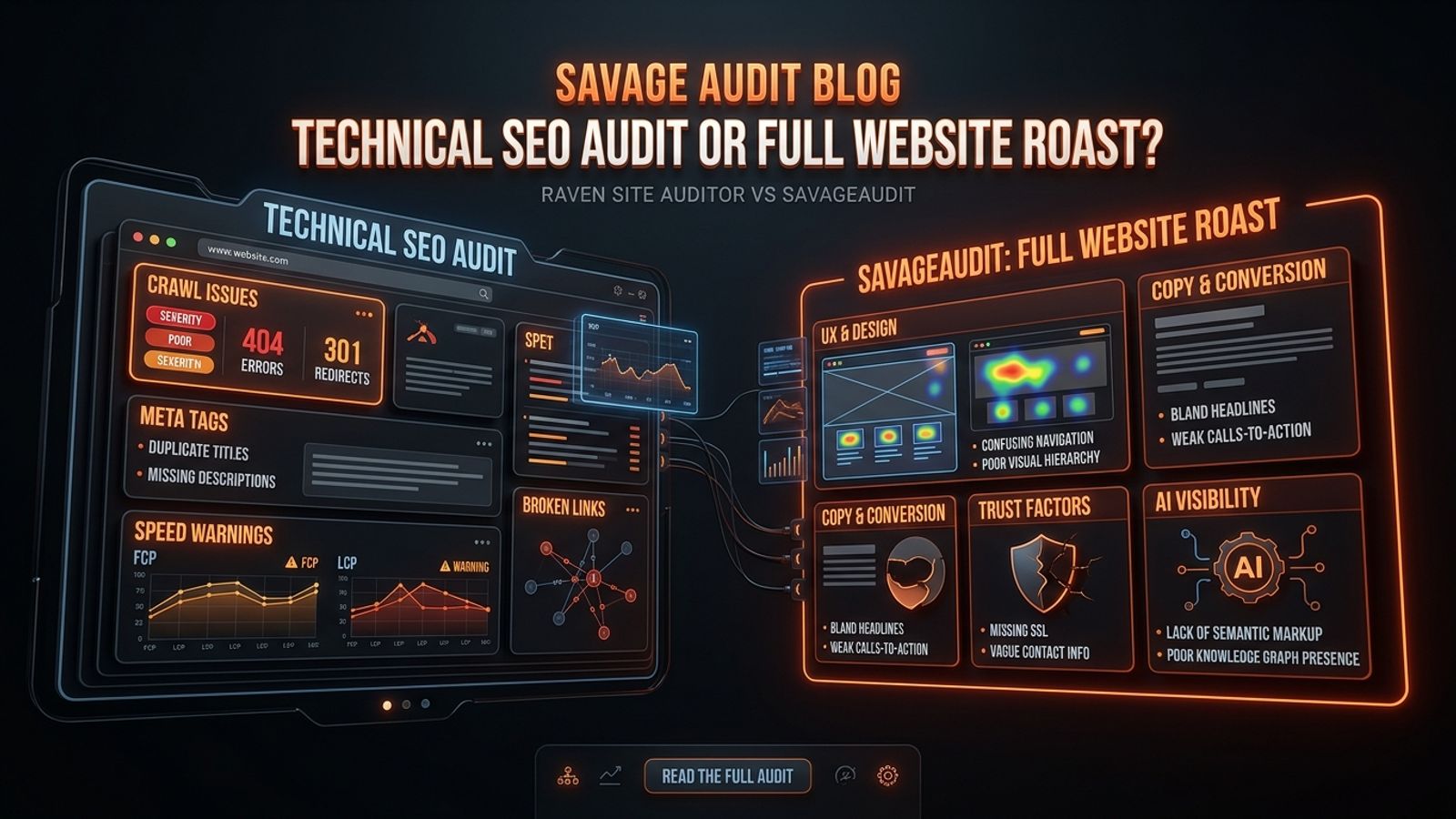
Raven Site Auditor is a technical SEO crawler designed for deep issue discovery, on-page checks, and structured site audit reporting. It is ideal for SEO teams managing large domains. SavageAudit is a fast website roast product that evaluates SEO alongside performance, design, copy, UX, conversion friction, trust signals, and AI visibility. While Raven maps technical architecture, SavageAudit diagnoses why a page fails to persuade and convert human visitors.
Most of what the industry calls a "website audit" is simply a crawl report dressed up in a polished interface. These tools scrape your URLs, flag missing meta tags, highlight broken links, and hand you a spreadsheet of on-page SEO issues. While this data is undeniably necessary for maintaining search hygiene, it rarely tells the whole story of why a website is failing to generate actual revenue.
When you evaluate Raven Site Auditor vs SavageAudit, you are looking at a hard split between technical detectability and commercial persuasion.
Raven Site Auditor is stronger when someone mainly needs technical/on-page SEO crawl checks, issue discovery, and site audit reporting. It is built to map the underlying architecture of a domain and ensure search engines can navigate it without hitting a wall.
On the other side of the spectrum, SavageAudit is a fast website roast and audit product. It steps in when a founder or team needs to understand why a page feels weak, unclear, slow, untrusted, or low-converting across SEO, performance, UX, design, copy, conversion, trust, and AI visibility.
Both tools have a legitimate place in a professional digital workflow, but they solve entirely different problems. Buying a roast when you actually need a technical crawler will leave you without the deep structural data you require. Conversely, staring at a list of 404 errors will not tell you why your target audience finds your homepage confusing and abandons their cart.
The fundamental divide: Detectability vs. Effectiveness
Making an informed choice between these platforms requires splitting the concept of an "audit" into two practical buckets.
The first bucket is detectability. This asks whether search engines can crawl, understand, and index your site without hitting structural roadblocks. A technical SEO audit is entirely about this operational layer. It organizes fixes, documents missing elements, and categorizes weak tags. It is absolutely necessary for search visibility, but it has almost nothing to do with conversion strategy.
The second bucket is effectiveness. A roast-style audit asks whether the page actually works as a communication and conversion asset once a human being arrives. It evaluates whether the headline says anything specific, whether the design guides attention rather than just decorating the screen, and whether the user experience creates unnecessary friction.
Raven helps you find the technical SEO roadblocks. SavageAudit helps you understand why the page itself is not working as a persuasive business asset.
Where Raven Site Auditor dominates
Raven Site Auditor is the superior choice when your daily work is centered on technical SEO auditing, on-page issue discovery, and generating structured site audit reporting for clients or stakeholders.
This makes it the natural fit when your team is staring down a massive, messy, or frequently updated website. Managing a domain with thousands of URLs requires a systematic approach. If your primary responsibility is to inspect huge batches of pages for SEO hygiene problems, you require a crawl-based diagnostic tool. You need a system that can reliably tell you which pages are missing canonical tags, where the broken internal links live, and how to document these audit issues for internal developers.
This narrow, highly technical focus is exactly what makes Raven valuable to search professionals. It supports a recurring SEO audit process where the goal is systematic cleanup and structural integrity.
To be absolutely clear: SavageAudit is not a deep technical crawler and should not claim to replace Raven Site Auditor for technical SEO auditing. If you need to crawl 10,000 eCommerce product pages to find missing title tags, Raven is the tool you need to deploy.
Where SavageAudit dominates
SavageAudit is built for the exact moment you realize a page is technically acceptable but commercially broken.
High-value websites rarely fail for one isolated, easily crawlable reason. Consider a typical B2B SaaS homepage. It might have perfectly optimized metadata, a lightning-fast server response time, and zero broken links. A technical crawler will give it a passing grade. Yet, that same page might bleed traffic because the positioning is mushy, the value proposition is buried three scrolls deep, and the primary call-to-action demands too much commitment upfront.
Or look at a consulting services page. It might include a few client logos, but still fail to build actual trust because the proof is vague and placed right next to a high-friction, 12-field contact form.
SavageAudit reviews SEO, performance, design, copy, UX, conversion friction, trust signals, and AI visibility. This wider lens is critical for diagnosing behavioral disconnects. It is the stronger fit when your core problem goes beyond "SEO error detected" and enters the realm of "why aren't these visitors buying our product?"
Feature focus: How the workflows compare
Instead of looking at a basic feature checklist, it is more helpful to examine how these tools handle the specific challenges teams face when trying to improve a website.
Technical SEO issue discovery
If your main priority is crawl-style SEO auditing and finding structural site errors, Raven Site Auditor is the definitive fit. It is built to run systematically across a domain, cataloging the technical debt that prevents search engines from properly indexing your content. While SavageAudit does review SEO as part of a holistic website roast, it is not designed to map an entire domain's architecture or replace a dedicated crawler.
Conversion friction and user experience
Conversion problems usually live in the gap between what a page claims and what a visitor actually needs to believe before clicking a button. Design is how a page controls attention, reduces user confusion, and builds confidence. A website can look aesthetically pleasing but still fail miserably because the visual hierarchy is broken or the mobile experience creates hesitation. SavageAudit tackles this directly. It reviews conversion friction, UX, and design, helping teams understand why a page feels clunky or unconvincing to actual users.
Copy and positioning
A page can feature a perfectly optimized title tag and H1, yet still say absolutely nothing of value to the reader. Technical audits are built for structure, not messaging. They will not tell you that your subhead is corporate filler or that your hero section sounds exactly like your biggest competitor. SavageAudit evaluates copy alongside its other checks, making it highly useful when the real problem is message clarity.
SEO reporting for agencies
When an agency needs to deliver structured reporting around technical and on-page SEO issues to a client, Raven Site Auditor provides the necessary framework. Generating comprehensive PDFs that list status codes and missing alt text is a standard part of the agency retainer model. While SavageAudit is excellent for critiquing high-value landing pages during a client engagement, it should not replace the foundational technical SEO reporting that agencies use to map out developer sprints.
Trust signals
Slapping a few grayscale company logos on a homepage does not automatically generate trust. True credibility comes from giving a skeptical visitor enough verifiable proof to believe your claims. SavageAudit specifically reviews trust signals. This evaluation is vital for SaaS companies, eCommerce brands, and consultants selling into highly skeptical markets where a lack of proof guarantees a lost sale.
AI visibility
The way users search is fracturing. People now discover, compare, and summarize brands through AI-assisted tools just as often as traditional search engines. A modern audit needs to account for this shift. SavageAudit includes AI visibility in its review scope, evaluating whether your content is structured, specific, and clear enough to be understood by these emerging systems.
Practical scenarios: Choosing the right tool
Understanding the theoretical differences is helpful, but looking at real-world workflows makes the choice obvious.
The SEO agency onboarding a massive client
Imagine an agency that just signed a client with a sprawling website, multiple subdomains, and years of undocumented content updates. The immediate priority is mapping out technical SEO problems, organizing a sprint of fixes, and creating a baseline audit report for the client's executive team. In this scenario, Raven Site Auditor is the necessary choice. This is a textbook technical SEO workflow. SavageAudit can be brought in later to roast the high-priority conversion pages, but it is the wrong tool for the initial crawl-scale cleanup.
The SaaS founder with flat signups
A software founder has steady traffic flowing from paid campaigns and organic content, but trial signups remain stagnant. A technical audit might find some minor issues, but the core business question is behavioral: why do people not want this product enough to act? The founder needs a sharp critique of the page’s copy, design, UX, trust signals, performance, and conversion friction to understand the disconnect. This is exactly where SavageAudit excels.
The marketing team launching a paid campaign
A marketing team is preparing to drive expensive ad traffic to a dedicated landing page. Obvious SEO and performance blockers need to be cleared, but the main financial risk is message match. Does the page deliver on the ad's promise? Is the call-to-action obvious? Does the page establish trust before demanding an email address? The team needs a full-page critique across performance, design, copy, UX, and conversion friction before the expensive traffic arrives. SavageAudit is the ideal fit for pre-launch validation.
Making the final decision
The choice between these platforms comes down to the specific problem you are trying to solve today.
Choose Raven Site Auditor if your main need is technical SEO auditing and crawl-style issue discovery. It remains a powerful choice for SEO teams and agencies managing large sites, organizing cleanup work, and generating the kind of site audit reporting that keeps development teams busy.
Choose SavageAudit if your site gets traffic but struggles to convert. It is the better fit when your product positioning is muddy, your copy sounds generic, your trust signals are thin, or your UX creates hesitation. Choose it when you want a fast, blunt evaluation of your most important pages, reviewing SEO alongside performance, design, copy, UX, conversion friction, trust signals, and AI visibility.
For serious digital teams, the most effective approach is often to use both. Run Raven Site Auditor to handle the technical and on-page SEO hygiene that ensures discoverability. Then, point SavageAudit at your high-value pages—your homepage, pricing page, and core landing paths—to ensure they actually persuade, build trust, and convert the traffic you worked so hard to acquire.
A technical audit tells you what is broken in the crawl. A SavageAudit roast tells you what is broken in the experience.
Common questions
Is SavageAudit a replacement for Raven Site Auditor?
No. SavageAudit is not a deep technical crawler and should not replace Raven Site Auditor for technical SEO auditing. Raven Site Auditor is stronger when the main need is technical SEO issue discovery and audit reporting across an entire domain.
Is Raven Site Auditor better for SEO teams?
Yes, when the SEO team mainly needs technical SEO issue discovery, crawl checks, and structured audit reporting. If the team's primary mandate is ensuring search engine accessibility and resolving technical debt, a crawler is the right tool.
Is SavageAudit better for founders?
Often, yes. Founders usually do not just need to know whether a technical SEO issue exists; they need to know why the site feels unclear, generic, untrusted, slow, or low-converting. SavageAudit reviews those broader page-performance and conversion factors to provide actionable business feedback.
Can agencies use SavageAudit?
Yes. Agencies can use SavageAudit when they need fast, blunt critique beyond technical SEO. It is highly effective for evaluating key client pages, diagnosing poor positioning, highlighting conversion friction, and assessing trust signals during a campaign or redesign.
Which tool is better for diagnosing conversion problems?
SavageAudit. Conversion problems usually involve copy, UX, design, trust, offer clarity, and friction. SavageAudit specifically reviews conversion friction along with those broader factors, whereas technical crawlers focus on code-level discoverability.
Which tool should I use first?
If your site has obvious technical SEO debt, broken architecture, or thousands of pages that need systematic auditing, start with Raven Site Auditor to clear the foundational errors. If your main concern is that an important landing page does not persuade visitors or generate revenue, start with SavageAudit. Mature teams use both: Raven for technical SEO auditing, and SavageAudit for the full website roast.
Keep the diagnosis moving
Run your own public presence audit
See how your website, search footprint, AI visibility, social proof, and conversion trust look from the outside.