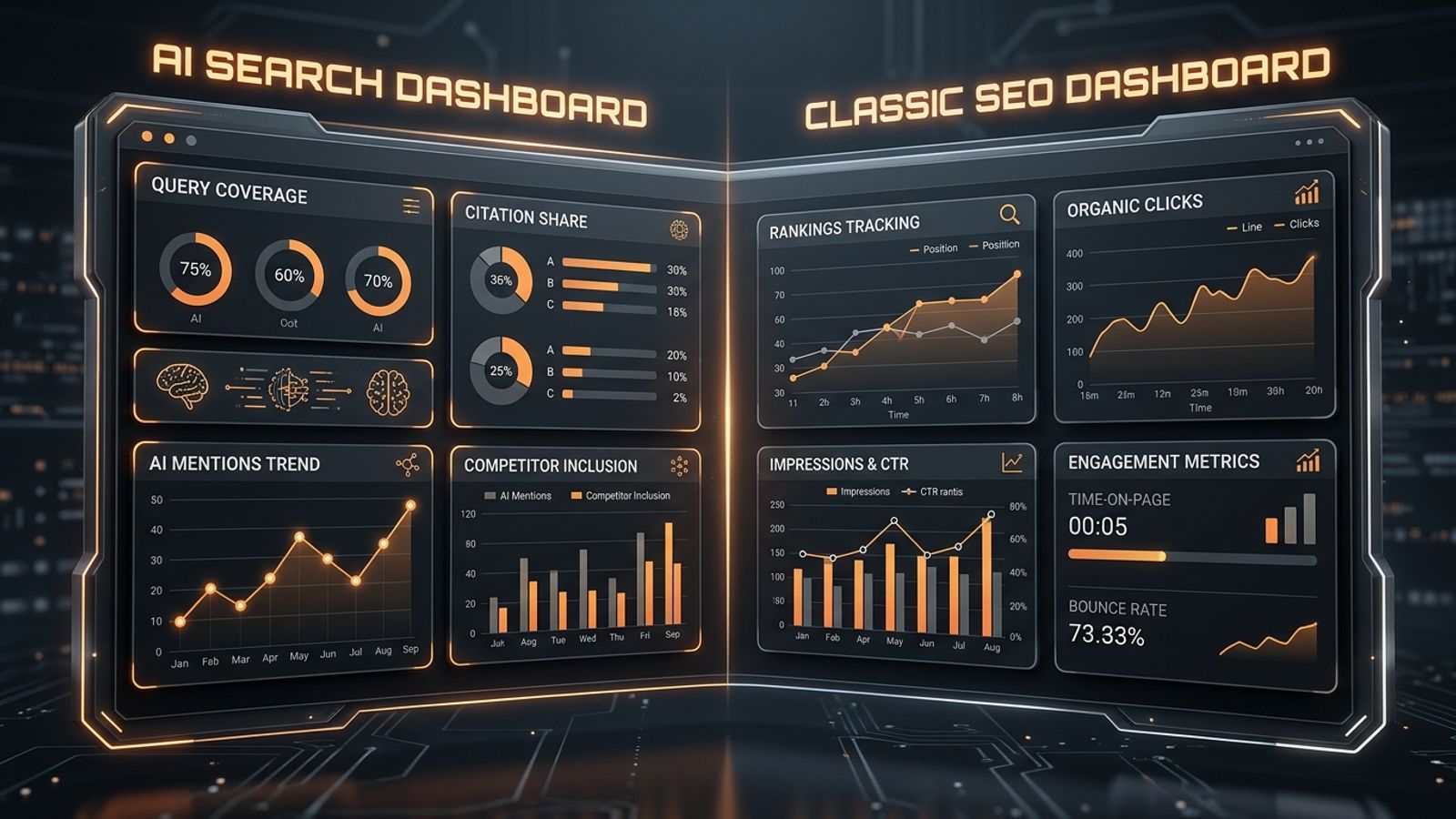
An SEO dashboard tracks traditional search performance (rankings, clicks, CTR) to measure visibility in search results. It is useful but incomplete because it ignores how content is used in AI-generated answers. An AI search dashboard adds a necessary layer, tracking metrics like brand mentions, citation gaps, query coverage, and competitor visibility within AI answers. It focuses on whether a brand is citable, trusted, and accurately represented by answer engines. The two are not interchangeable; they are complementary. A complete reporting strategy requires both: an operational view of SEO performance and a strategic view of AI answer
Your SEO dashboard is not enough anymore. For years, the default report was simple: rankings, clicks, impressions, and CTR. These metrics are still useful, but they are critically incomplete. A traditional search report tells you how your site performs in Google’s blue links. It does not tell you if AI systems can extract, cite, or trust your brand when generating an answer.
This is the core of the AI search dashboard vs SEO dashboard debate. They are not the same report, and they should not be treated as interchangeable.
- SEO dashboards track your visibility in a list of search results.
- AI search dashboards track your inclusion in generated answers, the quality of your citations, and the context around your brand.
If you build reports for agencies, SEO teams, growth marketers, or founders, you need both views. But first, you have to understand what each one is actually good at—and where it fails.
What an SEO Dashboard Tracks Well
A solid SEO dashboard is still the baseline for measuring demand capture and page performance. The core inputs are familiar: impressions, clicks, CTR, average position, landing-page performance, and query trends, alongside technical signals like index coverage and crawl health.
SavageAudit’s Google Search Console audit dashboard is built around this model. It translates raw Search Console data into prioritized SEO tasks because raw reporting isn’t enough. If a high-impression query has weak CTR, the problem is likely a weak title, meta description, or H1. If a query is stuck on page two, the fix may require more content depth, internal links, or better on-page proof.
This work is still valuable. It connects search demand to page-level action. But it has a massive blind spot.
An SEO dashboard does not tell you whether AI systems can actually use your content. A page can rank #1 and be completely invisible in AI answers. It can earn clicks but fail every citation test because its content is vague, stale, or too poorly structured for an answer engine to trust. That is why rankings alone are an incomplete model for performance. Websites must be clear, extractable, and verifiable for AI systems to cite them. Rankings are not proof of any of that.
What an AI Search Dashboard Needs to Add
An AI search dashboard has a different job. Instead of asking, “Where do we rank?” it asks harder questions:
- Are we mentioned in AI answers for our core queries?
- Are those mentions backed by a citation to our site?
- Which of our pages are being referenced as a source?
- Which competitors show up in answers when we don’t?
- Is the AI’s representation of our brand accurate?
- Is the proof on our referenced pages current enough to be trustworthy?
This is the problem SavageAudit’s AI visibility audit is built to solve. It focuses on GEO, AEO, and AI search by evaluating crawl posture, entity signals, public evidence, and citable content. The goal is citation-readiness, not vanity visibility.
The Metrics That Matter Now
To get there, your reporting needs to evolve. Forget vanity metrics and focus on these signals.
1. Brand Mentions in AI Answers
This is about context, not just counts. Track whether your brand is named in answer engines and how. SavageAudit’s approach to AI search measurement separates brand mention context from raw counts, because accuracy and audience fit matter more than a simple yes/no.
2. Citation Gaps and Share of Voice
A mention without a source link is just a description. A citation with a traceable URL is verifiable proof. Treat the citation as the real signal—a link to a page you own that an AI can retrieve and verify. Your share of citations for a query set is your true share of voice.
3. Query Coverage
You don’t need “AI visibility” in the abstract. You need it for the buyer questions that drive revenue: comparisons, pricing, implementation guides, use cases, and evaluation-stage objections. Map your visibility to these queries.
4. Answer Inclusion
Are you part of the direct answer, or just listed as a source below it? That distinction matters more than raw impressions. Inclusion means the AI used your content to form its response.
5. Competitor Visibility
If competitors are showing up in answers and you aren’t, that’s not just a branding issue. It’s a reporting gap that signals a content, proof, or structural weakness. AI answers are shaping buyer shortlists before they ever see your site.
6. Referenced Pages
You need page-level citation mapping. Which URLs are AI engines actually using? Is it your core product pages, blog posts, developer docs, or a stale page from five years ago? If you can’t answer that, you’re flying blind.
7. Entity Consistency
AI systems rely on clean entity signals. If your brand name, product names, and sameAs footprint are inconsistent across your site and third-party profiles, you make extraction harder. SavageAudit’s SEO + GEO Audit Tool emphasizes entity clarity as a prerequisite for citable content.
8. Proof Freshness
Stale proof kills AI trust. Old screenshots, retired integrations, and outdated statistics weaken citation readiness. As our freshness guidance makes clear, just changing a publish date is useless. The underlying facts have to be current.
9. Conversion Context
AI visibility without business context is noise. Your dashboard must show whether the referenced page supports a real action: a demo, trial, signup, or purchase.
AI Search Dashboard vs SEO Dashboard: The Blunt Comparison
| Area | SEO Dashboard | AI Search Dashboard |
|---|---|---|
| **Primary Goal** | Rankings and traffic | Mentions, citations, and answer inclusion |
| **Core Metrics** | Impressions, clicks, CTR, position | Brand mentions, citation share, query coverage, competitor visibility |
| **Best Input** | Search Console, analytics, crawl data | Prompt tests, citation mapping, entity checks, proof analysis |
| **Page Focus** | Landing pages and keywords | Referenced pages and answer-ready content |
| **Main Weakness** | Ignores trust and extractability | Can ignore traffic and conversion context |
The mistake is treating AI visibility as a replacement for SEO. It’s not. It’s an added layer that depends on the same site, pages, proof, and conversion paths. SavageAudit’s SEO + GEO Audit Tool is designed to assess if a page can be read, cited, and trusted by both AI answer engines and traditional crawlers.
How to Report Both Without Making a Mess
Do not dump AI metrics into your SEO dashboard and call it innovation. That just creates a cluttered, unusable report. Use a two-layer approach instead.
Layer 1 is your operational view of traditional search performance. This is where you track the classics: clicks, impressions, CTR, average position, and top landing pages from Search Console. This is what SavageAudit’s Search Console audit is for—turning raw search data into prioritized actions instead of pretty charts.
Layer 2 is your strategic view of AI answer visibility. This is where you track brand mentions, citation share, source quality, competitor inclusion, referenced URLs, and proof freshness. This layer tells you if your brand is being surfaced by AI systems when buyers ask real questions.
For example, if clicks for “best CRM for startups” fall, the SEO dashboard might show a title tag problem. The AI dashboard may reveal the real issue: an AI Overview now cites a competitor’s newer comparison page, while your page is missing fresh proof and an extractable summary table. That’s a content, proof, and citation problem, not just a rankings problem.
Where SavageAudit Fits
SavageAudit isn’t another generic dashboard. It’s the diagnostic layer that connects traditional website signals with blunt AI visibility diagnostics.
The tools answer specific questions. If you need to turn Search Console data into classic SEO action, use the Google Search Console audit dashboard. To check a specific page for AI readiness and citation potential, use the SEO + GEO Audit Tool. And to analyze broader citation readiness and your public evidence footprint, use the AI visibility audit.
Rankings, clicks, and indexed pages still matter. But they no longer tell you whether a brand can be named, cited, and trusted in AI answers.
What Not to Do
Avoid these common reporting mistakes:
- Reporting AI visibility like it's organic traffic. They are different signals driven by different user behavior.
- Chasing mentions instead of citations. A mention is not evidence. A citation is.
- Ignoring stale pages. Old proof looks weak to humans and unreliable to machines.
- Treating AI visibility as only a content problem. It can also be an entity, crawl, structure, or proof problem.
- Divorcing AI reporting from conversion reporting. Visibility that doesn’t connect to a business outcome is noise.
Bottom Line
The AI search dashboard vs SEO dashboard question isn’t an either/or choice.
SEO dashboards tell you how you perform in traditional search. AI search dashboards tell you if your brand shows up in machine-generated answers with credible citations and accurate context.
If your reporting doesn’t cover both, it’s incomplete. If it covers both but doesn’t connect them to page-level action, it’s useless.
Keep tracking rankings and clicks. Then add AI mentions, citation gaps, query coverage, answer inclusion, competitor visibility, referenced pages, entity consistency, and proof freshness.
Anything less is outdated reporting dressed up as strategy.
Common questions
Is an AI search dashboard replacing an SEO dashboard?
No. An SEO dashboard tracks traffic and rankings from traditional search results. An AI search dashboard adds visibility into how your brand appears inside AI-generated answers, citations, and summaries. You need both.
Can I just use Google Search Console for AI visibility?
No. Search Console is essential for understanding search demand and landing-page performance, but it does not tell you if AI systems are mentioning, citing, or misrepresenting your brand in their answers.
What is the most important AI visibility metric?
Citation-ready inclusion. Raw mentions are weaker than traceable citations to pages that AI systems can retrieve and verify.
Why do proof freshness and entity consistency matter?
Because AI systems need clean, current, and extractable evidence to generate trustworthy answers. Old screenshots, retired features, vague wording, and inconsistent brand naming make citation harder and less likely.
What should agencies report to clients now?
Report on both layers: traditional search performance and AI answer visibility. Clients need to know where their traffic is coming from and whether their brand is showing up credibly in AI-driven discovery.
Is this GEO or AEO?
It’s both. Generative Engine Optimization (GEO) and Answer Engine Optimization (AEO) are practices for making content readable, extractable, and citable. The dashboard is the scoreboard for how well you’re doing; the audits provide the diagnosis.
Keep the diagnosis moving
Run your own public presence audit
See how your website, search footprint, AI visibility, social proof, and conversion trust look from the outside.