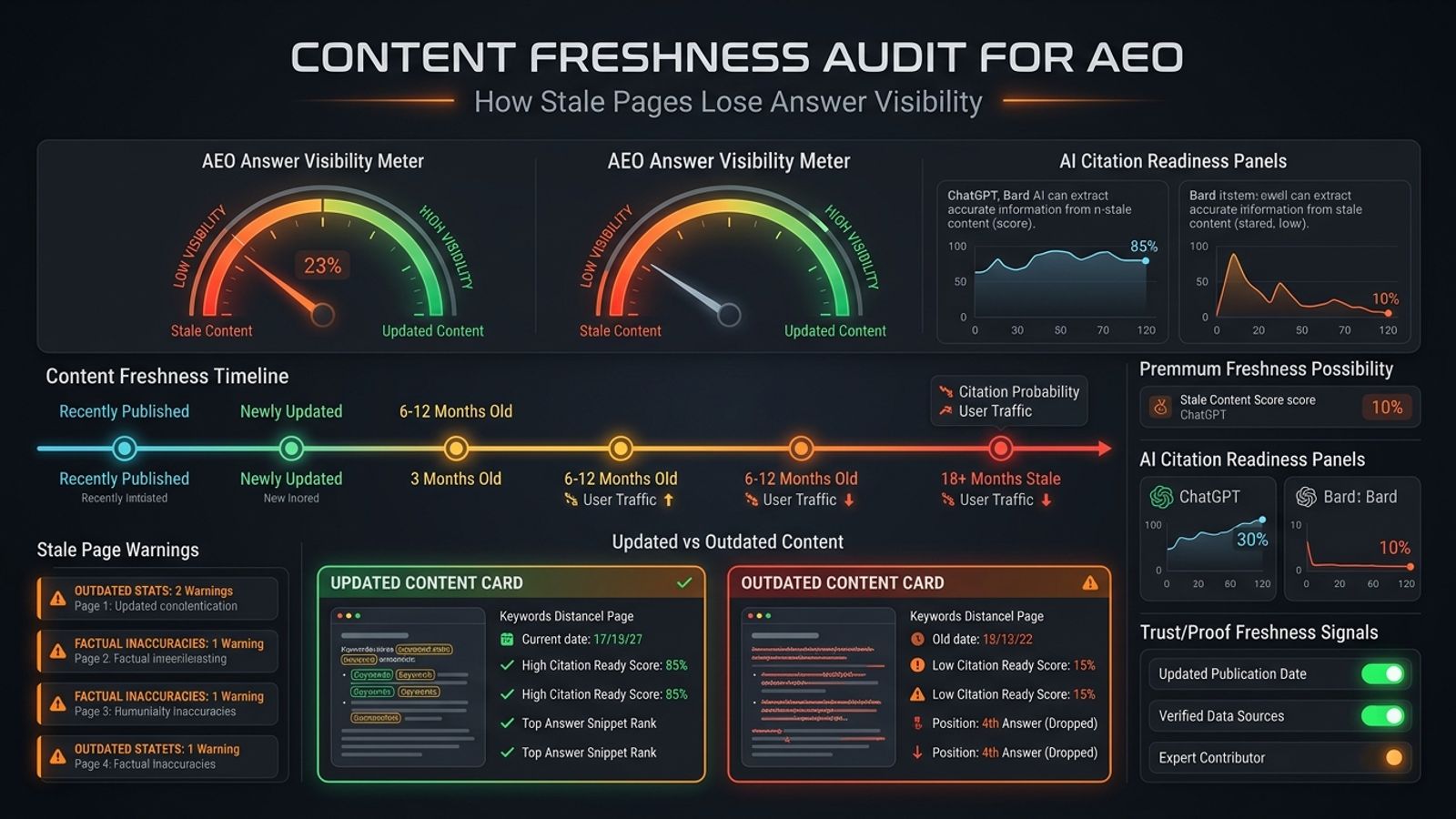
A content freshness audit for AEO evaluates whether existing pages remain current, specific, extractable, and trustworthy enough for generative search. Stale pages lose visibility because they answer outdated queries, rely on expired proof, or use vague copy that AI models struggle to parse. To fix this, teams must aggressively update core definitions, modernize examples, verify statistics, and rewrite FAQs to address current buyer objections. Changing the publish date is not enough; the underlying facts must reflect modern realities to earn AI citations.
Old content rarely crashes overnight. Instead, it gets quietly bypassed by the retrieval systems that matter today.
A legacy page might hold its ground in traditional search results and look perfectly healthy in your analytics dashboard, but its actual utility could be dead. If the text no longer directly answers the nuanced version of the question buyers are asking right now, it becomes a weak candidate for AI summaries and citations.
This is exactly why you need a content freshness audit for AEO. You are reviewing existing pages to ensure they remain current, specific, extractable, and trustworthy enough to support generative search experiences. Treating freshness as a cosmetic exercise—like updating the year in a title tag while leaving the core substance untouched—is just decorating stale copy.
What Content Freshness Actually Means for AEO
In traditional SEO, freshness often gets reduced to technical metadata. Teams check the original publish date or the last crawl timestamp to decide if a page needs attention.
For answer engine optimization, that technical view falls completely short. A page is only truly fresh when it reflects current search intent, modern product realities, and the exact proof required to earn a buyer’s trust today.
Consider a software comparison article that a marketing team "updated" last week by simply changing the publish date. If that piece still ignores modern AI workflow expectations, overlooks new security review requirements, and references pricing tiers the competitors abandoned six months ago, the answer remains fundamentally stale. Answer engines evaluate whether information is accurate and structured for extraction. They do not care about your updated timestamp if the underlying facts belong to a previous era.
Why Stale Pages Lose Answer Visibility
Stale pages lose visibility because they introduce friction into the retrieval and summarization process. They become harder for AI models to parse, more difficult to extract cleanly, and incredibly easy to replace with a competitor’s more accurate material.
Answering an Outdated Version of the Query
Search intent evolves much faster than the average corporate content calendar. A comprehensive page defining a core industry concept might have captured significant traffic when the market was first learning the term. Today, that same user is likely past the definition stage and trying to figure out how to audit content for answer engine readiness. If your page still reads like a beginner's glossary and fails to address implementation or troubleshooting, it is functionally incomplete. Accurate but superficial content is a massive visibility leak in generative search.
Weak or Expired Proof
Answer-ready content requires source-worthy material rather than a string of marketing adjectives. When a page relies on outdated screenshots, references retired integrations, or cites dead case studies, it actively degrades its own authority. Statistics are particularly vulnerable to this decay. Citing a conversion benchmark from 2019 practically guarantees an answer engine will bypass your page in favor of a competitor providing verifiable data from the current year. Content asking for trust without providing current evidence rarely gets selected for citation.
Entity Confusion and Vague Copy
Outdated terminology creates serious mapping problems for AI search experiences, which rely on understanding the relationships between brands, specific products, features, and use cases. Using deprecated feature names or old category labels makes it harder for a system to confidently use your page as a source.
Compounding this issue is vague positioning copy. Broad declarations about unlocking scalable digital transformation cannot be extracted to answer a direct question. Clear, declarative language is mandatory because retrieval systems need text that can stand on its own without requiring surrounding context to make sense.
How to Check If a Page Still Answers the Query
Do not start an audit by looking at word count or keyword density. Instead, pull up the page and aggressively question whether it still earns its place in the user's journey.
Every important asset needs a primary answer target. If you cannot articulate the specific question the page is built to resolve—such as figuring out how do i do a content gap analysis for aeo or finding out what updates prompt AI to cite a page—the content is likely too unfocused to perform well.
Once you know the target question, evaluate the title's alignment with the actual text. A title promising a comprehensive audit checklist cannot lead to a superficial overview with five generic tips. The content must deliver the criteria, diagnostic steps, and examples promised.
The core answer must appear early. Generative systems and human users alike lose patience when forced to wade through a long brand narrative or paragraphs about the evolving digital landscape before finding value. The definition, process, or evaluation criteria should be immediately visible.
From there, audit the facts. Review the product features, pricing mentions, integration lists, and competitor references to ensure everything aligns with the market today. Finally, test the extractability of the text by reading it section by section. Ask yourself if a specific paragraph could be quoted directly to answer a user's question, or if the headings are descriptive enough to form a standalone outline. If the text relies heavily on fluff, it is not built for AEO.
What to Refresh on Stale Pages
Refreshing content requires surgical updates to the components that directly impact usefulness.
Start with the main answer block. Strip away the introductory throat-clearing and rewrite the core definition or explanation to be as direct and information-dense as possible. Give the reader the most critical information in the first few sentences.
Next, modernize the examples. Theoretical fluff or outdated scenarios make a page feel abandoned. If you have a SaaS feature page that highlights a workflow nobody uses anymore, replace it with a highly specific, current use case. Examples should ground your advice in reality and demonstrate that your brand understands the current challenges buyers face.
Statistics and proof points require ruthless auditing. Keeping old numbers simply because they make the text look researched is a liability. Verify that the source is still live, the data is recent, and the metric actually supports the claim you are making. Unverifiable statistics should be removed entirely.
FAQs are another critical area for intervention. Stale pages often use FAQs to define basic acronyms or pad the word count. Rewrite these sections to address real, evaluation-stage objections. Answer questions about implementation timelines, the differences between your approach and a competitor's, or the specific signals indicating a process is failing.
Finally, scrutinize every product detail. Outdated feature names, old screenshots, and incorrect pricing references signal operational sloppiness to both buyers and automated systems. Keep product mentions tightly aligned with your current sales narratives. When recommending next steps, use internal links purposefully to guide the user to relevant resources, such as a targeted AI visibility audit or an SEO GEO audit tool that helps them take immediate action.
The AEO Freshness Audit Checklist
When reviewing pages for answer-engine readiness, rely on a structured evaluation. As part of an Online Presence Audit Checklist, you should group your analysis into a few core diagnostic areas.
Evaluate the query fit by confirming the target question has not shifted and ensuring the page answers it directly and early. Check currentness by verifying that all dates, product details, screenshots, and statistics are accurate for the current market. Assess extractability by reviewing the clarity of your headings, the conciseness of your definitions, and the usefulness of your formatting. Look for gap coverage to identify what the page currently omits, including missing buyer objections, unaddressed comparison questions, or areas where an AI system might be forced to cite a competitor to complete the answer.
How Freshness Connects to GEO and AI Citation Readiness
AEO and GEO are distinct but deeply connected disciplines. AEO focuses on building content that answers questions clearly, while GEO involves the specific tactics required to improve visibility in AI-generated responses. Content freshness is the foundation for both because stale material is fundamentally unsuited for citation.
You might have your technical SEO perfectly dialed in. You might understand exactly how to manage crawler access through llms.txt vs robots.txt vs structured data, and your internal architecture might be flawless. But if the text itself relies on old product realities or weak proof, the page remains a poor source.
To understand How Google AI Mode Finds Supporting Links, you have to recognize that these systems prioritize current, specific, and clearly structured information. Freshness exposes when excellent technical SEO is carrying dead content. A page built for AI citation must align with current buyer questions and provide verifiable proof, regardless of how fast it loads.
How SavageAudit Spots Stale Copy, Weak Proof, and Answer Gaps
A practical content audit does not ask when a page was last published; it asks if the page is still a defensible source of truth. At the SavageAudit homepage, our methodology breaks down content decay into three distinct categories.
First, we look for stale copy. This is content that sounds grammatically correct but answers yesterday's problem, often relying on old terminology, bloated introductions, thin definitions, and a lack of current examples.
Second, we hunt for weak proof. This occurs when a brand expects to be trusted without earning it, usually through unsupported claims, generic benefit statements, missing methodologies, and a lack of evidence that the brand has actually solved the problem they are writing about.
Third, we identify answer gaps. This is where the page simply fails to cover the details required for a complete AI response. We look for missing concise answer blocks, a lack of comparison data, absent implementation details, and missing FAQs. Brands frequently lose visibility not because their content is poorly written, but because it is too soft and incomplete for an answer engine to confidently extract and cite. We help teams figure out how do i audit content to fix ai answer gaps where my brand is omitted by mapping these exact failure points.
Prioritize Pages Like an Operator
Do not attempt to refresh every old page on your domain with equal effort. Treating all content as equally valuable is a fast way to waste a quarter.
Focus your auditing resources on pages that target high-intent queries, explain your core category, compare solutions, or directly support sales conversations. Look for pages that currently rank well but suffer from low engagement, or pages where your brand is notably omitted from AI answers despite having historical organic visibility.
Triage your content into clear actions. High-value pages with stale answers require immediate, comprehensive refreshes. Pages that overlap in intent and dilute your domain's authority should be consolidated into single, definitive resources. Have the discipline to retire or redirect pages that no longer serve a meaningful query.
How to Measure the Impact of an AEO Freshness Audit
Publishing volume is a terrible metric for content freshness. You need to track whether the refreshed pages are actually becoming more visible and useful in generative environments.
Before touching a page, document the target query, the visible competitors in AI overviews, the current answer gaps, and the missing proof points. After the refresh is deployed and indexed, monitor whether your brand inclusion in AI answers improves for those specific prompts.
Watch for query expansion in Google Search Console, as a more comprehensive answer will naturally capture a wider array of long-tail variations. Track engagement metrics on the page itself and monitor whether the updated assets are being utilized by your sales team. The objective of an aeo audit that checks content freshness signals is not simply to drive more raw traffic. The goal is to reduce brand omissions and establish your domain as a highly structured, citation-ready source.
Securing Your Place in AI Answers
When your content is stale, answer engines are not forced to figure out what you meant to say. They have a massive index of alternative material to draw from, meaning they will happily summarize a competitor, cite a third-party aggregator, or simply omit your brand entirely.
Running a content freshness audit for AEO forces you to look objectively at your domain and ask if your existing pages still deserve to be cited. If the answer is no, you have to do the hard work of updating the structure, proof, and examples. Content maintenance is not about preserving the illusion of an active blog. It is about ensuring your most important answers remain visible to the systems that buyers rely on today.
Common questions
What is a content freshness audit for AEO?
It is a targeted review of existing web pages to ensure they still answer current buyer questions in a format answer engines can easily extract, trust, and cite. It focuses on factual accuracy, proof strength, formatting, and query fit.
How often should AEO content be refreshed?
High-value pages tied to core revenue or category definitions should be reviewed quarterly, or immediately when the market, product, or competitive landscape changes. Evaluate lower-priority content during annual audits or when analytics show a clear visibility decline.
Is changing the publish date enough?
No. Updating a date without improving the substance is a cosmetic trick that does nothing for answer-engine readiness. You must update the actual facts, examples, structure, and proof points to regain citation value.
What makes a page stale for AI search?
A page becomes stale when it fails to match current search intent, relies on outdated examples or unverifiable claims, references old product details, or ignores the modern follow-up questions buyers are actively asking.
Should I refresh, consolidate, or delete old content?
Refresh pages with strong business value and high intent. Consolidate multiple pages answering the same question to avoid diluting domain authority. Delete or redirect content that no longer serves a useful purpose for your current audience.
Keep the diagnosis moving
Run your own public presence audit
See how your website, search footprint, AI visibility, social proof, and conversion trust look from the outside.