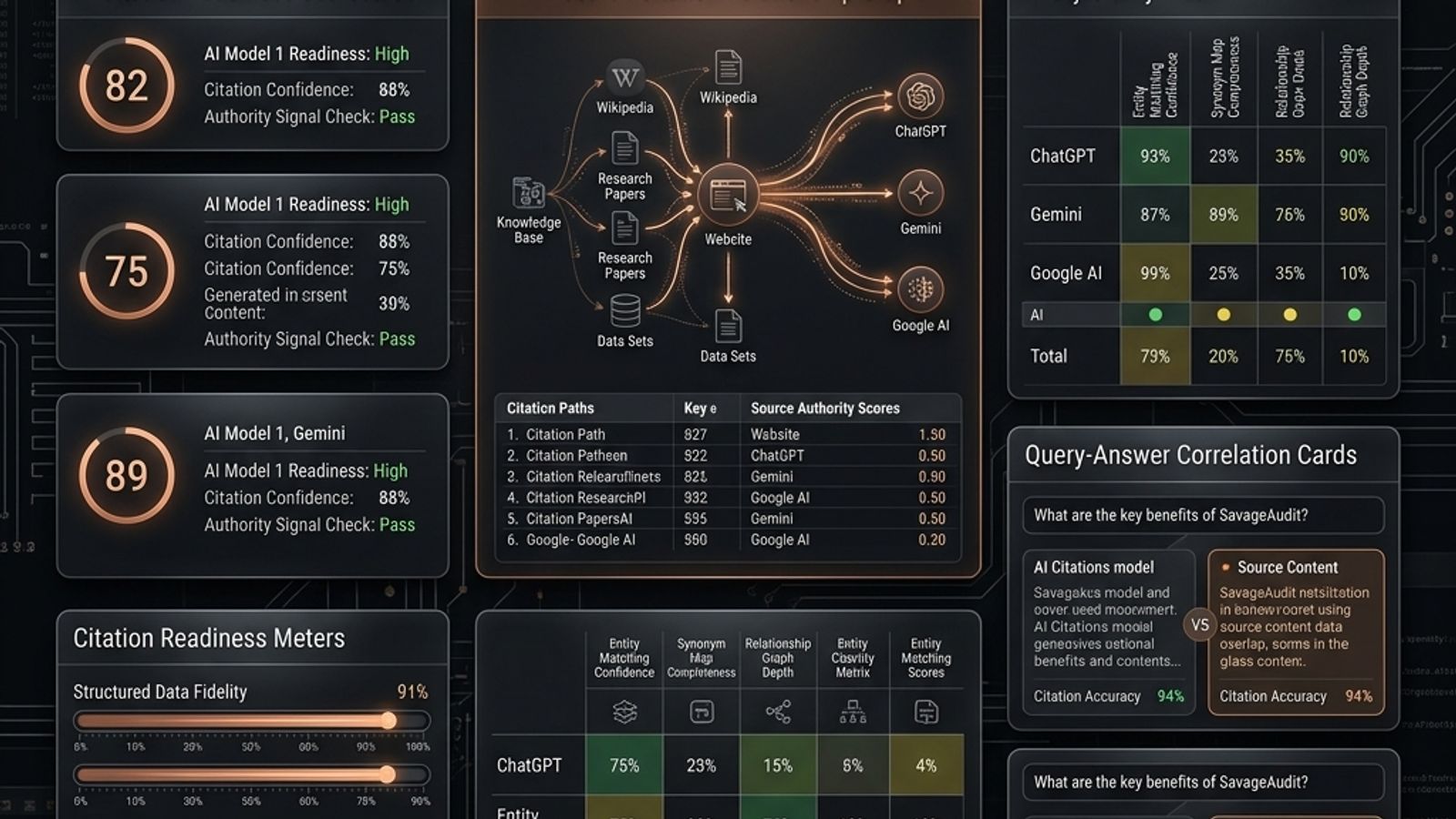
AI search visibility requires brands to be understandable, credible, and technically clean for answer engines like ChatGPT, Gemini, and Google AI. Most brands are invisible because their sites are vague, unproven, and hard to parse. This 10-point audit provides a practical framework for evaluating the signals that matter: entity clarity, category ownership, topical depth, claim support, extractability, technical cleanliness, structured data, authority signals, comparison readiness, and content freshness. Scoring these factors reveals why a brand might be ignored by AI and provides a clear path to fixing the self-inflicted wounds that...
# AI Search Visibility Ranking Factors: A Practical 10-Point Audit Checklist
Most brands aren't invisible in AI search because a model “hates” them.
They're invisible because their sites give answer engines nothing clean, specific, credible, or quotable to work with.
Let’s be precise: ChatGPT, Gemini, Google AI features, and other answer experiences do not publish one universal list of confirmed AI search visibility ranking factors. Anyone pretending otherwise is selling certainty they don't have.
This isn't a magic list of official levers.
This is SavageAudit’s practical framework for auditing the signals that make a brand easier to understand, summarize, compare, cite, and recommend in AI-assisted search.
The core question is simple:
Can a machine — and a buyer — quickly understand what you do, who you serve, why you're credible, what you offer, and where your proof lives?
If the answer is no, your AI visibility problem starts on your own site.
What AI Search Visibility Means
For this checklist, AI search visibility is your brand’s ability to appear accurately inside AI-generated answers, summaries, recommendations, and comparisons.
Traditional SEO asks:
Can this page rank?
AI search visibility adds another question:
Can this brand be understood, extracted, trusted, compared, and cited?
This breaks down into practical checks:
- Is your brand identified correctly?
- Is your product placed in the right category?
- Are your claims verifiable?
- Are your pages crawlable and parsable?
- Does your content answer buyer questions directly?
- Can you be compared against alternatives without guesswork?
If your website fails these checks, answer systems and buyers have to fill in the gaps. That’s where bad summaries, weak recommendations, and total invisibility begin.
How to Score This Checklist
Use this as a self-assessment, not an industry benchmark. Score each factor from 0 to 3.
- 0 = missing or broken
- 1 = weak
- 2 = decent
- 3 = strong
Maximum score: 30. Low scores usually mean your site is unclear, unsupported, hard to parse, or technically messy. High scores mean you have a stronger base, but still need maintenance.
1. Entity Clarity
If your homepage can’t explain your company in one clean sentence, don’t expect an AI or a buyer to do it for you. Entity clarity means your brand is easy to identify as a distinct company or product, and your site describes itself consistently.
Audit your site for clear answers. What is the brand name? What does it do? Who is it for? What category does it belong in? Is the company name different from the product name? Are old, conflicting positioning statements still live?
A common failure is wrapping a simple concept in vague marketing jargon.
- Bad: “We help modern teams unlock scalable growth through intelligent workflows.”
- Better: “Acme is a project intake and workflow automation platform for in-house legal teams.”
Specific beats impressive. Create one consistent entity statement: [Brand] is a [category] for [audience] that helps with [problem or use case]. Use it across your homepage, product pages, about page, pricing page, help docs, and structured data.
2. Category Ownership
Once a system knows who you are, it needs to know where to place you. Category ownership means connecting your brand to terms buyers already understand. If you invent a cute category nobody uses, you might sound differentiated in a board deck but you'll be invisible everywhere else.
Your core pages must reinforce real categories like “customer onboarding software,” “API monitoring platform,” or “SOC 2 compliance automation.” Burying these under abstract positioning is a strategic error.
- Bad: “The revenue command center for ambitious operators.”
- Better: “Revenue operations software for B2B SaaS teams.”
You can have a brand voice. First, be legible. Map your brand to its primary category, then to secondary use-case, industry, and integration categories. If you sell customer onboarding software, say that. Don't force systems to decode your metaphor.
3. Topical Depth
Owning a category isn't just about claiming it; it's about proving it with substance. A thin product page and a pile of generic blog posts are not a content strategy. Topical depth means your site covers the questions, objections, use cases, and decision criteria that surround your category.
Does your content address the hard questions? Implementation details, pricing considerations, security, alternatives, migration issues, buyer checklists? Many SaaS teams overproduce awareness fluff like “10 trends in digital transformation” but skip the decision content buyers and systems actually need, like “[Category] pricing model explained” or “How to evaluate [category] tools.”
Build a topical map around your revenue motion, not just keyword volume. For each core category, create or improve pages covering problems, features, comparisons, FAQs, security, and pricing.
4. Claim Support
Unsupported adjectives are weak evidence. If your site says you’re “the leading,” “best,” “most trusted,” or “fastest,” the next question is obvious: According to what?
Claim support means providing evidence for the statements you make. Find your biggest claims and ask: Is there proof on the same page? Is the claim specific, current, and measurable? Or is it just empty copy?
- Bad: “The most powerful analytics platform for modern teams.”
- Better: “Product analytics for B2B SaaS teams that need account-level reporting, funnel analysis, and CRM enrichment.”
The second version doesn't scream. It gives substance. Support claims with specifics: customer examples, product screenshots, feature details, security documentation, case studies, or a clear methodology. If you can't prove it, rewrite it.
5. Extractability
Proof is useless if it's trapped. A page can look polished and still be useless if every important fact is stuck inside vague design copy. Extractability means your content is structured so that answers, definitions, and product details are easy to identify and parse.
Many SaaS pages are designed like pitch decks: a big hero line, three icons, and no details. That may look clean, but it's informationally weak. Your pages need descriptive headings, short explanatory sections, tables for specs, and plain-language definitions.
Make every important page answer the obvious questions: What is this? Who is it for? How does it work? What features are included? What makes it different? Design should support clarity, not replace it.
6. Technical Cleanliness
None of this matters if the machines can't get in. AI visibility work doesn't get to ignore technical SEO basics. If important pages are hard to crawl, index, or parse, you reduce the chance that any system can understand them. Technical cleanliness means your site can be discovered and interpreted without unnecessary friction.
Teams obsess over AI prompts while their most important pages are thin, duplicated, blocked, or buried under JavaScript. You can't prompt-engineer your way out of a broken website.
At a minimum, verify that your important commercial pages are indexable, have clean canonical tags, and aren't orphaned from the rest of the site. Check internal linking, XML sitemaps, and structured data. If regional visibility is a factor, the SavageAudit SEO GEO Audit Tool can help teams evaluate how search results vary by location.
7. Structured Data
Technical hygiene includes structured data, but it’s a tool for clarification, not a magic fix. It should support strong visible content, not compensate for vague pages. The common failure is adding schema as if it will force visibility, while the visible page says one thing, the schema says another, and the content itself is still vague. This doesn't build clarity; it creates inconsistency.
Use structured data to clarify reality, not decorate nonsense. Prioritize schema for your organization, products, articles, and FAQs. Make sure it matches what users see on the page.
8. Authority Signals
Clarity and crawlability get you seen. Authority gets you trusted. Having pages isn't the same as being credible. Authority signals help buyers and systems assess whether your content is worth trusting.
Some SaaS sites look like anonymous landing pages stitched together by a growth team. No company depth. No proof. No docs. No names. No substance. That might convert a few paid clicks, but it doesn't build durable trust.
Your site needs real company information, customer proof, case studies, security documentation, and transparent pricing. Add credibility where buyers look. Don't hide trust signals in a PDF nobody can find.
9. Comparison Readiness
Trustworthy brands aren't afraid of the market. Buyers ask comparative questions: “Best tools for…,” “Alternative to…,” “Compare X and Y.” If your site doesn’t explain how you fit into the market, others will define you.
Brands often avoid comparison content because they're afraid of mentioning alternatives. This isn't strategic restraint; it's surrender. Buyers and answer systems will simply get their context from somewhere else.
Create comparison pages that are accurate, specific, and useful. Don't write childish hit pieces. Explain who your product is best for, who it’s not for, and where another option might fit better.
10. Freshness and Consistency
Finally, maintain what you've built. Outdated content creates confusion. Old positioning, stale feature pages, inaccurate pricing, and abandoned blog posts make your brand harder to trust. Freshness doesn’t mean publishing constantly. It means maintaining important information.
Inconsistency is a common failure. The homepage says one thing, a product page says another, and old blog posts use a previous category. This creates confusion about your brand, features, and positioning.
Create a brand entity brief with your official name, categories, descriptions, and approved claims. Use it everywhere. Then, set a quarterly maintenance cycle to refresh top commercial pages and remove obsolete pages.
Quick Scoring Template
| Audit factor | Score 0–3 | Notes |
|---|---|---|
| Entity clarity | ||
| Category ownership | ||
| Topical depth | ||
| Claim support | ||
| Extractability | ||
| Technical cleanliness | ||
| Structured data | ||
| Authority signals | ||
| Comparison readiness | ||
| Freshness and consistency |
Priority Fixes: Where to Start
If your score is weak, don't try to fix everything at once. Start here.
1. Fix Entity and Category Language
Write one clean sentence: [Brand] is a [category] for [audience] that helps with [problem/use case]. Make your site use it consistently.
2. Rewrite Unsupported Claims
Delete vague superiority language unless you can prove it. Replace “The most advanced platform” with a specific description of what your platform does and for whom.
3. Improve Your Highest-Value Pages
Start with the homepage, product pages, pricing page, comparison pages, and security page. These carry the clearest signals about your business.
4. Make Content Easier to Extract
Add clear definitions, short answer blocks, feature tables, and specific headings. Don't make systems or buyers dig through decorative copy to find the point.
5. Audit Technical Access
Make sure your best content can be crawled and indexed. Noindex mistakes, broken canonicals, and JavaScript-hidden content are self-inflicted wounds.
The Brutal Truth
Many AI visibility problems are self-inflicted.
Your brand isn't clear. Your category language is evasive. Your proof is thin. Your pages are hard to parse. Your technical foundation is messy. Your claims sound like every other SaaS homepage written in a positioning workshop.
Answer engines don't need your brand to be poetic.
They need it to be understandable.
If you want a better chance of appearing in AI-generated answers, build pages that are clear, specific, credible, and easy to quote. Fix the obvious gaps.
SavageAudit’s AI Visibility Audit is built for teams that need to find the gaps stopping AI search systems from understanding, trusting, and recommending their brand.
Common questions
What are AI search visibility ranking factors?
No platform has published a universal set of confirmed AI search visibility ranking factors. This checklist uses the phrase to refer to practical audit factors that may help answer engines understand, summarize, compare, cite, and recommend a brand more accurately.
Is AI search visibility the same as SEO?
No. They overlap, but they aren't identical. Traditional SEO centers on page visibility in search results. AI search visibility adds the question of whether your brand and content are clear enough to be summarized, compared, or referenced in generated answers.
Can structured data make my brand appear in AI answers?
Structured data can support machine-readable clarity, but it is not a magic switch. It should reinforce useful content, credible proof, crawlable pages, and consistent positioning.
What should SaaS teams fix first?
Start with entity clarity and category ownership. If your product is hard to understand, the rest of your content strategy is built on sand. Then fix claim support, technical access, and comparison content.
Why is comparison content important for AI search?
Because buyers ask comparative questions. If your site doesn't explain how you compare, answer systems may rely on other available information—like competitors, outdated pages, or old reviews—to frame the answer instead of you.
Keep the diagnosis moving
Run your own public presence audit
See how your website, search footprint, AI visibility, social proof, and conversion trust look from the outside.