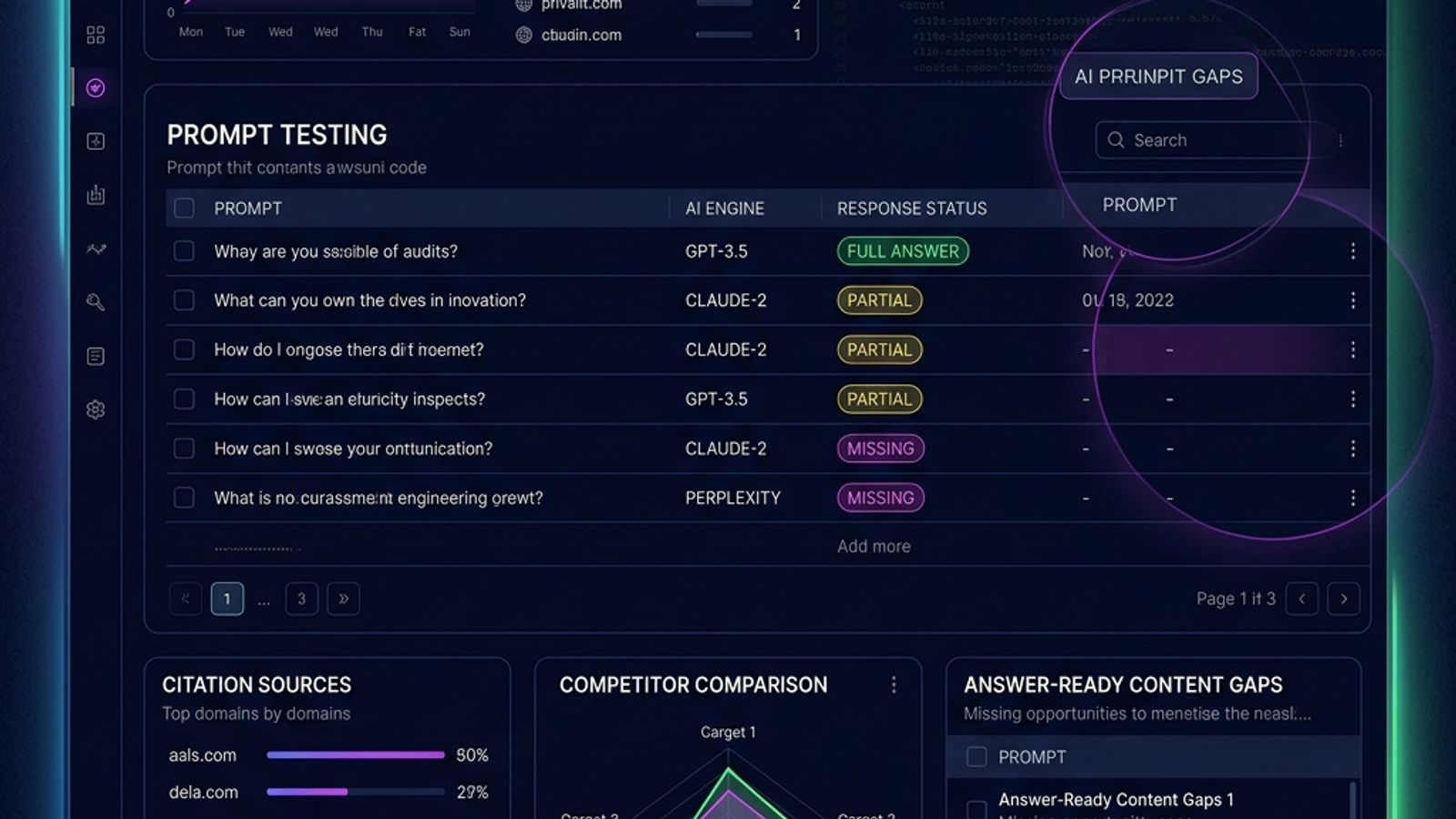
An AI search visibility audit measures how often your brand is mentioned or cited in AI-generated answers from engines like ChatGPT, Perplexity, and Google AI Overviews. The process involves building a prompt set based on real buyer intent (category, problem, comparison, use-case, trust), testing these prompts across multiple AI engines, and analyzing the results. Key steps include differentiating between mention gaps (not being included) and citation gaps (included but not linked), benchmarking against competitors, inspecting the sources AI systems trust, and auditing your own pages for 'answer readiness'—ensuring content is direct...
AI search visibility is how often your brand appears, gets mentioned, or earns citations inside AI-generated answers from tools like ChatGPT, Claude, Gemini, Perplexity, and Google AI Overviews. To audit it, test real buyer prompts, track mentions and citations, compare competitors, inspect cited sources, and create answer-ready pages that close the gaps.
What is an AI search visibility audit?
An AI search visibility audit checks whether AI answer engines understand, mention, and cite your brand when people ask questions related to your category, product, competitors, or use cases.
Traditional SEO audits focus on rankings, keywords, technical health, and backlinks. An AI visibility audit shifts the focus from rankings to inclusion: not just if you rank, but if you’re part of the answer. It measures whether your site gives AI systems enough clear evidence to reference you confidently.
A strong audit answers questions like:
- Does our brand appear when buyers ask category questions?
- Are we mentioned when people compare tools or vendors?
- Are competitors cited more often than us?
- Which third-party pages influence AI answers?
- Do our owned pages clearly answer the prompts AI systems are likely to use?
- What content, proof, or structure is missing?
AEO vs GEO vs SEO
AI visibility work overlaps with three terms: SEO, AEO, and GEO.
SEO (Search Engine Optimization) helps pages rank in traditional search results.
AEO (Answer Engine Optimization) helps content become clear enough to answer direct questions.
GEO (Generative Engine Optimization) focuses on helping AI systems understand, summarize, mention, and cite your brand inside generated answers.
Technical SEO gets your pages crawled. AEO structures your content for easy extraction. GEO signals convince AI systems that your brand is the right answer for a category, use case, or comparison.
Step 1: Build a prompt set around real buyer intent
Don’t start with random prompts. Start with the questions your buyers, users, and prospects actually ask.
Group prompts into five buckets.
Category prompts
These are broad discovery prompts where AI systems recommend tools, services, or approaches.
Examples:
- What is the best AI website audit tool?
- Best tools to audit website UX and conversion
- Best website audit tools for SaaS landing pages
- Best SEO and GEO audit tools
Problem prompts
These prompts describe pain points, not product names.
Examples:
- Why is my landing page not converting?
- How do I audit a website before launch?
- How do I find website UX issues?
- How do I check if my website is ready for AI search?
Comparison prompts
These prompts reveal who AI systems consider your alternatives.
Examples:
- SavageAudit vs traditional SEO audit tools
- Best alternatives to Semrush Site Audit for website critique
- Google Lighthouse vs AI website audit tools
- Website grader vs AI website audit tool
Use-case prompts
These prompts connect your product to a specific job.
Examples:
- AI website audit tool for developers
- Website audit checklist for SaaS demo pages
- Landing page audit tool for founders
- Tool to review website copy, UX, and conversion
Trust and proof prompts
These prompts test whether AI systems can explain why someone should believe you.
Examples:
- Is SavageAudit useful for landing page audits?
- What does SavageAudit check?
- Who is SavageAudit for?
- Does SavageAudit help with SEO and conversion?
Step 2: Test prompts across multiple AI engines
Run each prompt across the AI systems your audience may use. The landscape of AI engines is a moving target, but at a minimum, test ChatGPT, Claude, Gemini, Perplexity, and Google AI search experiences where available.
For every prompt, record:
- Whether your brand is mentioned
- Whether your brand is cited with a link
- Which competitors are mentioned
- Which sources are cited
- Whether the answer is accurate
- Whether the answer describes your category correctly
- Whether the answer includes outdated or incomplete information
Use a simple status system:
- Mentioned and cited: Strongest visibility.
- Mentioned but not cited: Brand recognition exists, but proof is weak.
- Not mentioned, competitor cited: A clear content or authority gap.
- Wrong positioning: The AI misunderstands your brand.
- No clear recommendations: An opportunity to create stronger category content.
Step 3: Separate mention gaps from citation gaps
A brand mention and a citation are not the same thing.
A mention gap means AI systems don’t include your brand in the answer at all.
A citation gap means AI systems may know your brand, but they don’t link to your site or supporting pages as evidence.
Both matter, but they require different fixes.
A mention gap demands stronger category pages, comparison guides, use-case content, and third-party validation.
A citation gap requires clearer answer blocks, better-structured pages, stronger internal linking, more direct definitions, and content that precisely matches the prompt.
Step 4: Compare your visibility against competitors
AI search visibility is competitive. You aren’t just trying to be understood; you are trying to be selected over others.
For each prompt, list every competitor or alternative that appears. Then look for patterns:
- Which competitors appear across multiple engines?
- Which competitors get cited most often?
- Which specific pages are AI systems using as evidence?
- Are competitors winning with product pages, blog posts, comparison pages, directories, reviews, or documentation?
- Do they have clearer category positioning than you?
This helps you find the gap behind the gap. Sometimes the issue isn’t that your page is missing keywords. The issue is that a competitor has a page built for the exact question the AI is trying to answer.
Step 5: Inspect the sources AI systems cite
When an AI cites a source, it’s showing you what it trusts on that topic.
Review each cited source and ask:
- What format is it? Blog post, directory, review, product page, forum, documentation, or comparison guide?
- What question does it answer directly?
- How is the page structured? Does it use definitions, tables, FAQs, examples, or lists?
- Does it mention specific brands?
- Does it include fresh information or clear proof?
- Does it use language that matches the prompt?
If AIs repeatedly cite third-party lists, you need an off-site visibility plan. If they cite product documentation, you need clearer feature and use-case pages. If they cite Reddit, you need stronger proof, public examples, and real conversations around the problem.
Step 6: Audit your owned pages for answer readiness
Your pages must make it easy for AI systems to extract a direct answer.
Check whether each important page includes:
- A clear page title that matches the topic
- A direct answer in the opening paragraph
- Descriptive H2s and H3s
- Definitions for important terms
- Specific use cases
- Comparison language where relevant
- Tables or structured lists
- FAQs that answer real questions
- Internal links to related pages
- Clear product positioning
- Evidence, examples, or proof points
Avoid vague copy like “unlock growth with AI-powered insights.” AI systems need concrete language. Say what the product does, who it is for, what it checks, and when someone should use it.
Step 7: Build the content that fills your gaps
Once you know the gaps, create pages designed to close them. Don’t just write another blog post; build assets that map directly to the prompts you audited.
Create category pages for broad questions
These pages educate buyers on the landscape and establish your brand as a credible player. They target broad discovery prompts.
Examples:
- What is an AI website audit?
- How to audit AI search visibility
- Website audit checklist for startups
Build comparison pages to win head-to-head
These pages are for people evaluating options. They should be honest, detailed, and structured for easy scanning.
Examples:
- Best AI website audit tools
- SavageAudit vs traditional SEO audit tools
- Google Lighthouse vs AI website audit tools
Launch use-case pages for specific jobs
These pages connect your product to a specific pain point or job-to-be-done, making your solution feel more relevant.
Examples:
- AI website audit tool for developers
- Landing page audit tool for SaaS teams
- Website audit tool for conversion friction
Publish proof pages to build trust
These pages provide the evidence that backs up your claims, making it easier for both humans and AIs to trust you.
Examples:
- Case studies
- Public teardown examples
- Before-and-after improvements
- Customer examples
- Review and testimonial pages
Step 8: Prioritize gaps by visibility upside
Not every missing page deserves immediate attention. Prioritize based on impact.
Score each opportunity by:
- Search Console impressions
- AI prompt priority
- Competitor visibility
- Buyer intent
- Product relevance
- Ease of creating a strong answer
- Internal linking potential
- Conversion value
The best opportunities combine high AI visibility, existing search demand, and direct product relevance.
A prompt with low search volume can still matter if it appears late in the buying journey. For example, “AI website audit tool for developers” may be more valuable than a broad informational query if the visitor is ready to try a tool.
Common AI visibility and AEO gaps
Here are the gaps that show up most often in AI visibility audits.
Your page takes too long to answer the question
AI systems prefer pages that get straight to the point. If your answer is buried paragraphs deep, it will likely be skipped.
Your brand positioning is vague
If your site doesn’t clearly state what your product does, who it helps, and how it’s different, AI systems will summarize it poorly or ignore it entirely.
You have no comparison content
AI answers thrive on comparing options. If you don’t publish your own comparisons, you force AIs to rely on competitors or third-party sources that you don’t control.
Your page is a wall of text
Tables, lists, definitions, FAQs, and concise summaries make content easier to parse, quote, and cite. Unstructured prose is a liability.
Weak internal linking hides your best content
Important pages should link to related product pages, guides, and comparisons. Strong internal links help crawlers understand topic relationships and authority.
Your content is all claims and no proof
AI systems are getting better at identifying unsubstantiated marketing fluff. They are more likely to trust and cite pages with proof: examples, screenshots, case studies, reviews, and clear methodology.
What to create after the audit
After the audit, create or improve assets that directly close the gaps you found.
Strong content options include:
- Category comparison pages
- Best-tools pages
- Use-case landing pages
- Competitor comparison pages
- Glossary pages for category terms
- Step-by-step guides
- FAQ sections
- Case studies and teardown examples
- Public audit examples
- Review or testimonial pages
Each asset should target a specific prompt cluster and answer the question directly.
How SavageAudit can help
SavageAudit helps teams review websites across SEO, performance, design, copy, UX, conversion, and AI visibility signals. That makes it useful when you need to identify pages that are unclear, under-positioned, hard to trust, or missing answer-ready content.
Use it to find practical issues such as:
- Weak page positioning
- Missing direct answers
- Unclear CTAs
- Thin proof sections
- Confusing copy
- Poor trust signals
- UX friction
- SEO and GEO content gaps
AI search visibility audit checklist
Use this checklist when reviewing your site:
- Build a prompt set from real buyer questions
- Test each prompt across multiple AI engines
- Record mentions, citations, competitors, and cited sources
- Separate mention gaps from citation gaps
- Review competitor pages that win AI answers
- Inspect third-party sources AI systems trust
- Check owned pages for direct answers and structured sections
- Add comparison tables where useful
- Strengthen definitions, FAQs, examples, and proof
- Improve internal links between related pages
- Create missing category, comparison, use-case, and proof pages
- Re-test prompts after publishing updates
Summary
An AI search visibility audit isn’t about gaming an algorithm; it’s about holding a mirror up to your content. It reveals if you are seen as a credible, clear, and useful authority when customers ask AI for help. By systematically testing prompts, analyzing competitors, and inspecting the sources AI systems trust, you can find and fix the gaps. The goal is to make your brand, pages, and proof so clear that AI systems can confidently understand, summarize, and cite you as part of the answer.
Common questions
What is AI search visibility?
AI search visibility is the degree to which your brand, pages, products, or expertise appear in AI-generated answers across tools like ChatGPT, Claude, Gemini, Perplexity, and Google AI search experiences.
What is an AEO gap?
An AEO gap is a missing or weak answer opportunity. It usually happens when your site does not clearly answer a question your audience asks, or when competitors provide a clearer, more quotable answer.
How do you audit AI search visibility?
Create a list of buyer prompts, test them across AI engines, record brand mentions and citations, compare competitor visibility, inspect cited sources, and improve pages so they answer important questions clearly.
Is GEO different from SEO?
Yes. SEO focuses on ranking in traditional search results. GEO focuses on how generative AI systems understand, mention, summarize, and cite your brand in generated answers. The two strategies overlap, but they are not identical.
How often should you rerun an AI visibility audit?
For important categories, rerun the audit monthly or after major content updates. AI answers can change as engines crawl new pages, sources shift, and competitors publish new content.
What pages help improve AI visibility?
Useful pages include category guides, comparison pages, use-case pages, FAQs, case studies, public examples, review pages, and clear product pages that directly explain what your product does and who it is for.
Keep the diagnosis moving
Run your own public presence audit
See how your website, search footprint, AI visibility, social proof, and conversion trust look from the outside.