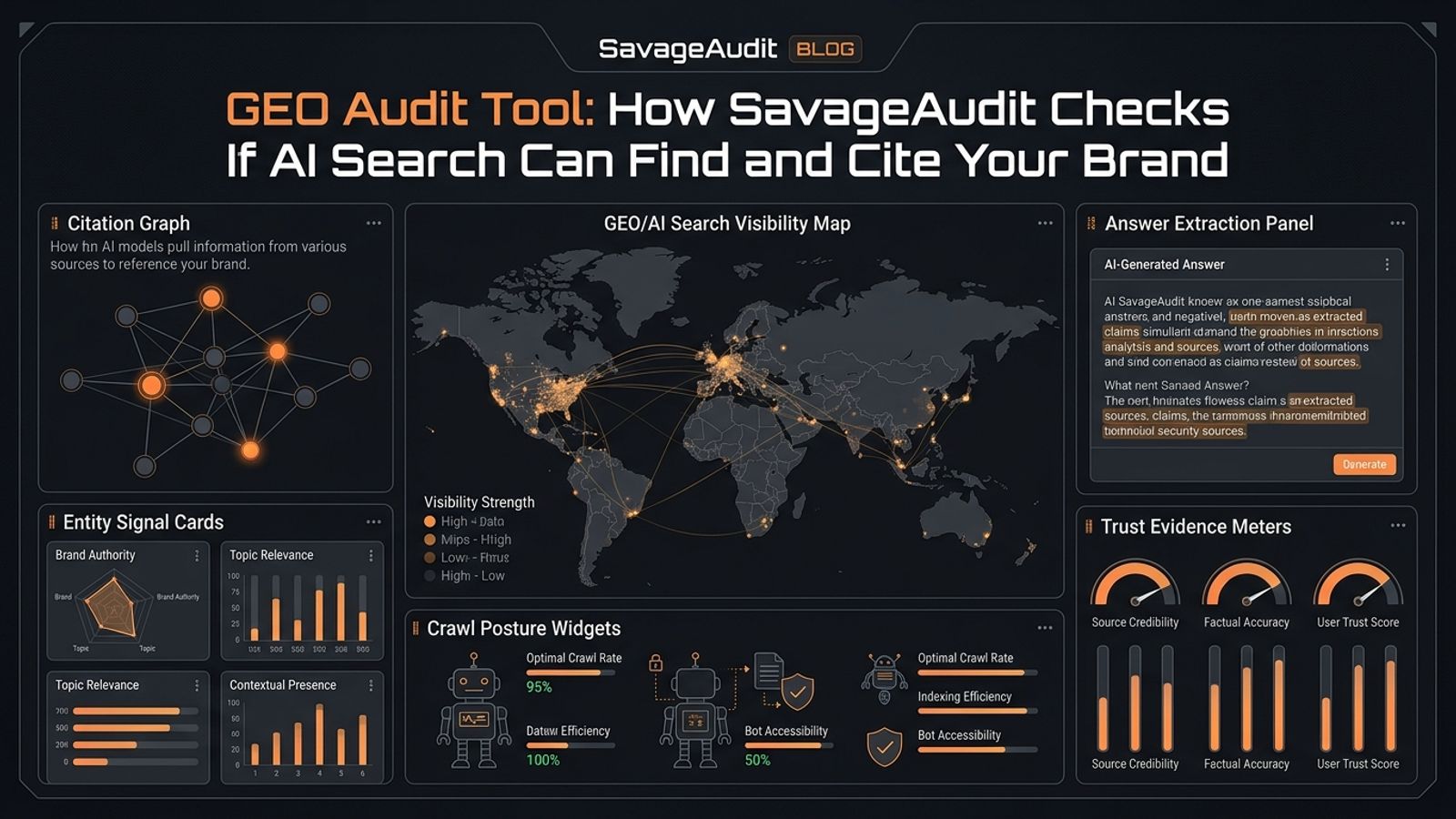
A GEO audit tool evaluates whether a website is structurally and contextually ready for AI search engines to understand, trust, and cite. Unlike traditional SEO audits that focus on crawlability and rankings, a GEO audit checks entity clarity, category placement, verifiable claims, and extractability. SavageAudit provides a blunt, data-backed roast of these signals, exposing vague marketing copy, missing proof, and technical friction that prevent AI systems like Perplexity or ChatGPT from recommending your brand.
Most "AI visibility" advice circulating today is just outdated SEO dressed up with new acronyms. Marketing teams add schema markup, publish a few generic FAQs, mention "AI search" in a hero headline, and hope ChatGPT, Perplexity, or Gemini magically decides their homepage deserves a citation.
Hope is not a strategy, and wishful formatting will not trick a machine into trusting you.
A reliable geo audit tool has to answer a much colder, more practical question. It needs to determine if an AI search engine can actually understand your brand, trust your claims, extract useful answers from your site, and cite you without guessing.
If a website is slow, vague, structurally confusing, or hostile to buyers, machines are going to struggle to parse it just as much as human visitors do. SavageAudit tackles this reality directly. As a fast, blunt website roast and audit product, it does not just check metadata. It reviews performance, SEO, design, copy, UX, conversion friction, and trust signals to provide a data-backed verdict on exactly why a site is failing to gain traction.
The Overlap Between Search and AI Visibility
To fix AI visibility, product and marketing teams have to understand where the disciplines overlap. SEO is fundamentally about whether traditional search engines can crawl, understand, rank, and drive clicks to your pages. AEO (Answer Engine Optimization) asks whether your content is formatted so it can be extracted as a direct, useful answer. GEO (Generative Engine Optimization) goes further, evaluating whether AI systems can identify the brand, place it in the correct category, corroborate its claims with public evidence, and comfortably cite it.
Many teams try to solve modern visibility problems with legacy tools. Finding a missing title tag is useful, but it is not enough.
An effective aeo geo audit tool evaluates whether your product marketing is actually answer-ready. It forces you to ask if you can define your software in a single sentence, support that definition with immediate proof, and make details like pricing and implementation easy to extract. SavageAudit’s SEO + GEO Audit Tool bridges this gap by assessing traditional search signals alongside AI citation readiness. It looks for entity clarity, extractable answer sections, and verifiable proof positioned right next to conversion paths.
Why Answer Engines Ignore Vague Brands
AI search engines do not owe any brand a mention. When a website relies on abstract metaphors instead of clear categories, AI systems are forced to infer the details. When bold claims lack proof, they become weak candidates for citation. If your public profiles and structured data disagree about what your company actually does, your entity becomes muddy and unreliable.
The framework for AI search visibility is built on ten core ranking factors: entity clarity, category placement, topical depth, verifiable claims, extractability, technical cleanliness, structured data, authority signals, comparison readiness, and content freshness. None of these elements are glamorous, which is exactly why so many websites fail at them.
Visibility failures usually stem from boring, foundational gaps. A SaaS homepage might refuse to explicitly name its category because leadership wants to sound "category-defining." While that might feel differentiated in a board meeting, AI systems simply will not know when to recommend the product. Buyers search for real, established categories like "customer onboarding software" or "SOC 2 compliance automation." If your site never uses the plain language that machines and buyers rely on, you are actively asking to be skipped. An aeo geo audit exposes these exact blind spots.
Answer engines are also frequently used to evaluate alternatives. Buyers ask for direct comparisons between competitors. If a website refuses to address how it stacks up against alternatives, AI systems will simply pull that framing from Reddit or a third-party review site. Comparison readiness is a critical factor. Brands need to present clear, concrete ways they differ from alternatives to reduce guesswork. Furthermore, content freshness plays a massive role. Maintaining up-to-date documentation on pricing, security standards, and deployment details ensures that when an AI system pulls a fact, it is accurate and verifiable.
Entity Clarity and Content Extraction
Your entity is the machine-readable identity of your company. When an AI agent crawls your site, it needs to confidently determine what the product is, who it serves, and what specific problem it solves.
Marketing copy like, "We help modern teams build better workflows," provides zero signal. It is useless fog. Conversely, stating, "Acme is customer onboarding software for B2B SaaS teams," gives both the machine and the buyer a concrete classification.
Beyond establishing a clear identity, the content itself must be built for extraction. Design teams often fall in love with complex layouts, scroll-jacked animations, and vague hero sections. Machines, however, require clean semantic structure. Information needs to be text-rich, logically grouped, and clearly headed. If a newly hired employee cannot quickly extract your core features, pricing model, and security posture from a landing page, an AI system definitely cannot do it either.
Proof Density and Technical Plumbing
Unsupported bragging is a massive liability in the era of AI search. Subjective claims like "the fastest platform" or "enterprise-grade security" are essentially meaningless without immediate evidence.
A rigorous geo audit looks for public evidence and citable proof positioned directly next to these claims. This means embedding named customer stories, specific product screenshots, linked documentation, and attributable testimonials right where the claim is made. Proof should never be buried three clicks away on a forgotten case study page.
Of course, none of this content matters if bots cannot access the pages in the first place. Technical cleanliness serves as the plumbing for AI visibility. The standard SavageAudit pipeline runs an AI 5-agent process that combines live internet context with raw data to review foundational issues. It flags missing meta tags, broken heading hierarchies, and robots.txt problems, alongside Lighthouse performance metrics such as Largest Contentful Paint (LCP), Cumulative Layout Shift (CLS), First Contentful Paint (FCP), and Total Blocking Time (TBT).
This is not just about making a site look pretty. If typography is illegible, contrast is poor, or navigation depth requires five clicks to find a feature page, both human buyers and AI crawlers will bounce. If bots hit a wall of technical friction, your carefully crafted authority signals will never even enter the conversation.
The Reality of Conversion Friction
Getting cited by Perplexity or ChatGPT is only half the battle. If a highly qualified buyer clicks through an AI citation and lands on a confusing, high-friction website, the traffic is entirely wasted. This is why GEO cannot end at the citation. Revenue requires a site that actually converts.
Evaluating visual hierarchy, mobile layout, form friction, and CTA placement is critical because these elements dictate the buyer's next step. If a site fails to explain the product clearly, hides pricing context, offers weak social proof, and makes the demo request feel like a chore, the AI visibility is useless. The audit flags these UX and conversion blockers to ensure that when traffic finally arrives, it has a clear path to action.
A Practical Workflow for Citation Readiness
Fixing a website for AI search requires a logical, phased approach rather than blindly addressing a checklist of 80 random errors.
Start with basic plumbing. Confirm crawl access, fix robots directives, and resolve page speed blockers. Basic search systems must be able to reach and render the page before any AI citations can happen.
Next, fix the entity statement. Write one boring, accurate sentence that defines the brand, category, target audience, and primary use case. Align this exact statement across the homepage, the about page, the documentation, and the structured data. Boring is perfectly fine; accuracy is mandatory.
Once the identity is locked in, turn vague marketing pages into extractable resources. Build sections that directly answer how the product works, what it integrates with, and how it compares to alternatives.
Finally, attach verifiable proof to every major product and security claim. Claim, proof, context, repeat.
Where SavageAudit Fits
When a product team needs a direct, unvarnished read on what is blocking their search visibility and conversion rates, SavageAudit provides the necessary friction.
The SavageAudit AI Visibility Audit focuses strictly on whether a brand can be cited, extracted, and trusted by answer engines. It analyzes crawl posture, entity signals, public evidence, and hint readiness. For a broader analysis, the SEO + GEO Audit Tool combines traditional search signal evaluation with entity clarity, answer-ready blocks, and social trust analysis.
Instead of delivering a sterile PDF filled with generic best practices, SavageAudit delivers this data as a blunt website roast. It provides screenshots of the verdicts, highlighting exact pain points. The system offers tiers ranging from a mild burn to a medium roast, utilizing different personas to deliver the critique. This format cuts through the usual corporate ego, forcing teams to confront exactly why their landing pages are failing to resonate.
Teams rely on these audits before launching a new website, overhauling product positioning, or scaling their content production. Publishing more pages on a broken, confusing foundation just creates a larger mess for both humans and machines.
The Final Word
AI search does not reward brands for being vague.
If your website cannot state what you do, show who it is for, prove why it matters, and package those answers in a clean structure, AI systems have absolutely no reason to cite you over a competitor.
A proper audit treats GEO like a structural engineering test, not a buzzword exercise. It tests the foundations of crawlability, entity clarity, answer-readiness, proof, UX, and trust. Finding the holes in your positioning and technical setup is uncomfortable, but it is the only way to build a site that machines can cite and buyers can trust.
Common questions
What is a geo audit tool?
A geo audit tool evaluates whether your website is structurally and contextually ready for AI search systems to understand, trust, extract, and cite your brand. It reviews signals such as crawl posture, entity clarity, public evidence, citable content, and extractability.
How is a GEO audit different from an SEO audit?
SEO focuses on whether search engines can crawl, understand, rank, and drive clicks. GEO focuses on whether AI systems can identify your brand, place it in the correct category, verify your claims with public evidence, and cite your website as a trusted source.
How is AEO different from GEO?
AEO is about formatting content for direct answer extraction. GEO is about AI-generated relevance, trust, evidence, and citation. In practice, a site needs both: answer-ready content for extraction and strong proof and entity signals for citation.
What does SavageAudit check for AI search visibility?
SavageAudit’s AI visibility audit assesses whether a brand can be cited, extracted, and trusted by AI search and answer engines. It checks signals like crawl posture, entity signals, public evidence, and citable content while reviewing traditional metrics like performance, design, UX, and conversion friction.
Is GEO only about adding schema?
No. While schema markup helps machines parse data, GEO relies heavily on entity clarity, category alignment, topical depth, verifiable claims, extractability, technical cleanliness, authority signals, comparison readiness, and content freshness.
Who should use an aeo geo audit tool?
SaaS founders, marketers, SEO teams, product teams, and operators should use an audit tool when they need to know whether their site can actually answer buyer questions, support claims with proof, and become citation-ready for AI-driven discovery.
Keep the diagnosis moving
Run your own public presence audit
See how your website, search footprint, AI visibility, social proof, and conversion trust look from the outside.