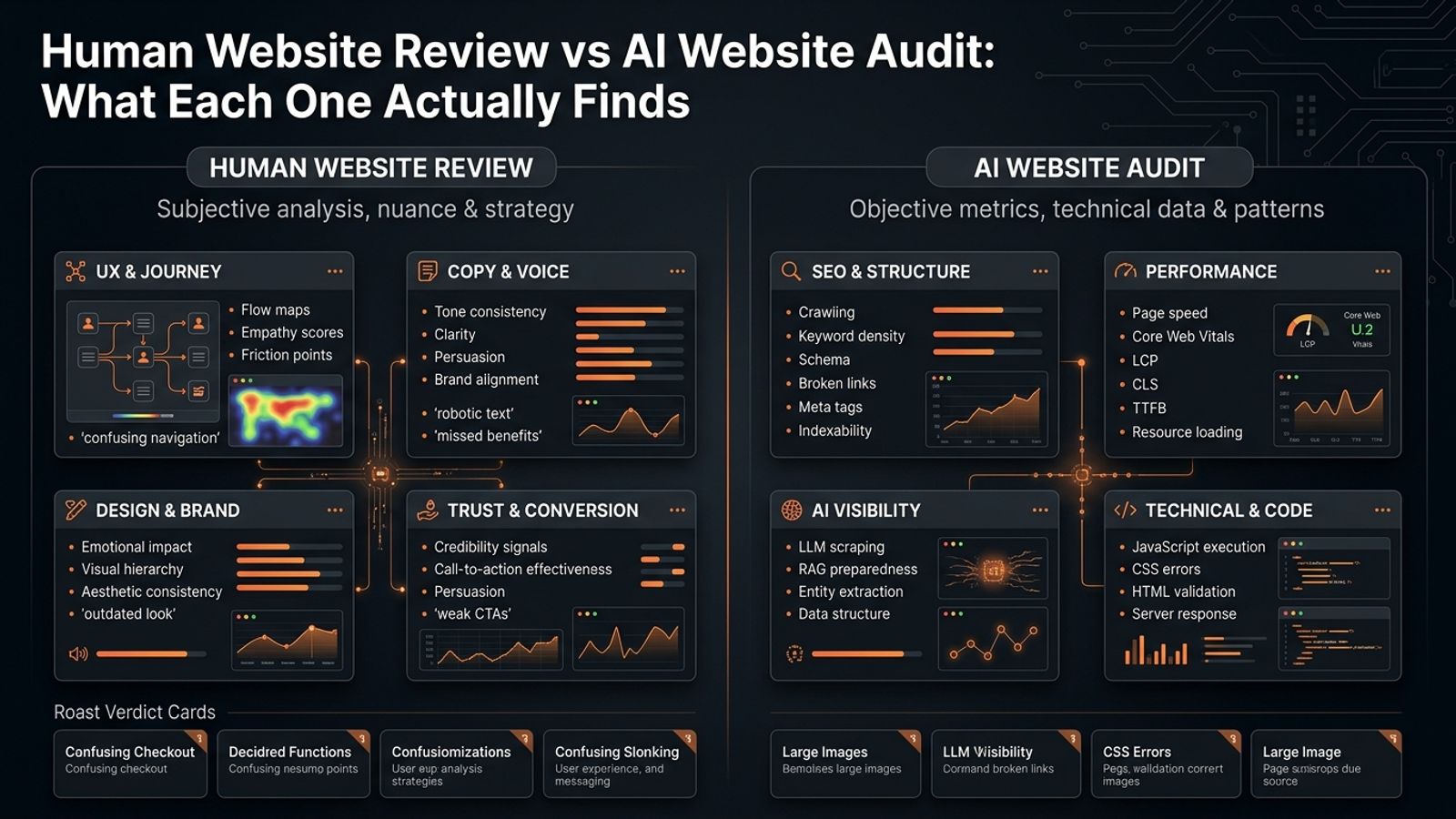
A human website review excels at diagnosing unclear messaging, weak trust signals, and hidden conversion friction. An AI website audit is built for scale, instantly flagging performance bottlenecks, SEO hygiene gaps, and structural defects. The most effective diagnostic process relies on both: software for broad coverage and precise measurement, and human-style judgment to determine the actual meaning and priority of those findings.
Websites fail for highly specific reasons, but those reasons usually fall into two distinct camps. A page might break because of a measurable layout shift that frustrates mobile users, or it might fail simply because the headline reads like a corporate riddle. Deciding between a human website review vs AI website audit depends entirely on which type of failure is draining your revenue.
Automation excels at repeatable signals and raw data. Software scales effortlessly. Human reviewers, on the other hand, understand context, persuasion, and whether a visitor actually trusts the brand enough to spend money.
SavageAudit bridges this gap by delivering automated speed alongside a blunt, human-readable critique across performance, SEO, design, copy, UX, and conversion. It does not render human judgment obsolete. It replaces the vague, overpriced feedback that often plagues the agency world, giving you clear technical data wrapped in strategic context.
Quick Answer: Which One Do You Need?
A human website review shines when diagnosing unclear messaging, weak trust signals, confusing user experiences, and hidden conversion friction. It provides the strategic context a machine lacks.
An AI website audit or automated scan is built for scale. It instantly flags performance bottlenecks, SEO hygiene gaps, structural defects, and recurring template errors across hundreds of pages.
The most effective diagnostic process relies on both. You use software for broad coverage and precise measurement, then apply human-style judgment to determine the actual meaning and priority of those findings.
What Automated Website Audits Actually Find
Diagnostic tools are indispensable when a problem can be quantified or checked against a known technical rule. A crawler does not suffer from fatigue and will never forget to check a meta description just because the homepage design is visually distracting.
Performance and stability bottlenecks are perfect targets for software. Automated tools are ruthless about speed, instantly flagging a delayed First Contentful Paint, a massive layout shift, or a render-blocking script that degrades the mobile experience. Instead of just sensing that a page feels sluggish, you get the exact asset, image, or third-party script causing the delay. The SavageAudit engine brings this into focus by integrating real Lighthouse metrics—including LCP, CLS, FCP, and TBT—to identify performance anchor points. You get the exact milliseconds lost, giving your engineering team a clear target for optimization.
Search engine visibility operates on strict structural rules, making it another ideal match for automation. Tools meticulously check for missing title tags, broken heading hierarchies, accidental noindex tags, and canonical errors. If search engines cannot efficiently crawl your core pages, your broader brand strategy is irrelevant. For teams preparing to go live, referencing a startup website audit checklist guarantees foundational elements like XML sitemaps and Open Graph tags are locked down before launch.
Crawlers are also uniquely equipped to spot site-wide template errors. One broken landing page is an isolated issue, but a flawed template is a revenue leak across your entire architecture. The Full Website Audit runs a representative crawl spanning homepages, pricing tiers, major landing pages, blog templates, and trust-critical legal pages. Aggregating these findings produces a single operator-grade verdict, preventing cross-functional teams from obsessing over minor homepage tweaks while the rest of the site bleeds traffic.
Where Automated Audits Miss
Software can hand you a perfect technical score on a page that actively drives away qualified buyers. Algorithms read structure effortlessly, but they struggle with meaning.
A crawler easily verifies that an H1 tag exists and contains a keyword. It cannot tell you the words inside it are completely meaningless to your target buyer. Consider a headline like "Empowering teams to unlock operational excellence." A machine logs it as structurally compliant, but a human recognizes a fog machine that could apply to a SaaS product, a consulting firm, or a corporate leadership retreat.
Evaluating the credibility of social proof is incredibly difficult for algorithms. Scanning a page for a testimonial section is easy for a bot, but it struggles to distinguish between a highly specific, named customer outcome and a generic strip of anonymous company logos. Real trust requires measurable case studies, verifiable contact details, and clear pricing models placed exactly where a buyer's doubt peaks.
Most scanning tools can detect a form or a button and verify the link resolves, yet they rarely measure the emotional cost of the ask. Hiding pricing behind a mandatory sales call, stacking three competing CTAs above the fold, or demanding excessive personal information before explaining the product's value creates massive friction. An effective audit evaluates these CTA placements and trust gaps to determine if a visitor actually has enough confidence to click.
What a Human Website Review Actually Finds
Capable human reviewers approach a site like a skeptical buyer. They read the copy, navigate the menus, and weigh the promises against the provided evidence. They look for hesitation and confusion.
Founders and product teams frequently write for themselves, their investors, or their direct competitors. This results in copy that sounds impressive internally but falls completely flat externally. Human reviewers catch when a product category is left undefined, when hyper-specific features bury the actual business outcomes, or when the messaging assumes the reader has deep industry context they do not possess. Our website audit categories treat copy as a core component of the conversion system, testing whether a stranger can instantly grasp what you sell within a five-second comprehension window.
A website can be technically functional while still being deeply annoying to navigate. Humans feel the friction of navigation labels built on internal company jargon. They notice claustrophobic mobile layouts and demo flows that demand too much upfront commitment. Reviewers focus on whether the user journey feels obvious and rewarding or disjointed and frustrating.
Visual design is fundamentally about creating enough confidence for the user to take the next step. A technical audit confirms a page loads quickly and has sufficient color contrast, but a human reviewer notices when a high-ticket enterprise service looks like a cheap, template-driven hobby project. They spot the weak visual hierarchy, the unreadable typography choices, and the vague stock imagery that actively damages brand perception.
Where Human Reviews Miss
Human review without data easily devolves into expensive opinion theater. People are subjective, costly, and relatively slow at processing large volumes of pages.
A reviewer might get hung up on a subjective design preference while completely overlooking a JavaScript rendering issue that breaks the experience for half your mobile users. Humans routinely miss hidden canonical mistakes, intermittent rendering bottlenecks, and site-wide metadata gaps. Furthermore, they cannot easily evaluate AI-search readiness or extractability at scale unless they are explicitly utilizing software to test those specific entity signals.
Machine vs Human Across the Six Audit Categories
SavageAudit’s six-part framework provides a practical lens for comparing the strengths of both methods.
| Category | AI / Automated Audit Finds | Human Review Finds |
|---|---|---|
| Performance | LCP, CLS, FCP, TBT, oversized assets, blocking resources | Whether the site actually feels slow enough to damage buyer confidence |
| SEO | Metadata, headings, robots.txt, canonicals, crawlability gaps | Whether the page content genuinely satisfies the searcher's intent |
| Design | Contrast ratios, layout signals, visual hierarchy patterns | Whether the brand aesthetic feels credible, polished, and clear |
| Copy | Headline presence, CTA existence, basic message coherence | Whether the promise is persuasive and legible to a real buyer |
| UX | Navigation depth, form fields, mobile layout, dead links | Whether the journey feels intuitive, obvious, or highly annoying |
| Conversion | CTA placement, social proof presence, contact accessibility | Whether the requested action feels justified at that exact moment |
What AI Website Audits Actually Find
The phrase "AI website audit" is heavily diluted in the current market. It gets applied to everything from simple text generators offering generic writing tips to complex diagnostic pipelines.
A genuinely useful AI audit combines crawl data, visual analysis, external brand context, and structured critique. It translates raw data into business reality. A founder does not need a spreadsheet containing 400 minor warnings. They need to know exactly what is damaging their credibility and actively suppressing their conversion rate.
While AI models are increasingly sharp, they can also be confidently wrong when deprived of context. An AI audit lacks access to off-site business realities. It does not know your internal sales constraints, the nuances of your competitive positioning, or the specific objections your account executives hear on live calls. It cannot weigh legal or compliance requirements that dictate how certain features must be described. AI can critique what it observes on the screen. It should augment customer research, analytics review, and experimentation strategy, but it should never entirely replace them.
Where SavageAudit Fits
SavageAudit is built for teams that require direct, human-readable feedback without waiting three weeks for an agency to discover the primary call-to-action is confusing.
The platform delivers a blunt critique across Performance, SEO, Design, Copy, UX, and Conversion. This framework exposes whether a growth bottleneck is a technical failure, a storytelling gap, or a conversion issue. It is particularly effective when you need a ruthless pre-launch sanity check, when SEO traffic lands but refuses to convert, or when cross-functional teams need a unified, prioritized list of fixes rather than competing departmental opinions.
For organizations preparing for generative search, the AI Visibility Audit evaluates the signals required for discovery in modern answer engines. Websites must now make sense to people, traditional search engines, and AI models simultaneously. This requires extractable structure, consistent entity signals, and credible public proof. The focus here is strictly on citation-readiness and extractability. No audit can promise rankings, citations, conversions, or revenue.
Choosing the Right Audit
Choosing your approach depends entirely on the specific problem you are trying to solve.
Rely on automated tools for massive scale and technical coverage. When you need to check metadata, speed, broken links, and recurring template issues across thousands of URLs, machines are the only logical choice.
Bring in human experts for strategic positioning and persuasion. When you need deep UX diagnosis, brand perception feedback, sales-objection mapping, or high-stakes redesign decisions, human judgment is irreplaceable.
When you need the speed of a machine combined with the blunt prioritization of a human, a hybrid AI tool provides the necessary data alongside a founder-friendly critique so your team can stop debating and start shipping fixes. For teams actively comparing diagnostic tools, our breakdown of the best website audit tool for founders provides a deeper look at evaluating these options for your specific growth stage.
Common questions
Is a human website review better than an AI website audit?
A human review is superior for strategy, nuance, competitive positioning, and conversion judgment. An AI website audit is far better for speed, repeatability, and fast cross-category feedback at scale. The strongest diagnostic processes utilize both.
Are automated website audit tools reliable?
They are highly reliable for measurable issues like performance metrics, metadata presence, crawlability, heading structure, and repeatable technical checks. They are significantly less reliable for judging messaging quality, brand trust, emotional friction, and buyer persuasion.
Can AI effectively review website copy?
Yes, but the quality depends entirely on the audit parameters. A shallow AI review provides generic grammar tips. A stronger audit specifically evaluates headline clarity, CTA strength, messaging coherence, and whether the page explains the core value in plain language.
Can an AI website audit replace a CRO expert?
No. An AI audit can find obvious friction points and provide a strong first-pass critique of a page's layout and copy. It should not replace deep analytics review, qualitative user research, experimentation strategy, or complex conversion diagnosis.
What does SavageAudit find that a normal SEO audit may miss?
A standard SEO audit generally stops at technical and on-page search issues. SavageAudit also critiques design credibility, copy clarity, UX friction, conversion bottlenecks, and AI visibility. It is built to explain why visitors hesitate to buy, not just whether a page is technically crawlable.
Should marketing agencies use AI website audits?
Yes, provided they use them honestly. An AI audit can drastically speed up initial discovery, sharpen client conversations, and expose obvious technical problems before deep strategy work begins. It should support agency expertise and speed up delivery, not replace the strategic thinking the client is paying for.
Keep the diagnosis moving
Run your own public presence audit
See how your website, search footprint, AI visibility, social proof, and conversion trust look from the outside.