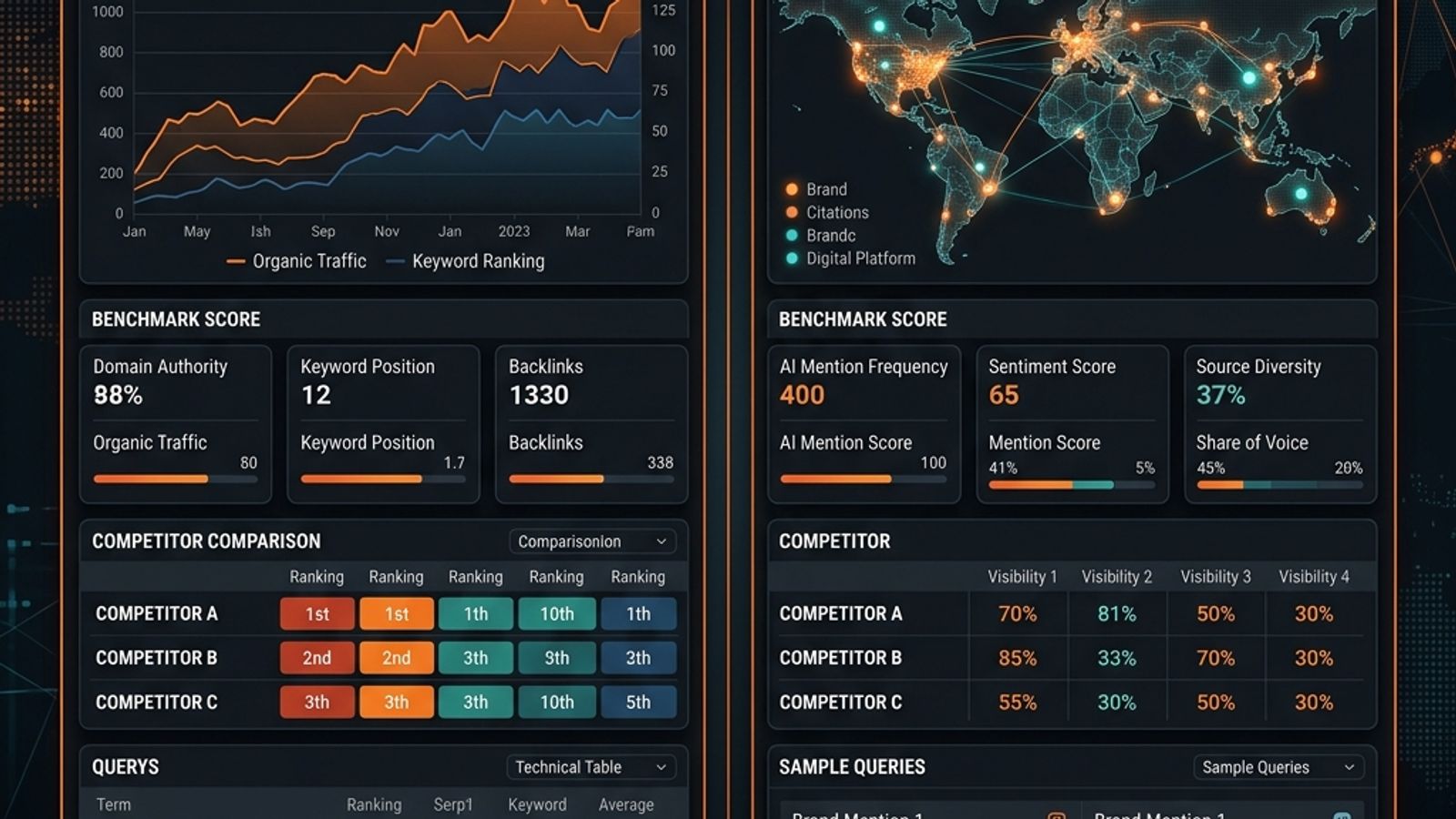
SEO benchmarking measures your rank in a list of links (findability). AI visibility benchmarking measures your presence in AI-generated answers (citability). Traditional SEO metrics like rankings and clicks don't reveal if AI systems ignore, misrepresent, or cite your competitors over you. While SEO focuses on query relevance and technical health, AI visibility depends on extractability, entity clarity, and citable proof. To win, you must measure both. A high rank is useless if you're not considered a credible source for AI-generated answers. One tells you if you're findable; the other, if you're citable.
# SEO Benchmarking vs. AI Visibility Benchmarking: What to Measure When Rankings Are a Lie
Your SEO report says you’re winning. You rank for your target keywords. Traffic is stable.
But your rank tracker doesn’t tell you when an AI answer engine summarizes your competitor’s solution and ignores yours completely. It doesn’t show you when generative AI misrepresents your product, cites a biased review, or recommends an alternative.
SEO benchmarking vs. AI visibility benchmarking is the difference between measuring your position in a list of links and measuring your presence inside the answers themselves. For any SaaS team—founders, marketers, developers, SEOs, product—ignoring this shift is a critical mistake. One benchmark tells you if you’re findable. The other tells you if you’re credible enough to be cited.
You need to measure both. A great ranking on a weak technical foundation is useless. Great AI visibility without the SEO basics is unsustainable.
The Short Answer
SEO benchmarking measures traditional organic search performance. It tracks rankings, clicks, impressions, CTR, technical health, and how well your pages align with search queries. It’s about performance in the classic blue-link SERP.
AI visibility benchmarking measures your presence in AI-generated answers. It tracks whether your brand is mentioned, cited, accurately described, or recommended in environments like Google AI Overviews and other answer engines. It’s about being a trusted source.
One is about ranking. The other is about being referenced. The systems that decide each are not the same. AI-generated answers can summarize multiple sources, cite pages that don’t rank first, and mention brands without linking.
No one can give you the exact formula for how these AI systems work. The job isn’t to chase a secret algorithm. It’s to make your brand easier to crawl, understand, verify, and cite.
What SEO Benchmarking Measures
SEO benchmarking is the classic discipline of comparing your organic search performance against competitors and your own history. A useful benchmark cuts through vanity metrics to find actionable problems.
It should cover fundamentals like:
- Keyword rankings and average position
- Organic clicks, impressions, and click-through rates
- Query-to-page alignment and intent matching
- Indexed pages and crawlability issues
- Metadata, heading structure, and internal linking
- Page speed and Core Web Vitals
- Technical blockers like
robots.txtmisconfigurations or broken redirects
The goal is to answer blunt questions about performance. Using data from tools like Google Search Console, you should be able to diagnose exactly what’s broken: Which queries earn impressions but fail to get clicks? Which pages rank for the wrong user intent? Where are we cannibalizing our own traffic?
Most importantly, which fixes will actually impact revenue, not just traffic numbers? That last point is where most SEO reporting fails. An informational blog post with high impressions isn’t more important than a pricing page with low trust signals. SavageAudit’s GSC audit workflow forces this focus by prioritizing fixes based on business value, not just raw search volume. SEO benchmarking should produce a work plan, not a chart museum.
What AI Visibility Benchmarking Measures
AI visibility benchmarking is different. It measures if your brand can be understood and trusted by AI systems that generate answers. It’s not about your rank; it’s about your citability.
This benchmark looks at your presence in:
- Google AI Overviews
- AI answer engines (e.g., Perplexity)
- Chat-based search and recommendation flows
- Answers to prompts about categories, problems, comparisons, and alternatives
A proper AI visibility benchmark answers a different set of questions: Does our brand appear for critical category prompts? Are we cited as a source, just mentioned, or completely ignored? Is the AI-generated description of our product accurate? Which competitors are being cited instead, and from which URLs?
This is where you find the gap between ranking well and actually being part of the conversation. An AI Visibility Audit from SavageAudit focuses on this by assessing your site’s extractability, trust signals, and citation posture. It exposes whether you’re a legible, trustworthy source or just another URL in the index.
The Core Difference: Ranking vs. Referencing
This is the central split.
Traditional SEO benchmarking asks: Where do we rank, and how much traffic do we get from it?
AI visibility benchmarking asks: Are we referenced as a credible source, product, or recommendation?
Search results are a list of options. Users click a link. Your rank and snippet determine your odds.
AI-generated answers compress that process. The system might synthesize information from ten sources but only cite two. It might recommend a competitor even if you rank higher organically. In this environment, being a citable source of truth is more important than being position #3.
You can have SEO visibility without AI visibility. Your site can rank well but be ignored by answer engines because your content is unstructured, your proof is thin, or your core message is unclear. Rank tracking alone will never show you this problem.
Why Your Rankings Are Not Enough
A top-ranking SaaS site can be invisible in AI-assisted discovery. Here’s why.
1. The Answer Is Buried
Your 3,000-word guide might rank, but if the actual answer is buried 1,800 words deep under a vague H2, it’s not built for extraction. AI crawlers aren’t looking for prose; they’re looking for structured, citable information. The SavageAudit SEO + GEO Audit Tool specifically evaluates answer-ready sections and extractable proof for this reason. The fix isn't more words; it's better structure.
2. Your Claims Are Generic
"Save time." "Boost productivity." "Streamline workflows." This copy could describe hundreds of SaaS products. If your public-facing content lacks specific use cases, differentiators, and proof, you give AI systems nothing unique to summarize. Generic positioning leads to generic—or nonexistent—visibility.
3. Your Proof Is Hidden
Your best proof lives in sales decks and private docs. Meanwhile, your public website gets a logo strip and some vague benefit statements. An AI can’t cite what it can’t find. The SavageAudit AI Visibility Audit scrutinizes owned and public proof, forcing you to confront whether your claims are backed by public evidence. If your key features are unsupported, you’re asking both buyers and AI to do the hard work of trusting you.
4. Your Competitor Is Easier to Explain
Your competitor might not be better, just clearer. They may have stronger documentation, more direct comparison pages, and more consistent product naming across the web. They aren’t necessarily more deserving of a citation; they are simply easier to cite. The web is an evidence trail, not a meritocracy.
How AI Engines Choose Sources: What to Assume
Nobody outside these companies knows the exact weighting of every signal. Don’t build a strategy on pretending you do. Focus on practical readiness factors that make your brand easier to crawl, understand, and trust.
- Crawl Access: If your key pages are blocked, slow, or technically broken, nothing else matters. Technical SEO is the foundation.
- Entity Clarity: Your brand, products, and features should be named consistently. Clear entity signals,
sameAsreferences, and organized site structure help machines understand who you are and what you do. - Answer-Ready Structure: Pages must answer buyer questions directly. No bloated intros or vague headings. Put the answer first, then elaborate. This is fundamental to Generative Engine Optimization (GEO).
- Citable Proof: Back up your claims with public evidence. This includes customer stories, product documentation, transparent pricing, security information, and comparison pages.
- Public Corroboration: What you say on your site matters. What others say about you matters, too. Consistent, positive information across the web reinforces your credibility. Inconsistent or outdated information creates confusion.
SEO Benchmarking vs. AI Visibility Benchmarking: Side-by-Side
| Category | SEO Benchmarking | AI Visibility Benchmarking |
|---|---|---|
| **Primary Question** | Where do we rank and how much traffic do we earn? | Are we mentioned, cited, or recommended in AI answers? |
| **Main Surfaces** | Google Search results, organic listings | AI Overviews, answer engines, chat assistants |
| **Common Metrics** | Rankings, clicks, impressions, CTR, technical health | Mentions, citations, prompt coverage, share of voice, description accuracy |
| **Core Inputs** | GSC, analytics, rank trackers, crawlers | Prompt testing, AI answer sampling, citation checks, entity analysis |
| **Optimization Focus** | Query relevance, crawlability, metadata, links, performance | Extractability, entity clarity, answer structure, citable proof, trust signals |
| **Failure Mode** | You don’t rank or don’t earn clicks. | You rank, but AI systems ignore or misdescribe you. |
| **SavageAudit Fit** | SEO + GEO Audit Tool, GSC audit workflow | AI Visibility Audit, GEO readiness checks |
What to Compare Against Competitors
Your benchmark is useless if you only track direct sales competitors. You’re competing against four groups:
- Direct Competitors: Companies selling a similar product.
- Search Competitors: Any page outranking you for commercial queries.
- Content Competitors: Review sites, directories, and publishers who own the educational content in your space.
- AI-Visible Competitors: The brands that consistently appear in AI-generated answers for your category, even if they don't rank #1.
This last group is often the most revealing. Compare your site against theirs on these fronts: category rankings, prompt-level mentions, citation frequency, description accuracy, quality of documentation, and public proof. The goal isn’t to gather data; it’s to find out why another brand is easier to rank, cite, or trust.
Example Benchmark Table
This is an illustrative example. Use your own GSC data, prompt sets, and competitor analysis.
| Benchmark Area | Your Brand | Competitor A | Competitor B | What It Means |
|---|---|---|---|---|
| Google Top 10 Rankings (Category Keywords) | 8/25 | 14/25 | 10/25 | You're losing traditional search visibility. |
| GSC CTR on Commercial Pages | 1.8% | Unknown | Unknown | Your titles, snippets, or intent match are weak. |
| AI Mention Rate (50 Buyer Prompts) | 12% | 42% | 28% | Competitors are dominating AI discovery. |
| AI Citation Rate (50 Buyer Prompts) | 4% | 22% | 14% | Your content isn't seen as a primary source. |
| Description Accuracy in AI Answers | Medium | High | Medium | Your positioning is likely unclear. |
| Owned Pages Cited by AI | 1 | 6 | 3 | Your site lacks extractable, citable pages. |
| Third-Party Proof Sources | Weak | Strong | Moderate | Competitor A has stronger public evidence. |
| Answer-Ready Feature Pages | 3/10 | 8/10 | 5/10 | Your product pages need clearer answers. |
When to Run Each Benchmark
SEO Benchmark
Run a traditional SEO benchmark whenever you need to diagnose search performance: after a site migration, when traffic drops, when GSC impressions are high but clicks are flat, or before a major growth push. The basics still matter. A slow, confusing site isn't "AI-ready"—it's just broken.
AI Visibility Benchmark
Run an AI visibility benchmark when you rank well but feel invisible, when competitors show up in AI answers and you don’t, or when AI tools describe your product inaccurately. Do this after any major shift in positioning, product, or category. If your foundation is weak, creating more content will only create more noise.
How SavageAudit Helps With Both
SavageAudit is built to deliver the blunt, data-backed critique that polite tools avoid.
- The SEO + GEO Audit Tool connects the dots between technical SEO, GEO readiness, trust signals, and conversion. It checks everything from metadata and crawl posture to entity clarity and extractable proof.
- The AI Visibility Audit focuses squarely on your readiness for AI search and answer engines. It evaluates your citation posture, entity signals, and whether your content is structured to be used as a source.
- The GSC audit workflow turns raw Search Console data into a prioritized fix list based on business impact, not just impressions.
The stack is simple: use SEO benchmarking to fix search performance, AI visibility benchmarking to fix answer-engine presence, and a sharp UX critique to ensure the traffic you earn actually converts.
Common questions
What is the difference between SEO benchmarking and AI visibility benchmarking?
SEO benchmarking measures performance in traditional search results (rankings, clicks, traffic). AI visibility benchmarking measures your presence in AI-generated answers (mentions, citations, accuracy).
Is traditional SEO dead?
No. SEO is foundational. Crawlability, site speed, and query alignment are prerequisites for any kind of digital visibility. But rankings alone are an incomplete metric.
Can a page rank well but fail in AI visibility?
Yes. A page can rank #1 but be ignored by AI if its answers are buried, its proof is thin, or its content is hard to extract.
How do AI engines choose sources?
The exact formulas are proprietary. Practical optimization focuses on making your site a better source through crawl access, entity clarity, answer-ready structure, and citable proof. SavageAudit’s tools are built to audit these readiness factors.
How often should we run an AI visibility benchmark?
Run one after any major product or positioning change. For competitive SaaS categories, a quarterly check-in is a good baseline.
Bottom Line
SEO benchmarking tells you if you’re competing in search results.
AI visibility benchmarking tells you if you exist in generated answers.
You need both.
If your benchmark stops at rankings, it’s incomplete. If your AI strategy ignores your technical foundation, it’s fragile. Measure the entire discovery path—from crawlability and rankings to entity clarity and citable proof.
That’s the difference between looking visible in a dashboard and being visible where your buyers are actually looking for answers.
Keep the diagnosis moving
Run your own public presence audit
See how your website, search footprint, AI visibility, social proof, and conversion trust look from the outside.