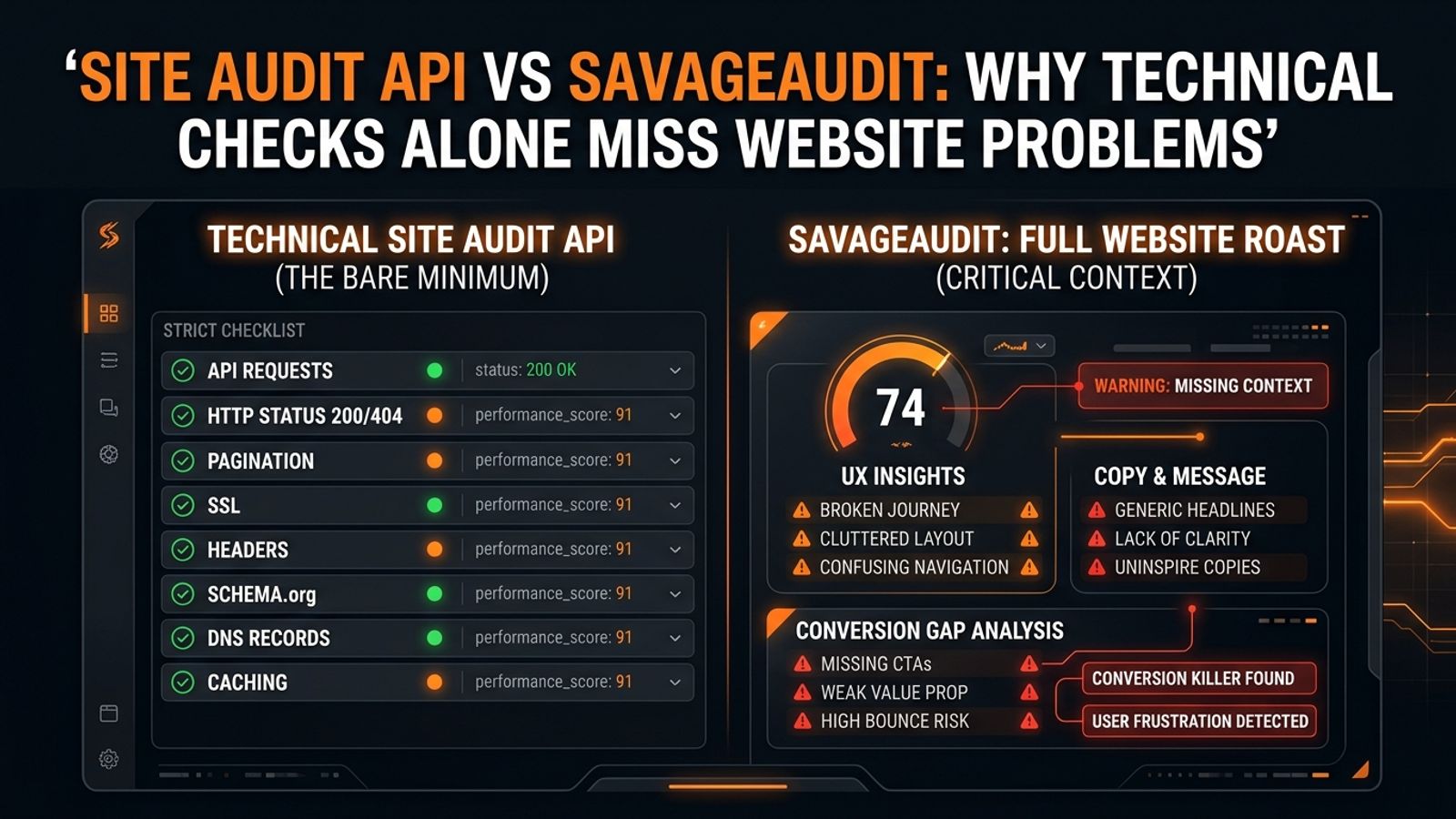
A site audit API provides programmatic access to technical website data, making it ideal for scalable SEO monitoring, finding broken links, and tracking performance metrics. However, these automated tools only measure what can be quantified. They miss subjective, human-centric problems like vague copywriting, confusing UX, weak trust signals, and poor conversion logic. SavageAudit fills this gap by offering a blunt, AI-driven critique of the actual page experience, evaluating how well a page persuades buyers and ranks in AI summaries.
A site audit API can reliably tell you your page has missing meta tags, slow load times, crawl errors, broken links, and a suspicious heading structure. It will not tell you that your homepage sounds like it was written by a committee hiding from revenue.
Developers, SEO teams, agencies, SaaS marketers, and founders often reach for an API because it feels clean. You send a URL, get structured data back, pipe it into a dashboard, trigger alerts, and ship the workflow. For technical SEO and scale, this makes perfect sense. APIs are excellent when the problem is measurable, repeatable, and rule-based.
But websites fail for reasons that do not fit neatly into a JSON payload.
SavageAudit is not an API-first technical crawler. It is a fast, blunt website roast and audit product built to critique the actual page experience across SEO, performance, design, copy, UX, conversion friction, trust signals, and AI visibility.
What a Site Audit API Is Good For
A site audit API gives programmatic access to audit data. Instead of manually clicking through a dashboard, your application requests an audit, retrieves the results, and feeds that data into your own systems.
A good SEO audit API answers critical technical questions by flagging missing title tags, duplicated meta descriptions, broken status codes, and malformed canonical tags. It identifies crawl traps, missing image alt text, and deteriorating performance metrics after a new release.
This level of structured data is highly useful for scalable crawling and scheduled technical monitoring. If you need to build internal dashboards, generate client reporting, set up regression alerts, or run bulk checks across thousands of URLs, an API is the right choice. Technical SEO debt is real. Broken templates, bad deploys, accidental noindex tags, and redirect chains quietly poison a site's search visibility. If your team manages a massive footprint, an API is often the only sane way to keep track of the technical mess.
Passing technical checks simply means the website passed technical checks. It does not mean the website is actually good.
The Problem With Automated Website Audit Output
An automated website audit is incredibly strong at things it can measure, but it struggles with things it must judge. Buyers experience your website as a story, a promise, a path, and a risk calculation—not a list of technical validations.
A crawler easily flags missing metadata. It completely misses positioning so generic your competitors could paste it onto their own homepage. An API reports a slow Largest Contentful Paint (LCP). It ignores a hero section that wastes its first five seconds saying “empowering teams to unlock transformation” instead of explaining what you actually sell. An SEO audit API identifies heading hierarchy problems without realizing that your perfectly structured H2s are commercially useless.
Most technical automated audits are inherently biased toward the obvious. They look for broken links, crawl errors, basic accessibility failures, and duplicate content patterns. You should absolutely fix those issues. However, the highest-leverage problems on a website are almost always human.
The headline is unclear. The offer lacks differentiation. The page has no credible proof, and the screenshots are decorative instead of explanatory. The pricing page creates anxiety rather than clarity.
This is why marketing and product teams get frustrated. They run an automated website audit, fix 37 structural issues, celebrate the new perfect score, and watch their conversion rates stay exactly the same. The audit graded a very narrow part of the problem.
Where SavageAudit Fits
SavageAudit is built specifically for the problems a technical crawler usually misses. It provides a no-signup, 60-second, free initial audit reviewing six core categories: Performance, SEO, Design, Copy, UX, and Conversion. It layers in live internet context and uses a 5-agent AI pipeline to deliver a blunt, personalized roast. The point is not just to find defects, but to explain why the page feels weak, confusing, slow, untrusted, or unconvincing to the person looking at it.
Websites do not fail in departmental silos. A landing page might have acceptable SEO, clean headings, and decent speed, yet still lose buyers because the core message is vague. It might feature strong copy and solid proof, but leak conversions because the mobile layout buries the CTA. Or it could have polished visuals and modern typography, but offer no real reason for a skeptical buyer to believe any of the claims.
SavageAudit is not trying to replace a deep technical crawler. Dedicated crawl tools are far better fits for domain-wide architecture mapping, large-scale technical issue discovery, and structured technical debt reporting. If you need to crawl 50,000 URLs and inventory technical debt, use a crawler or an API.
SavageAudit is for the team asking why their homepage fails to persuade.
Site Audit API vs SavageAudit: The Practical Difference
A site audit API gives you raw data, while SavageAudit provides a diagnostic critique. Confusing their purposes will make your website optimization workflow highly inefficient.
A site audit API excels when the work needs to be repeatable, structured, machine-readable, large-scale, and technically objective. It is the perfect tool for building an SEO health dashboard, a client reporting portal, a release QA check, or a multi-site agency reporting process. Developers and technical SEO teams prefer APIs because JSON is much easier to route through systems than a strategist’s subjective feedback.
SavageAudit is strong when the work needs to be interpretive, cross-functional, buyer-aware, and bluntly prioritized around the current page experience. It evaluates whether the page explains the offer clearly, if the design guides attention or scatters it, and if the copy actively answers objections.
SavageAudit uses data—including performance and SEO signals—but the output is positioned around data-backed, roast-style feedback. Telling a team “your hero section lacks clarity” is polite and easily ignored. Pointing out that “no one knows what you sell above the fold” gets fixed.
Technical Checks Matter. They Are Just Not Enough.
Technical checks are not busywork. A site with broken crawlability, poor performance, missing metadata, and busted mobile rendering is simply broken. SavageAudit itself includes performance and SEO in its core audit categories, utilizing real Lighthouse data for performance metrics like LCP, CLS, FCP, and TBT alongside SEO checks for meta tags, heading hierarchy, and robots.txt.
The argument is that technical audits are incomplete.
Consider a page that passes SEO but fails on clarity. An SEO audit API might report that your title tag, H1, and meta description exist, and that the page is indexable. But if that H1 says, “The modern platform for teams that want to move faster,” it could describe project management software, DevOps tooling, HR automation, or a motivational poster. The technical check passes, but the buyer has no idea what you do.
The same applies to performance. Speed prevents you from burning attention before the pitch begins, but speed itself is not persuasion. A fast-loading vague page just disappoints people sooner. A technical tool verifies the speed, while SavageAudit critiques whether the page used that speed to deliver an actual message.
Automated tools also struggle with logic and trust. An automated website audit can count CTA buttons, but asking a cold visitor to “Book a Demo” before explaining the product is premature. A crawler might detect testimonials, but it won't judge whether the proof is credible. “Trusted by innovative teams worldwide” is wallpaper. Real trust signals show specifics—who uses you, what result happened, and why the buyer should believe you.
Why AI Visibility Makes the Gap Bigger
Search behavior is changing. People are asking AI systems for answers, comparisons, summaries, and recommendations. This shift makes thin content far more dangerous than it used to be.
A traditional SEO audit API confirms whether a page has headings, metadata, and indexability. AI visibility depends on whether your content is clear, answerable, structured, specific, and credible enough to be understood and summarized by AI-driven systems (AEO and GEO).
Many SaaS sites have pages full of marketing claims but lack answer-ready substance. They offer no direct definitions, no comparison content, no concrete use cases, and no pricing clarity. There is no objection handling and no specific customer language. To rank in AI summaries, a page must be easy to understand, summarize, compare, and trust. An API will catch missing schema markup, but it will completely miss missing substance.
Competitor Benchmarking: Where Raw API Data Gets Thin
Technical APIs can compare sites on crawl health, status codes, performance, and missing tags. While useful, that data does not answer why a competitor's landing page feels more convincing than yours.
SavageAudit Compare offers page-to-page benchmarking to answer that exact question. It runs two individual page audits using the same persona and heat level, then compares them across SEO, design, copy, UX, and conversion.
Competitor gaps are rarely just technical. Your competitor likely wins because their headline is clearer, their proof appears sooner, and their CTA matches buyer intent. Their page structure handles objections better, and their design creates more trust. A site audit API helps you see if their plumbing is cleaner, but SavageAudit’s comparison flow judges the page experience itself.
The Best Workflow: Use Both
The smartest teams do not argue over whether technical audits or practical critiques matter more. They use both.
A highly effective workflow relies on a site audit API to catch crawlability, metadata, performance, indexability, structural, and template issues. You fix those technical blockers first, because copy cannot save a page that takes forever to load or cannot be indexed by search engines.
Once the foundation is stable, you run SavageAudit on key pages—the homepage, pricing page, product page, comparison pages, and paid landing pages. This allows you to prioritize the conversion and trust issues that stop humans from understanding and acting. You can then use SavageAudit Compare for page-to-page benchmarking against key competitors, and re-test after changes are made.
The API watches the machinery. SavageAudit judges the pitch.
Bottom Line
Technical checks tell you what is broken in the machinery. SavageAudit tells you why the buyer still does not care.
Common questions
What is a site audit API?
A site audit API is a programmatic interface that lets software trigger website audits, crawl pages, and retrieve structured issue data. It is commonly used for technical SEO checks, reporting dashboards, monitoring workflows, and large-scale site analysis.
Is a site audit API the same as an SEO audit API?
Not always, but they heavily overlap. An SEO audit API usually focuses on search-related checks such as metadata, headings, indexability, links, crawl errors, and on-page SEO signals. A broader site audit API may also include performance, accessibility, or site health metrics.
Can an automated website audit replace a practical website review?
No. An automated website audit catches technical and rule-based issues, but it misses judgment-heavy problems like unclear positioning, weak CTAs, poor trust signals, confusing UX, vague copy, and thin answer-ready content.
Is SavageAudit a site audit API?
No. SavageAudit is not positioned as an API-first technical crawler. It is a fast, blunt website roast and audit product focused on practical critique across performance, SEO, design, copy, UX, conversion friction, trust signals, and AI visibility.
Should agencies use a site audit API or SavageAudit?
Both fit into a healthy agency workflow. Use a site audit API for scalable technical reporting across all clients. Use SavageAudit when you need a sharp critique of key pages before redesigns, landing page updates, SEO content upgrades, paid campaigns, or conversion rate optimization projects.
Keep the diagnosis moving
Run your own public presence audit
See how your website, search footprint, AI visibility, social proof, and conversion trust look from the outside.