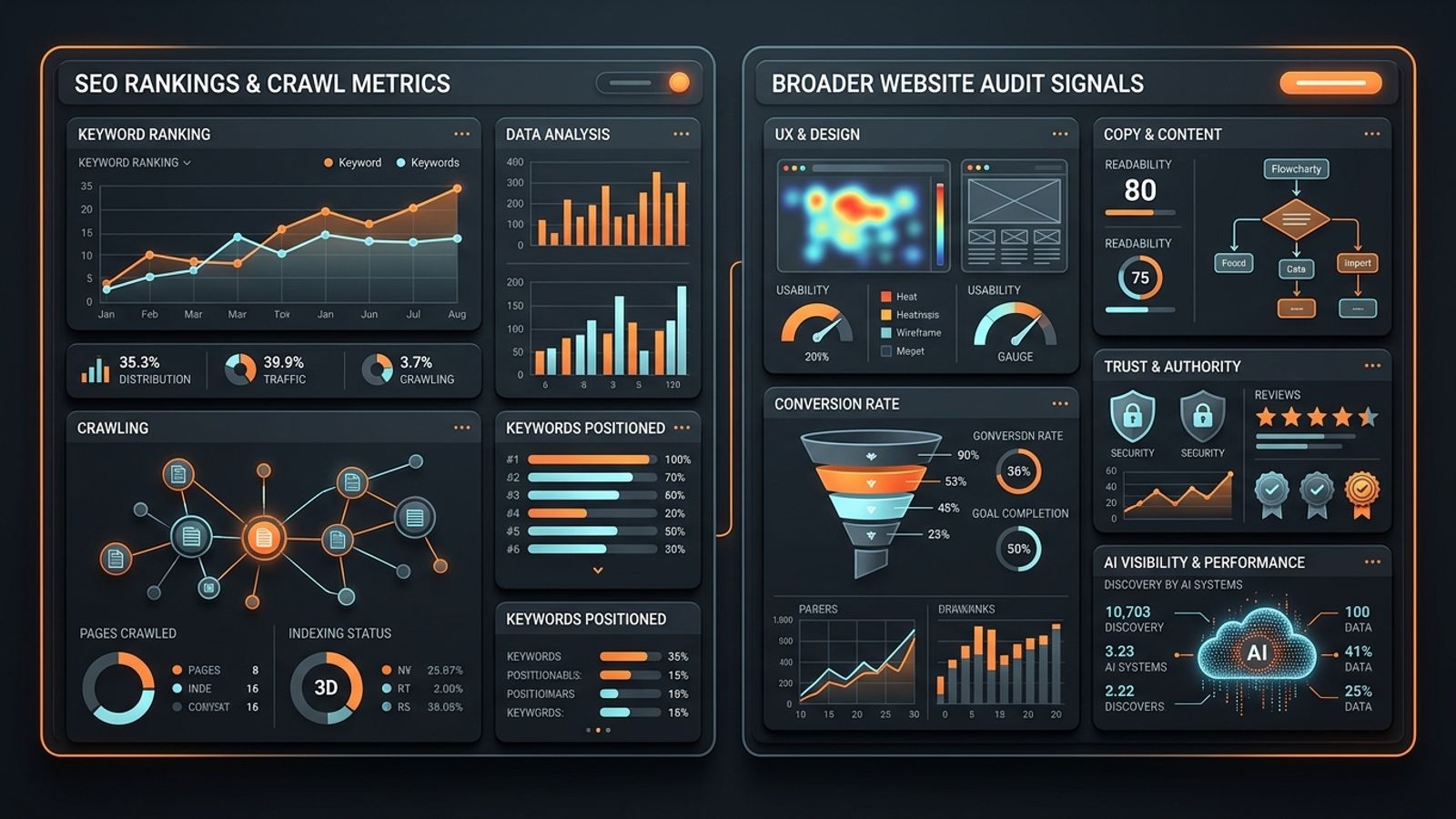
An SEO audit is a narrow review of search visibility, evaluating technical health, metadata, and indexation to ensure search engines can crawl your site. A website audit is a holistic review of the site as a business asset. It evaluates performance, design, copy, UX, conversion, and AI visibility to ensure humans and AI systems can understand, trust, and act on your pages. While an SEO audit is necessary for traffic, a full website audit is required to fix conversion and pipeline problems.
If your site ranks but fails to convert, the underlying problem is almost certainly bigger than your search strategy.
Teams frequently request an “SEO audit” when they actually need a full diagnostic of why their site fails to explain, persuade, load, guide, prove, or convert. The distinction is straightforward but critical. An SEO audit focuses on whether search engines can crawl, index, and rank your pages. A website audit asks a much broader question, evaluating whether humans, buyers, stakeholders, and AI systems can actually understand, trust, and act on your site.
Understanding this difference is the core of the website audit vs SEO audit conversation. Search optimization is one component of the machine, but the website is the entire machine.
SavageAudit was built to handle this broader scope rather than acting as a narrow SEO crawler. It evaluates sites across Performance, SEO, Design, Copy, UX, and Conversion, augmenting the analysis with live brand, review, and internet context where relevant. A comprehensive audit doesn't stop at flagging a missing title tag. It interrogates whether your headline clearly states your value, if your primary call-to-action is obvious, whether your mobile navigation is painful, and if modern AI systems can extract and cite what you actually do.
Website Audit vs SEO Audit: The Short Version
An SEO audit is a structured, focused review of search visibility. It evaluates technical health, content quality, and infrastructure elements like metadata, heading hierarchy, robots.txt, and indexation to ensure search engines can access and understand your site.
A website audit is a holistic review of the site as a business asset. SavageAudit’s website audit categories treat the site as an interconnected system, benchmarking how traffic, story, design, trust, SEO, and action align.
| Question | Narrow SEO Audit | Full Website Audit |
|---|---|---|
| Can search engines crawl and understand the site? | Yes | Yes |
| Are titles, descriptions, headings, and robots handled correctly? | Yes | Yes |
| Does the page load and behave properly? | Sometimes | Yes |
| Is the design credible? | Usually limited | Yes |
| Is the copy clear and persuasive? | Sometimes | Yes |
| Does the UX create friction? | Usually limited | Yes |
| Are CTAs obvious and convincing? | Usually limited | Yes |
| Are trust signals visible near decision points? | Sometimes | Yes |
| Is the page ready for AI visibility review? | Sometimes | Yes, if included |
| Does the report help product, design, marketing, and engineering prioritize fixes? | Not always | It should |
While an SEO audit is a necessary step for traffic growth, it is rarely sufficient on its own for solving revenue or pipeline problems.
What Does It Mean to Audit a Website?
To audit a website is to measure how well it performs its actual job. For most SaaS, service, product, and B2B companies, a website is a working asset with a specific set of responsibilities. It needs to get found, load quickly, explain the offer plainly, build trust, remove friction, drive the next action, and make the brand understandable to both human visitors and AI systems.
A standard SEO audit primarily covers the discovery phase. A real website audit evaluates the entire chain of events. The goal isn't to generate a theoretical score but to expose exactly where the site is leaking attention, clarity, trust, and conversion pressure.
What an SEO Audit Actually Finds
A competent SEO audit is highly valuable for catching expensive technical and structural problems. When important pages are blocked, misindexed, duplicated, poorly titled, or technically slow, search visibility suffers.
A typical SEO audit reviews page titles, meta descriptions, heading structures, canonicals, robots.txt, XML sitemap logic, internal linking, and overall crawlability. It also looks at keyword targeting, structured data, and search performance metrics if platforms like Google Search Console are connected. SavageAudit includes this fundamental SEO layer, checking basics like meta tags, robots.txt, and heading hierarchy to catch the errors your technical team should have already handled before launch.
Resolving these issues is vital for discovery, but it leaves a massive blind spot regarding what happens after a visitor clicks the link. An SEO audit might confirm your page is visible to Google, but it won't tell you that your hero section sounds like a generic corporate word salad. It won't flag that your pricing page hides the exact numbers buyers came for, or that your mobile form is a rage-click hotspot.
Many teams fall into the trap of "fixing SEO" and watching their traffic improve, only to realize their site still underperforms because the underlying page experience is fundamentally weak.
What a Website Audit Finds That an SEO Audit Can Miss
A full website audit treats the site as an ecosystem where technical health, narrative, and user experience overlap. The evaluation moves past asking how to get traffic and focuses on how to turn that attention into meaningful action. SavageAudit reviews this system across six primary pillars, deliberately breaking away from the narrow focus of traditional crawlers.
1. Performance: Respecting the Visitor’s Time
Performance metrics shape the user's first impression long before they read your copy. SavageAudit uses actual Lighthouse data to measure Largest Contentful Paint (LCP), Cumulative Layout Shift (CLS), First Contentful Paint (FCP), and Total Blocking Time (TBT).
Instead of just flagging a slow load time, a broader audit connects performance directly to user experience. It looks for late-loading hero sections that leave visitors staring at a blank screen, layout shifts that cause accidental misclicks on mobile devices, heavy scripts bogging down the browser, and pages that feel generally sluggish. A narrow SEO tool might warn you about speed for ranking purposes, but a website audit highlights how a three-second delay actively damages your conversion rate.
2. Design: Building Visual Credibility
Design serves as your trust infrastructure. A page can have perfectly optimized metadata and still look like a neglected staging environment, which immediately repels potential buyers. SavageAudit’s design review evaluates visual hierarchy, color contrast, typography, and the presence of credibility signals.
Common design failures include layouts where every element has the exact same visual weight, effectively burying the primary call-to-action. Poor contrast makes scanning difficult for users trying to skim your features, while generic typography fights the core message of a premium product. When proof elements like client logos are shoved below generic feature blocks, the design feels cheaper than the offer. SEO crawlers ignore visual credibility, but human buyers rely on it to make split-second purchasing judgments.
3. Copy: Creating Absolute Clarity
Most underperforming website copy isn't necessarily poorly written; it is simply unclear. It relies on internal jargon, fake differentiation, and vague promises, forcing the visitor to work too hard to figure out what the product is, who it is for, and why they should care.
SavageAudit assesses headline clarity, messaging coherence, and CTA strength. The SavageAudit startup website checklist outlines practical rules for this evaluation. For example, the homepage headline must describe the product rather than just an ambition, and the target user should be obvious to an outsider without reading the entire page. Furthermore, the subhead needs to state the outcome in plain language, and the primary CTA must be specific. Clear copy isn't just a marketing preference—it is structural conversion infrastructure.
4. UX: Removing Navigation Friction
User experience problems often hide in plain sight because internal teams already know how to navigate their own site. Visitors arrive cold, impatient, and looking for immediate answers. SavageAudit’s UX layer checks navigation depth, mobile layout, form friction, and user-flow dead ends to identify rage-click hotspots.
A thorough UX review catches important pages buried three clicks deep, navigation labels that mirror internal organizational charts instead of real user questions, and mobile layouts that break the buying path. It flags forms that demand too much information too soon and pages with multiple CTAs fighting for attention. A clean XML sitemap won't save a confusing user journey.
5. Conversion: Earning the Action
Traffic without conversion is just rented attention. A conversion review determines whether a page provides enough clarity, confidence, and proof for a visitor to take the next step. SavageAudit evaluates CTA placement, trust signals, and social proof.
This process involves asking if CTAs are placed where user intent is highest and if they clearly explain the post-click step. It requires checking if testimonials are specific and verifiable rather than decorative, and whether logos, case studies, or security claims are visible near actual decision points. Often, what teams categorize as an SEO problem is actually a conversion problem wearing a traffic mask. The visitor arrived, but the page simply didn't earn the action.
6. AI Visibility: Preparing for Answer Engines
Modern search extends beyond classic blue-link rankings. Brands now need to know if their content is clear, extractable, attributable, and supported by evidence so AI systems and answer engines can cite them accurately.
SavageAudit approaches this challenge from two distinct angles. The SEO + GEO Audit Tool focuses on page-level readiness, connecting traditional metadata and headings with AI entity posture, extractable proof, and answer-ready blocks. Meanwhile, the AI Visibility Audit zooms out to assess the brand's overall citation readiness. It evaluates crawl posture, entity signals, the proof footprint, and public evidence to determine if a brand can be trusted by AI search engines. If your site's narrative is vague to human readers, it will be equally opaque to machine-learning models trying to extract facts.
Types of Website Audits Teams Actually Need
The term "website audit" is heavily overloaded. Before initiating a review, teams should be specific about the exact diagnostic they require to avoid wasting time on the wrong metrics.
Technical SEO Audit: Best utilized when search access is the primary suspected problem. It focuses on crawlability, indexation, redirects, metadata, canonicals, robots.txt, sitemaps, and ranking-related technical issues.
Full Website Audit: Best for diagnosing the entire site experience, including performance, SEO, design, copy, UX, conversion, and recurring template issues. SavageAudit’s Full Website Audit Tool runs a representative crawl sampling homepages, pricing, key landing pages, blogs, and trust-critical pages. It produces a unified site audit report with category-level scoring and a defensible, prioritized fix sequence.
AI Visibility Audit: Best for understanding whether AI systems can extract, attribute, cite, and trust your brand. Use this when your growth strategy relies heavily on GEO, AEO, and answer-engine discoverability.
Launch Readiness Audit: Essential before a startup launch, relaunch, redesign, or major migration. A credible launch requires, at minimum, a clear homepage, a primary product or service page, a working conversion path, and published trust pages like About, Privacy, and Terms.
When You Only Need an SEO Audit
You don't always need to tear down the entire house to fix a leaky pipe. A focused SEO audit is the right choice when your primary bottleneck is search discoverability.
If you recently migrated to a new CMS and organic traffic dropped, or if Search Console is flagging indexing anomalies, a technical search review is exactly what you need. It is also the right move if important pages aren't being crawled, you suspect canonical errors, or you are stuck on page two and need targeted content cleanup. If your site already converts well but organic traffic volume is weak, focus strictly on search.
For these scenarios, SavageAudit’s SEO + GEO Audit Tool bridges the gap by evaluating traditional SEO requirements alongside AI-driven visibility signals. However, avoid using an SEO audit as a shield against harder business questions. If the underlying page is confusing, slow, or unconvincing, your ceiling isn't your search strategy—it's the website itself.
When You Need a Full Website Audit
A full website audit is necessary when performance issues aren't clearly isolated to search. The signs are usually obvious to operators paying attention to the entire pipeline.
You might have decent traffic volume, but the leads generated are weak. Paid campaigns might send visitors who immediately bounce or stall out on the pricing page. Sales teams might complain that inbound prospects fundamentally misunderstand the product before they even get on a call. Often, the homepage has been rewritten by committee so many times that it looks credible to insiders but generic to everyone else.
When nobody can agree whether the bottleneck belongs to SEO, product marketing, design, engineering, or sales, a full audit creates a shared, objective diagnosis. One vague headline is a copywriting issue, but vague positioning across the homepage, product pages, and pricing page is a systemic business communication problem. A real website audit exposes these patterns so cross-functional teams can align on a unified fix sequence.
How SavageAudit Fits the Whole Machine
Websites fail in highly connected ways. A technically slow page immediately degrades the user experience. Poor UX introduces friction that damages conversion rates. Weak copy makes hard-earned SEO traffic practically useless. A lack of visible proof reduces buyer trust and weakens AI citation readiness, while sloppy design makes a legitimate company look unserious.
SavageAudit’s process uses a five-agent pipeline—visual analysis, Lighthouse data, external context gathering, roast writing, and a quality check—to produce a final, data-backed verdict. The goal is to make these interconnected issues visible enough that teams can stop debating internal opinions and start implementing actual fixes.
No audit tool can guarantee rankings, citations, conversions, or revenue. What a strong audit provides is an evidence-backed roadmap. You can use the website audit categories to understand the framework, run the full site audit for a site-wide verdict, deploy the SEO + GEO audit for search and extraction readiness, or use the AI visibility audit to check your brand's trust signals.
The most important step is choosing the diagnostic tool based on the actual business problem you need to solve, rather than just defaulting to the department asking for the report. If your search visibility is strong but your pipeline is weak, you don't need another keyword report. You need to fix the machine.
Common questions
What is the main difference between a website audit and an SEO audit?
An SEO audit focuses strictly on search engine visibility, analyzing factors like crawlability, indexing, metadata, headings, technical SEO, and ranking-related signals. A website audit takes a broader approach. It includes SEO but also reviews overall site health, user experience, performance, design credibility, copy clarity, conversion friction, and AI visibility.
Is an SEO audit part of a website audit?
Yes. SEO is a critical component of a full website audit. SavageAudit’s six-category framework integrates SEO alongside Performance, Design, Copy, UX, and Conversion to ensure the site is both discoverable and effective for human users.
When should I choose an SEO audit instead of a full website audit?
Choose a focused SEO audit when your primary problem is organic discoverability. If you are dealing with indexing errors, ranking drops, weak metadata, or crawl anomalies—and your site already converts visitors effectively—a narrow search visibility review is likely sufficient.
Can a website rank well and still need an audit?
Absolutely. High search rankings do not guarantee that a site persuades visitors or drives revenue. A page can attract significant organic traffic while suffering from weak copy, poor UX, thin proof, confusing CTAs, or major credibility problems. Search rankings only solve the discovery part of the problem.
Keep the diagnosis moving
Run your own public presence audit
See how your website, search footprint, AI visibility, social proof, and conversion trust look from the outside.