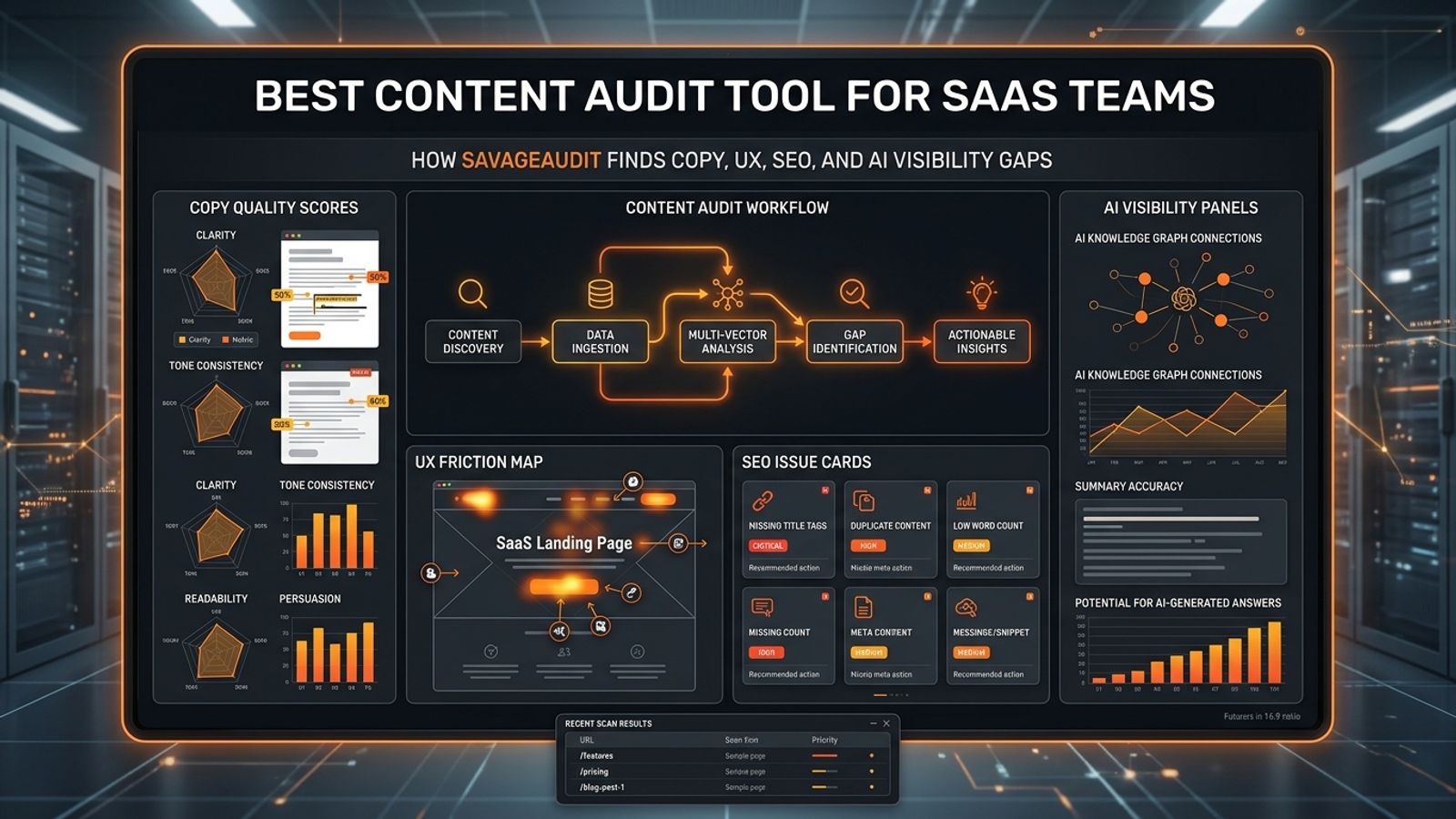
Most content audits just check word counts and missing meta tags. For SaaS teams, the best content audit tool must evaluate whether a page actually helps a buyer understand, trust, and choose the product. SavageAudit exposes gaps in copy clarity, UX friction, conversion paths, trust signals, and AI visibility. It moves beyond basic SEO hygiene to provide blunt, actionable feedback that improves both human persuasion and answer-engine readiness.
Most content audits are little more than spreadsheet theater. You run a crawl, export a massive list of URLs, and spend hours staring at missing meta descriptions or flagging word counts. Baseline data like this has its place, but for a SaaS team trying to turn confused visitors into actual pipeline, it completely misses the point.
The best content audit tool needs to look past basic SEO hygiene to answer a much harder question: Does this page actually help a buyer understand, trust, and choose the product?
A true SaaS content audit evaluates copy clarity, UX friction, conversion paths, trust signals, product positioning, and AI visibility. SavageAudit is a fast, blunt website audit product built to expose exactly these gaps. Rather than acting as a traditional bulk inventory platform, it reviews the page experience across Performance, SEO, Design, Copy, UX, and Conversion. It pairs real Lighthouse metrics with direct, evidence-based critique.
SavageAudit also offers an AI visibility audit to evaluate whether your brand's content is ready to be cited, extracted, and attributed by AI search and answer engines. This involves looking closely at crawl posture, entity signals, public evidence, proof footprint, and answer-ready structure.
SaaS content rarely fails just because rankings drop. It fails when buyers land on a page and still cannot figure out what the product does or why they should believe your claims. If your audit software ignores messaging and friction, you are just auditing formatting.
---
Quick Answer: What Is the Best Content Audit Tool for SaaS Teams?
For marketing and growth teams, the ideal content audit goes beyond keyword coverage and stale pages. It evaluates whether your site explains the offer clearly, matches search intent, answers buyer objections, builds trust with concrete proof, and reduces conversion friction.
| Approach | What It Checks | Turnaround | Conversion Actionability |
|---|---|---|---|
| SavageAudit | Copy clarity, proof density, UX friction, search intent, and AEO citability | 60 seconds | High: Exact roast lines and prioritized fix path |
| Manual Spreadsheet Audit | Page URLs, word count, meta tags, and subjective notes | 2 to 4 weeks | Low: Trapped in spreadsheet theater without clear verdicts |
| Traditional SEO Crawlers | Index status, broken links, keyword density, and title tags | 15 to 45 minutes | Medium: Catches technical hygiene but ignores copy and conversion |
| Grammar & Readability Checkers | Spelling, passive voice, reading level, and tone score | Instant | Low: Grammatically perfect copy can still completely fail to convert |
Ready to inspect your SaaS website copy and conversion funnel? Run our free SaaS Content Audit Tool or compare your landing page against your top competitor in Compare Mode.
SavageAudit is a strong fit for SaaS teams that need actionable feedback across copy, UX, SEO, conversion, performance, trust signals, and AI visibility in a single page-level review.
---
What SaaS Teams Usually Get Wrong About Content Audits
Standard audits check for duplicate content, broken links, and indexability. Treating those technical checks as the finish line is a massive mistake.
SaaS content sits inside a complex buying journey where your homepage, comparison pages, and blog posts all influence trust. Missing tags might cost you a few clicks in the SERPs, but a mushy headline kills the entire session. Ranking in position five means nothing if the page attracts the wrong search intent, buries the product explanation, and ends with a weak CTA.
SavageAudit’s founder-focused philosophy treats a startup website as a positioning document, a sales rep, a trust filter, and an onboarding surface all at once. Your content is part of the sales system, not just decoration.
---
What Website Content Audit Software Should Actually Check
When evaluating website content audit software for a SaaS company, stop asking only if it can crawl pages. You need to know if it can find the gaps that make buyers hesitate.
Offer Clarity
SaaS pages are notorious for using vague, category-level language like "Empower teams to unlock operational excellence." Visitors need to know exactly what the product does, who uses it, and the expected outcome. Useful audit software flags headlines that describe a broad category rather than a specific deliverable. It points out feature lists lacking business outcomes and CTAs that appear long before the value is established. SavageAudit tackles this by reviewing headline clarity and messaging coherence directly.
Buyer Objection Coverage
Good content answers objections before a sales rep gets involved. Buyers want to know about integrations, implementation difficulty, competitive advantages, and pricing transparency. Traditional tools miss this entirely because objections do not trigger crawler warnings. There is no technical SEO error for a vague testimonial. A proper SaaS content audit examines whether each page supports a decision by evaluating human behavior and conversion psychology.
UX and Conversion Friction
Strong messaging trapped inside a confusing layout will still fail. A thorough audit identifies buried CTAs, navigation menus that hide pricing, forms asking for too much information too early, and mobile layouts breaking the reading flow. SavageAudit looks for these exact issues—including navigation depth and form friction—while reviewing conversion factors like contact accessibility. Buyers convert when a page reduces uncertainty.
Trust Signals and Social Proof
Slapping five random company logos on a page is a weak strategy. A serious review inspects whether customer logos have relevant context, if testimonials are tied to specific outcomes, and whether case studies offer concrete before-and-after details. SavageAudit evaluates design credibility, visual hierarchy, and trust signals. Its AI visibility audit also weighs public evidence and your proof footprint, recognizing that AI visibility heavily depends on extractable structure and credible public anchors.
---
SEO Still Matters. Keyword Tunnel Vision Does Not.
A good audit should absolutely review heading structure, indexability, robots.txt issues, orphaned pages, and internal linking. SavageAudit checks this core SEO hygiene alongside its qualitative reviews.
Its Google Search Console website audit workflow takes this further by turning GSC data into prioritized fixes. It looks at queries, clicks, impressions, and CTR to classify branded versus non-branded intent, map queries to ranking URLs, and identify cannibalization.
The goal is prioritizing fixes by business value. Not every declining blog post deserves a refresh. The audit should help you decide which pages support pipeline and which simply need a clearer CTA. Keyword coverage is just one input, not the entire strategy.
---
Why AI Visibility Belongs in a SaaS Content Audit
Traditional SEO asks if a page can rank. AI visibility asks if a brand can be understood, extracted, attributed, and cited by answer engines.
SavageAudit’s AI visibility audit evaluates content readiness for these new contexts by analyzing signals beyond traditional SEO, such as crawl posture, entity signals, hint readiness, and public evidence. AI-ready SaaS content is clear about the entity (the company, product, and category), specific about use cases, structured with direct answers, and supported by public proof.
SavageAudit provides a practical ready/not-ready readout and a fix path for cleaner evidence. Bluntly: if your own website cannot explain the company clearly, AI systems won't be able to either.
---
How SavageAudit Works as a Content Audit Tool
SavageAudit avoids the generic spreadsheet export entirely. It is a fast website roast and audit product built to expose blind spots.
The audit runs through a five-agent processing pipeline: visual analysis, Lighthouse data, external context gathering, roast writing, and a quality check. It can pull in live brand, review, and internet context to tailor the feedback. The output provides evidence-based verdicts, concrete fix suggestions, and shareable screenshots, making it ideal for reviewing high-value surfaces like the homepage, pricing page, and high-intent SEO landing pages.
---
A Practical SaaS Content Audit Workflow
Here is a practical way to start auditing your content without getting bogged down in endless data exports.
Step 1: Start With Revenue-Relevant Pages
Ignore the old blog posts from four years ago. Focus on the pages closest to revenue: the homepage, pricing page, demo page, top use cases, and highest-intent SEO pages. If these core pages are weak, fixing top-of-funnel awareness content will not save your pipeline.
Step 2: Run Each Page Through SavageAudit
Enter the public URL to get feedback across performance, search visibility, design clarity, copy quality, UX, and conversion. This is where the integration of real Lighthouse metrics—like LCP, CLS, FCP, and TBT—comes in, pinpointing the exact causes of slowness without requiring a separate developer tool.
Step 3: Separate Technical Issues From Persuasion Issues
Technical bugs like broken links are easy to assign and ticket. Persuasion gaps—vague value propositions, weak CTAs, missing proof—require harder conversations. Most teams fix the technical bucket and ignore the persuasion bucket. SavageAudit forces both discussions.
Step 4: Use Search Data to Prioritize
If you use Google Search Console data, map queries to ranking URLs to identify low CTR or wrong intent. GSC shows search performance but cannot judge copy quality. If a page gets traffic but poor conversions, audit the copy, CTA, proof, and UX. Data tells you where to look; a blunt page audit tells you what is actually broken.
Step 5: Add an AI Visibility Review
Run AI visibility checks on core brand and category content. Ensure each page clearly names the product, defines the audience, provides concise answers, and has extractable structure. If your content lacks credible public anchors, it will struggle to surface in answer-engine contexts.
---
What SavageAudit Catches That Basic Content Audit Software Misses
Traditional content audit software tends to focus on quantitative metrics, noting if a page has 900 words, missing alt text, or a lengthy title tag.
SavageAudit, on the other hand, prioritizes qualitative persuasion. It highlights when your headline makes the product sound interchangeable with competitors or if a CTA asks for a demo long before earning any trust. Where a standard crawler simply charts a traffic decline, this tool reveals if a page is technically optimized around a keyword but fundamentally weak as a buyer-decision asset. By critiquing weak social proof, unclear navigation, and messaging coherence, it helps SaaS teams make better decisions instead of just handing them a longer export file.
---
Who Should Own the SaaS Content Audit?
A highly effective SaaS content audit is a cross-functional effort.
Founders need to clarify positioning. Content marketers assess page quality and intent fit. SEO teams bring the query and ranking data, while product marketers pressure-test differentiation. Demand generation teams must review landing pages before paid traffic exposes weak messaging, and growth operators turn these findings into measurable fixes.
SavageAudit gives all these roles a shared artifact: a direct, undeniable critique of what is working and what needs fixing, eliminating vague debates about whether the hero section "feels right."
---
Final Take
A SaaS content audit should never be a vanity cleanup project. It needs to expose exactly why buyers hesitate, why pages fail to convert, and why AI systems might struggle to understand your brand.
The best audit tool isn't the one that generates the most rows of data; it's the one that tells you the truth the fastest. SavageAudit achieves this by combining technical diagnostics, page-level critique, conversion review, and AI visibility into a blunt workflow. If your SaaS site is vague, slow, unconvincing, hard to navigate, or weak in answer-engine readiness, you need a tool that will directly point out the friction so you can finally fix the leak.
Common questions
What is the best content audit tool for SaaS teams?
The best tool is one that reviews copy clarity, UX, conversion friction, trust signals, performance, SEO, and AI visibility. SavageAudit fits the bill for blunt, page-level feedback rather than just a spreadsheet of URLs.
How is a SaaS content audit different from a normal content audit?
Normal audits focus heavily on inventory, rankings, and technical SEO. A SaaS content audit goes further to judge whether pages explain the product, answer objections, build trust, and move visitors toward a signup or demo.
Does SavageAudit replace Google Search Console?
No. Google Search Console is essential for performance data like queries, clicks, impressions, and CTR. SavageAudit reviews the qualitative, page-level issues that GSC cannot judge, including copy quality, trust, UX, and conversion readiness.
Why does AI visibility matter in a content audit?
Content must be understandable beyond traditional search results. You need extractability, attribution, entity clarity, and public evidence for answer engines to confidently cite your brand.
What pages should a SaaS team audit first?
Always start with revenue-relevant pages: the homepage, pricing page, demo page, core product pages, feature pages, use case pages, comparison pages, and high-intent SEO landing pages.
Keep the diagnosis moving
Run your own public presence audit
See how your website, search footprint, AI visibility, social proof, and conversion trust look from the outside.