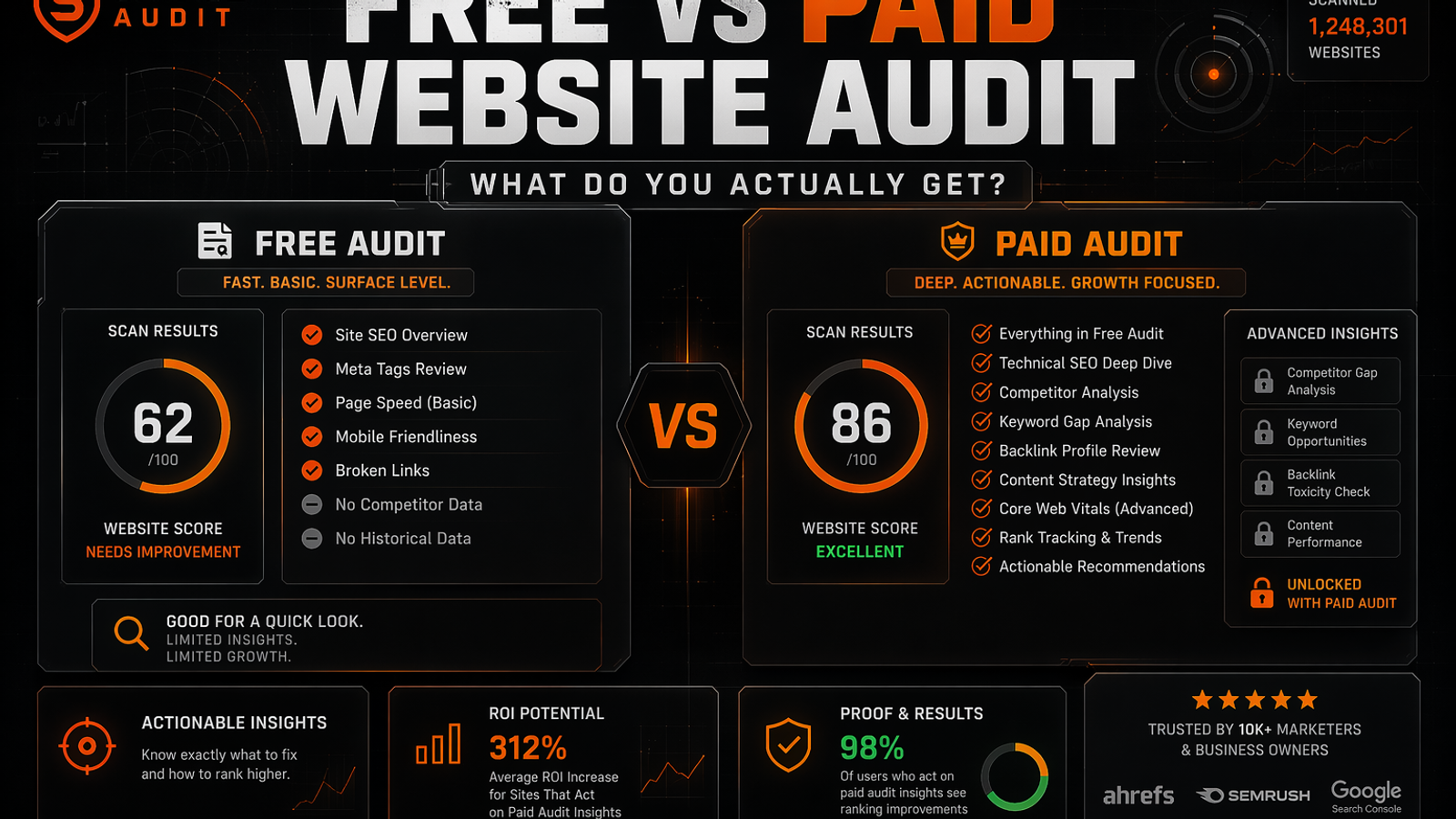
A free website audit tool is excellent for catching basic technical SEO errors like broken links and missing tags. However, paid audits provide strategic prioritization, business context, and deep analysis of UX friction, copy clarity, and conversion leaks. While free scanners give you a list of unweighted issues, a paid review delivers a prioritized action plan tailored to your business goals.
Staring at a free website audit tool report with 170 red errors is a SaaS rite of passage. You download the PDF, note the missing canonical tags, wince at a slow image warning, and send the link to engineering. The plumbing gets fixed. Yet, your paid traffic continues to bounce, and your pipeline remains dry.
Basic scanners catch mechanical problems: missing title tags, broken links, and slow pages. Fixing these errors is mandatory because a site with broken fundamentals will not rank. However, free-first tools are designed strictly to detect what software can parse cleanly. They hit a wall when a problem requires judgment. A crawler cannot tell you that your positioning is vague, your social proof is buried, your call-to-action is confusing, or your homepage technically passes while failing to explain what your product actually does.
A free audit gives you findings. A paid website audit should give you judgment. When an agency or SaaS team invests in a paid review, the output must deliver prioritization, business context, and a fix plan. Otherwise, you did not buy an audit—you just paid for a longer report.
Scanners vs. decision engines
Free scanners belong at the start of your workflow. They provide a low-friction first pass to catch obvious technical errors.
Paid audits step in when your team needs prioritized fixes, business context, and a ruthless diagnosis of the user experience. A serious paid review translates technical issues into business risk, delivering a practical action plan your team can actually ship. It evaluates copy, positioning, and conversion friction alongside standard SEO health.
This distinction matters heavily for founders, marketers, and product teams. Your website is not just a collection of crawlable URLs. It is a sales surface, a product explainer, a trust filter, and a conversion engine.
Why free website audit tools are popular
Automated scanners remove friction from the discovery process. Paste a URL, and you immediately receive a score or a downloadable website audit report.
Well-known SEO platforms position their free offerings around fast scans and issue lists. Ahrefs describes its site audit as a way to identify and fix over 170 technical and on-page SEO issues. Semrush frames its free checker around finding critical issues quickly, reserving deeper site-wide analysis for upgraded tiers. AIOSEO and Rank Math focus their analyzers on generating free reports with suggested fixes to improve baseline visibility.
For a team just starting to look at their search health, a free seo audit tool answers the most basic questions quickly. It will tell you if a page is indexable, whether title tags and meta descriptions exist, and if there are obvious crawl problems. You should not pay a consultant just to discover your site is blocking search engines or missing basic heading structures. Just remember that uncovering an issue is very different from knowing how to fix it within the context of your business.
What a free website audit tool usually gives you
Most automated tools excel at detecting quantifiable signals. Standard technical checks reliably flag missing metadata, duplicate descriptions, broken links, robots.txt conflicts, and canonical tag errors. These are table stakes for a free website seo audit. Fixing the plumbing is mandatory before optimizing button copy.
Alongside crawlability, standardized performance checks provide a baseline. SavageAudit uses Lighthouse metrics such as Largest Contentful Paint (LCP), Cumulative Layout Shift (CLS), First Contentful Paint (FCP), and Total Blocking Time (TBT) to measure performance. Speed directly impacts the user experience, especially on mobile devices, where slow load times increase bounce rates.
Finally, health scores make ambiguity look manageable. Most platforms generate a score out of 100 alongside simple recommendations like compressing images or adding alt text. While this advice is technically correct, it is often unweighted. A page can score a 95 and still fail to convert visitors because the copy is incomprehensible. A missing alt tag on a blog post and a broken demo button on a pricing page might both be flagged as errors, but they carry drastically different business risks.
What free audit tools often miss
Your biggest bottleneck might be entirely invisible to a standard crawler. Bots verify heading tags; they do not judge whether those headings make a skeptical buyer care about the product.
Prioritization
Generating lists is easy. Making decisions is hard. Handing an engineering or marketing team a spreadsheet with 86 unweighted issues creates anxiety, not progress. Founders need to know which three fixes matter this week and which are purely cosmetic. Transforming a list of errors into an operating plan requires human judgment or highly specialized logic. Building a website audit action plan means organizing findings by business impact, confidence, and effort. Blockers affecting indexation come first, followed by improvements to high-intent pages.
Copy clarity
The most common disease among SaaS homepages is incomprehensible copy. A headline like "Empowering teams to unlock seamless workflows at scale" passes every standard SEO check while telling the visitor absolutely nothing about the product. Useful audits judge whether a stranger can understand what you do, who the product is for, the outcome it creates, and why it beats the competition.
UX friction
Basic tools flag layout shifts, but they struggle to identify buyer hesitation. UX friction occurs when navigation hides the most important commercial pages or a pricing page creates anxiety instead of clarity. It happens when forms demand too many fields too early or product pages rely entirely on screenshots without a supporting narrative. These buying-path failures require a human website review vs AI website audit perspective to assess design credibility and conversion bottlenecks alongside SEO checks.
Conversion leaks
Persuasion failures are subtle. A page might have perfect keyword density but lack the confidence needed for someone to book a demo. Conversion leaks include weak social proof placed near high-intent CTAs, a lack of verifiable customer logos, vague testimonials, or feature-dumping without explaining business outcomes. Visitors leave when comparison content is missing or common objections remain unanswered.
Business context
Scanners ignore your Ideal Customer Profile (ICP), sales cycle, category maturity, and Average Contract Value (ACV). A bootstrapped founder selling a $19-per-month self-serve product requires a different critique than an enterprise SaaS company selling annual contracts. A real audit evaluates what a specific page is supposed to do and who the buyer is.
What you should get from a paid website audit
Paying for an audit should never just yield a longer version of a free scan. You are buying synthesis, prioritization, and strategic judgment. The output should start with an executive summary that identifies the biggest problem, the biggest opportunity, and the top three immediate fixes. It must clearly state the expected business impact and define who owns the work. Furthermore, serious reviews inspect high-value pages individually. The homepage, pricing page, product pages, and demo flows all have specific jobs, and the audit must diagnose whether each page is actually doing its job.
Technical triage remains foundational. The review must cover crawlability, indexation, canonicals, redirects, internal linking, and structured data, explicitly separating critical blockers from minor annoyances. Beyond mechanics, high-quality audits bluntly call out vague headlines, weak differentiation, and proof gaps. For founders, the Best Website Audit Tool for Founders goes beyond technical SEO to explain exactly why visitors hesitate to convert, evaluating trust signals and value proposition clarity.
A comprehensive UX and conversion review examines the entire path to action. It verifies that primary CTAs align with buyer readiness, objections are answered before asking for action, and navigation naturally guides the user toward a buying decision.
Modern audits must also evaluate how well content is understood and cited by large language models. Evaluating AEO audit cost and value requires looking beyond traditional search. An AI website audit assesses answer readiness, entity clarity, proof density, and external footprint. This means ensuring your site has a clear question-and-answer structure, consistent brand descriptions, and sourceable claims. However, any agency guaranteeing inclusion in Google AI Overviews or Perplexity is misleading you. The goal is simply to build machine-readable clarity.
Free vs paid website audit: practical comparison
| Area | Free website audit tool | Paid website audit |
|---|---|---|
| **Speed** | Fast, often instant | Slower, requires deliberate synthesis |
| **Cost** | Free or freemium | Paid investment |
| **Technical SEO** | Useful for basic scans and obvious errors | Deep triage separating blockers from noise |
| **Performance** | Often useful for baseline metrics | Connects performance metrics to UX and revenue impact |
| **Copy clarity** | Usually limited or non-existent | Direct, specific critique of messaging and positioning |
| **UX friction** | Limited to technical layout shifts | Identifies path problems, form friction, and layout confusion |
| **Conversion leaks** | Often weak | Diagnoses trust gaps, CTA mismatch, and missing proof |
| **Prioritization** | Generic, unweighted lists | Ranked by business impact, confidence, and effort |
| **Business context** | Minimal to none | Essential foundation of the recommendations |
| **Output** | Score, automated report, or issue list | Strategy, prioritized fixes, ownership, and next steps |
| **Best use** | First-pass scan and routine hygiene | High-stakes decisions and execution planning |
When a free audit tool is enough
Rely on basic scanners when you need to check a new page before publishing, catch obvious SEO mistakes, or get quick technical feedback during a staging review. They work well for comparing before-and-after changes on a purely technical level.
Not all free tools are limited to basic crawlers, though. SavageAudit supports a fast triage use case that goes much deeper. With no signup required for basic use, you can paste a public URL and get a verdict in roughly 60 seconds. Unlike traditional scanners, it evaluates the page across Performance, SEO, Design, Copy, UX, and Conversion, combining real Lighthouse metrics with live internet context to produce a data-backed critique. Whenever a fast scan reveals obvious messaging or load-time problems, fix them immediately.
When you should pay for an audit
Invest in a deeper review when the cost of being wrong is high. Flat organic traffic or poor conversion rates on paid acquisition campaigns signal the need for a broader perspective. Redesigning a site, launching a new category, or dealing with confused inbound leads requires more than a basic scan.
When cross-functional teams have too many competing opinions and no priority list, a paid audit provides a defensible, client-ready action plan. Relying on a free scan to diagnose a landing page that supports your entire sales pipeline is like checking the tire pressure on a race car and calling it a vehicle strategy.
Website audit checklist: what actually matters
Use this website audit checklist to judge whether the output you receive is actually useful for your business.
Technical and SEO
- Search engines must be able to crawl and index the correct pages.
- Title tags and meta descriptions should be unique, accurate, and compelling.
- Canonical tags need to point to the right destination.
- Redirect chains and broken links must be cleaned up.
- Internal links should pass value to high-priority commercial pages.
- Mobile page speed must not create friction.
- Headings need to logically outline the page content.
- Structured data must be implemented appropriately for your category.
Copy and positioning
- The value proposition must be clear within five seconds of landing.
- The hero section must explicitly state what the product does, avoiding vague jargon.
- The Ideal Customer Profile (ICP) should be immediately obvious.
- Product claims require concrete outcomes and evidence.
- The Call to Action (CTA) must align with the buyer's current stage of readiness.
UX and conversion
- The visual hierarchy must guide the user naturally down the page.
- The mobile layout needs to be clean and easily navigable.
- Forms should only ask for strictly necessary information.
- Social proof and verifiable trust signals belong directly next to conversion buttons.
- Common buying objections must be answered before asking the user to act.
- Testimonials must feature specific outcomes rather than generic praise.
AI visibility
- Pages need a clean structure for easy extraction by language models.
- Common industry questions should be answered directly and concisely.
- Brand descriptions and entity signals must remain consistent across the site and external profiles.
- Claims require sources, and proof must be concrete.
- Use cases and comparison content need to be easy to find.
Where SavageAudit fits
SavageAudit is built for teams wanting a blunt middle ground: an analysis faster than a traditional consultant-led review, but significantly broader than a narrow technical SEO scan.
It audits across six core categories (Performance, SEO, Design, Copy, UX, and Conversion) using quantitative Lighthouse metrics and qualitative live internet context. This delivers quick, data-backed triage of public URLs to help cross-functional teams align on what is actually broken.
However, an AI tool should not pretend to replace a senior strategist, a conversion rate optimization lead, and a lead engineer all at once. It surfaces obvious leaks, exposes weak assumptions, and helps the team decide where to focus. Weighing software against human expertise? Read Website Audit Consultant vs AI Audit Tool. To see how the broader software landscape stacks up, review the Best AI Website Audit Tools Compared.
Bottom line
Basic scanners find problems. Paid audits make decisions easier. Your site's baseline hygiene matters, but a crawler cannot explain why buyers do not trust your brand, why your demo page underperforms, or why expensive paid traffic leaves without acting. If your audit does not tell you exactly what to fix first, why it matters to your bottom line, and how to turn those findings into immediate action, it is just another report nobody will read.
Common questions
What is a free website audit tool?
A free website audit tool is software that scans a URL or website to report issues related to SEO, performance, and technical setup. They are best used for fast, first-pass checks to catch obvious mechanical errors.
Is a free website audit tool enough for SEO?
If you only need to run basic health checks—like verifying indexability or finding broken links—a free seo audit tool is often enough. However, if you need strategic prioritization, conversion analysis, or business-specific recommendations, a basic scanner will fall short.
What should a website audit report include?
A truly useful website audit report includes an executive summary, a prioritized list of fixes, page-level findings, technical SEO diagnostics, performance metrics, copy and UX critiques, conversion recommendations, and a clear action plan detailing who should do what.
What is the difference between a free website seo audit and a paid website audit?
A free website seo audit typically focuses on detectable technical and on-page issues like metadata and headings. A paid website audit adds human or advanced AI interpretation, business context, prioritization, UX review, copy critique, and a conversion strategy.
Can an AI website audit replace a consultant?
Not entirely. An AI website audit is excellent for fast triage, establishing a baseline, and surfacing obvious conversion leaks. For complex strategy, deep customer research, analytics interpretation, or major site migrations, human expertise is still required. The best workflow uses AI audits to complement and accelerate human experts.
Keep the diagnosis moving
Run your own public presence audit
See how your website, search footprint, AI visibility, social proof, and conversion trust look from the outside.