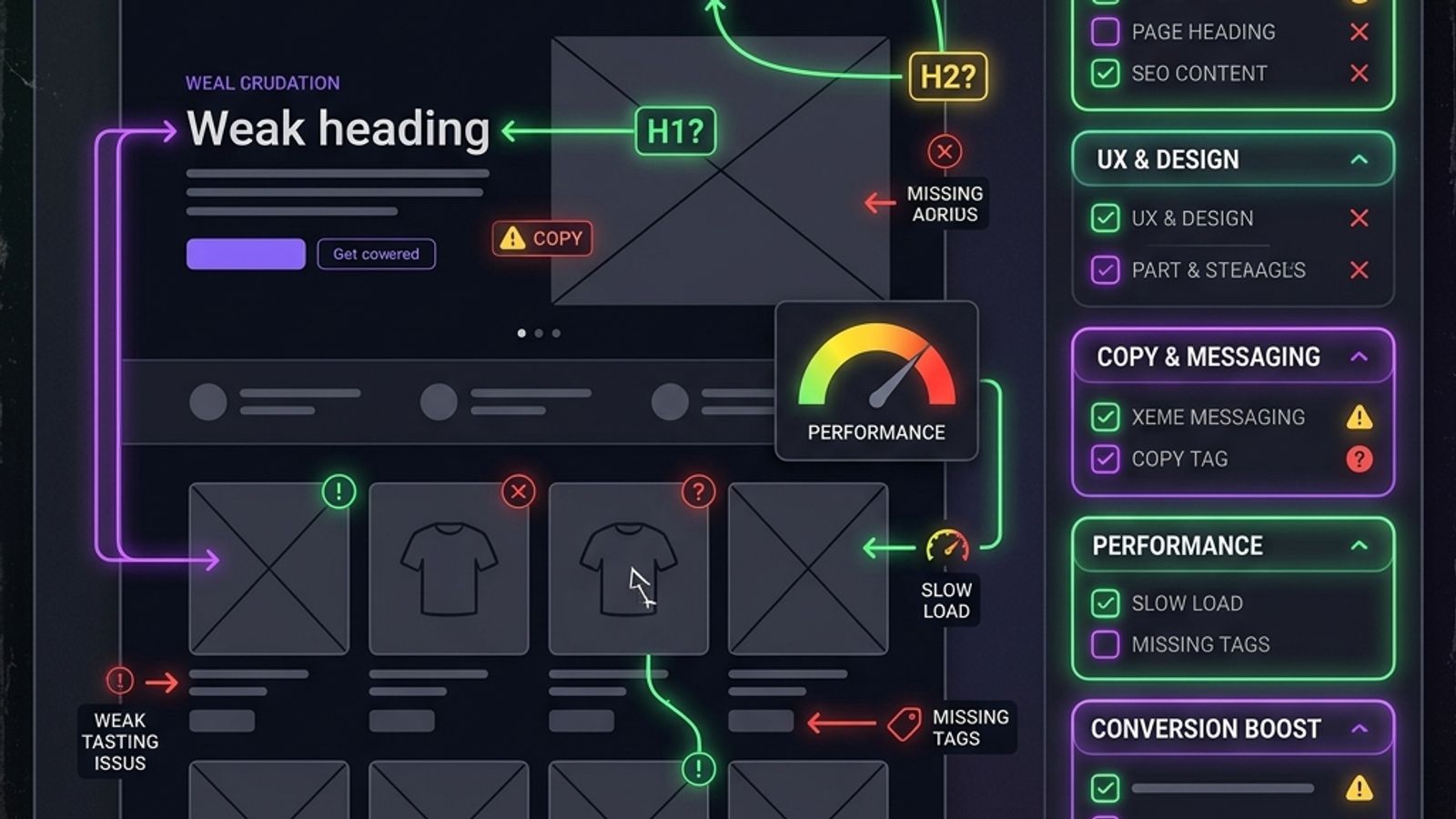
An SEO roast is a blunt, practical website critique that analyzes search visibility, user experience, copy, trust signals, performance, and conversion friction. Unlike a technical SEO audit, a roast delivers fast, prioritized, and actionable feedback in plain English, making it useful for founders, marketers, and developers. It focuses on human-facing issues: Is the page's value clear? Is the copy credible? Does the design build trust? The goal is to quickly identify and prioritize high-impact fixes that kill visibility and prevent visitors from converting, using a checklist that covers search intent, clarity, copy quality, UX, and proof.
An SEO roast rips apart a website's search, copy, UX, trust, performance, and conversion problems in plain English. Unlike a traditional SEO audit, it’s fast, memorable, and brutally actionable—showing teams exactly what kills visibility and why visitors don't convert.
What is an SEO roast?
An SEO roast directly critiques a website’s search visibility and user experience. It combines SEO analysis with copy feedback, design critique, UX review, trust checks, and conversion feedback to deliver a holistic, unfiltered view of what’s wrong with a page.
A good roast doesn't just say your title tag is too long. It explains why the page is confusing, why Google struggles to understand it, why visitors bounce, and what to fix first.
The best SEO roasts are:
- Specific: They point to actual page problems, not generic best practices.
- Prioritized: They separate urgent, high-impact fixes from nice-to-have polish.
- Plain-English: They’re useful to the entire team—founders, marketers, and developers, not just SEO specialists.
- Actionable: They turn harsh criticism into a clear list of next steps.
- Memorable: They deliver feedback that’s impossible to ignore.
SEO roast vs traditional SEO audit
A traditional SEO audit is technical and exhaustive. It’s a deep diagnostic report covering crawlability, indexation, metadata, internal links, schema, site speed, content quality, backlinks, and keyword gaps. It’s often delivered as a spreadsheet or a dense PDF.
An SEO roast is direct, opinionated, and human-facing. It asks the questions a skeptical visitor would: Does this page make sense? Is the offer clear? Does the copy sound credible? Does the design build trust? Does this page give search engines enough context to understand what it’s about?
Use a traditional SEO audit when you need a comprehensive technical health check across your entire site.
Use an SEO roast when you need fast, candid feedback on why a specific page feels weak, unclear, untrustworthy, slow, forgettable, or unlikely to convert.
The Unforgiving Website Roast Checklist
A useful roast looks beyond keywords. Search visibility depends on whether a page is understandable, useful, credible, and crawlable. This checklist covers the core areas where most websites fail.
1. Search intent
Start with the searcher’s problem. If you get this wrong, nothing else matters.
Ask:
- What problem would someone have right before landing on this page?
- Does the page solve that problem immediately, or does it make them hunt for the answer?
- Is the page’s goal educational, transactional, comparative, or navigational? Does the content match that goal?
- Does the headline and introduction confirm the visitor is in the right place?
A page can have perfect design and copy but still fail if it’s the right answer to the wrong question.
2. Title tag and meta description
The title tag and meta description form your search snippet. This is your one chance to earn the click against a sea of competitors. Vague snippets get ignored.
Check whether:
- The main keyword appears naturally in the title.
- The title clearly explains the page’s value, not just its topic.
- The title isn't generic ("Services"), keyword-stuffed, or duplicated across the site.
- The meta description gives a compelling reason to click, supporting the title.
Common failure: Vague titles like “Solutions” or “Products” signal vague positioning and a lack of confidence in the offer.
3. Above-the-fold clarity
The first five seconds above the fold determine whether someone stays or leaves. Most websites fail here.
Ask:
- Can a first-time visitor understand what this site does in five seconds?
- Is the headline specific and compelling, or does it sound like every competitor?
- Does the subheadline clarify the audience, outcome, or use case?
- Is the primary call-to-action (CTA) obvious, or is it hidden?
- Is there visual clutter distracting from the main message?
If the hero section makes people think too hard, they won't scroll to see the rest of the page.
4. Copy quality
Website copy isn't just for keywords; it's for reducing doubt. It should help people understand, compare, trust, and act.
Roast the copy for:
- Generic claims like “innovative solutions,” “grow faster,” or “unlock your potential.”
- Missing proof to back up bold claims.
- Weak or non-existent examples.
- Unclear audience (if you’re talking to everyone, you’re talking to no one).
- Jargon without explanation.
- Long, dense paragraphs that bury the main point.
Common failure: The copy talks about features before explaining the problem they solve, leaving visitors wondering, "Why should I care?"
5. UX and page structure
Bad UX is friction. It makes people work to find answers or click a button. A roast calls out that friction without mercy.
Check whether:
- The page has a logical heading structure (H1, H2, H3) that guides the reader.
- Page sections follow a natural decision-making path.
- CTAs appear where user intent is strongest (e.g., after a strong testimonial).
- Critical information is buried in tabs, accordions, or dense walls of text.
- Navigation is simple and supports the user’s journey.
- The mobile experience is effortless to scan and use.
If visitors need a treasure map to find the pricing page or the demo button, the page has a UX problem.
6. Trust and proof
Most pages fail because they make big promises without any evidence. Skepticism is the default online state.
Look for:
- Specific customer examples.
- Real testimonials with names and faces.
- Third-party reviews.
- Data-driven case studies.
- Product screenshots or demos.
- Security badges, privacy signals, or guarantees.
- Author or company credentials.
- Real contact information (not just a form).
This is becoming critical as AI answer engines synthesize information. Models are designed to find and cite credible sources; a page without proof is less likely to be seen as a reliable authority worth mentioning.
7. Performance and technical basics
A roast isn't a full technical audit, but it catches the technical issues that directly sabotage the user experience or search visibility.
Check:
- Page speed (Is it noticeably slow?).
- Core Web Vitals.
- Mobile usability (Are tap targets too small? Is text readable?).
- Broken links.
- Missing canonical tags on duplicate pages.
- Indexability (Is the page accidentally set to
noindex?). - Basic schema markup (Is it present for reviews, FAQs, products?).
- Heavy images and missing alt text.
The goal is to spot the technical blockers that make the page harder for humans and search engines to use.
8. Conversion friction
Traffic is a vanity metric if your page can't convert it. A roast scrutinizes the path from interest to action.
Roast the conversion path by asking:
- Is there one obvious next step, or are there five competing CTAs?
- Does the page explain what happens after a user clicks the button?
- Are the expectations for a demo, trial, or purchase clear?
- Does the page anticipate and address common objections?
- Is the CTA repeated after key sections of proof?
A page can rank #1 and still waste every dollar of traffic if it fails to guide visitors to a decision.
How to turn a roast into fixes
A roast is only useful if it leads to action. After collecting feedback, sort every issue into four groups to build a practical roadmap.
Fix now
These are the bleeding wounds. Problems actively killing visibility, trust, or conversions. Examples: unclear positioning in the hero, a broken primary CTA, a noindex tag on a key page, a missing title tag, a painfully slow page, or misleading copy.
Fix next
These are important improvements that require some planning. Examples: sourcing better testimonials, writing a detailed case study, building out a new comparison section, improving internal linking, adding FAQ schema, or rewriting a weak section of copy.
Test later
These are subjective or conversion-related ideas that should be validated with data, not just implemented on a whim. Examples: CTA wording, hero section layout, pricing page structure, social proof placement, or form length.
Ignore for now
Not every criticism is a priority. A good roast also helps identify which comments are matters of personal taste, low-impact tweaks, or simply not worth delaying a launch for.
When should you use an SEO roast?
Use an SEO roast when you need fast, direct feedback before investing weeks or months into a project.
It is especially useful before:
- Launching a new website.
- Publishing a critical landing page.
- Sending paid traffic to a page.
- Pitching a client on a redesign.
- Rewriting your homepage copy.
- Comparing your site against a top competitor.
- Preparing for a deep-dive SEO or AI visibility audit.
For deep technical diagnostics, use a site crawler. For fast, human-centric clarity, use a roast.
Is an SEO roast enough?
An SEO roast is a starting point, not a replacement for technical SEO, analytics, user research, or A/B testing.
Use it to find the obvious, painful problems fast. Then use deeper tools when you need more data:
- Google Search Console to find queries, impressions, CTR, and ranking opportunities.
- PageSpeed Insights for Core Web Vitals and performance diagnostics.
- A crawler (like Screaming Frog) for site-wide technical SEO issues.
- Heatmaps or session recordings to analyze user behavior once you have traffic.
- AI visibility checks to see whether answer engines mention or cite your brand.
The best workflow is roast first, deeper audit second, prioritized action plan third.
How SavageAudit handles SEO roasts
SavageAudit turns the concept of a website roast into a structured, shareable report. Instead of just a joke or a score, it reviews a page across performance, SEO, design, copy, UX, and conversion, delivering prioritized, actionable feedback.
This makes the insights more useful than a casual roast and faster than a traditional manual audit.
Use SavageAudit when you want to know:
- Why your page feels unclear.
- Why visitors may not trust your offer.
- Why the page isn't converting.
- Which SEO basics are missing.
- Which design or copy issues are hurting credibility.
- What to fix first.
The roast style makes the feedback easy to understand. The audit structure makes it easy to act on.
Summary
An SEO roast is a diagnostic tool, not a gentle suggestion. It exposes the painful truths about why a page feels weak, untrustworthy, or confusing to a skeptical visitor.
While a deep technical audit has its place for site-wide issues, a roast is the fastest way to get unfiltered feedback that forces you to confront what’s actually broken. Use it to get clarity, prioritize fixes, and stop wasting traffic on a page that doesn't work.
Common questions
What is an SEO roast?
An SEO roast is a blunt website critique that reviews search visibility, copy, UX, trust, performance, and conversion issues in plain English. It is usually faster and more direct than a traditional SEO audit.
Is an SEO roast the same as an SEO audit?
No. An SEO audit is usually more technical and comprehensive. An SEO roast is more direct, memorable, and focused on the issues that are easiest for website owners, founders, developers, and marketers to understand quickly.
What does a website roast include?
A website roast can include feedback on the title tag, meta description, hero section, copy, design, UX, trust signals, mobile experience, performance, internal links, indexability, and conversion path.
Who should use an SEO roast?
Founders, developers, freelancers, marketers, agencies, and website owners can use an SEO roast when they need fast feedback before launch, redesign, paid traffic, client delivery, or content updates.
Can an SEO roast improve rankings?
An SEO roast can help improve rankings indirectly by identifying weak intent match, unclear titles, thin content, poor internal links, missing proof, technical basics, and UX issues that may reduce engagement or search performance.
Is a public website roast useful?
Yes, if the feedback is specific and actionable. Public roasts can be useful for learning, social content, team discussion, and quick prioritization, but they should still turn criticism into practical next steps.
What is the fastest way to roast my website?
The fastest way is to review one important page against a checklist covering search intent, title tag, hero clarity, copy, trust, UX, performance, and conversion. SavageAudit can produce a structured AI website roast from a URL.
Keep the diagnosis moving
Run your own public presence audit
See how your website, search footprint, AI visibility, social proof, and conversion trust look from the outside.