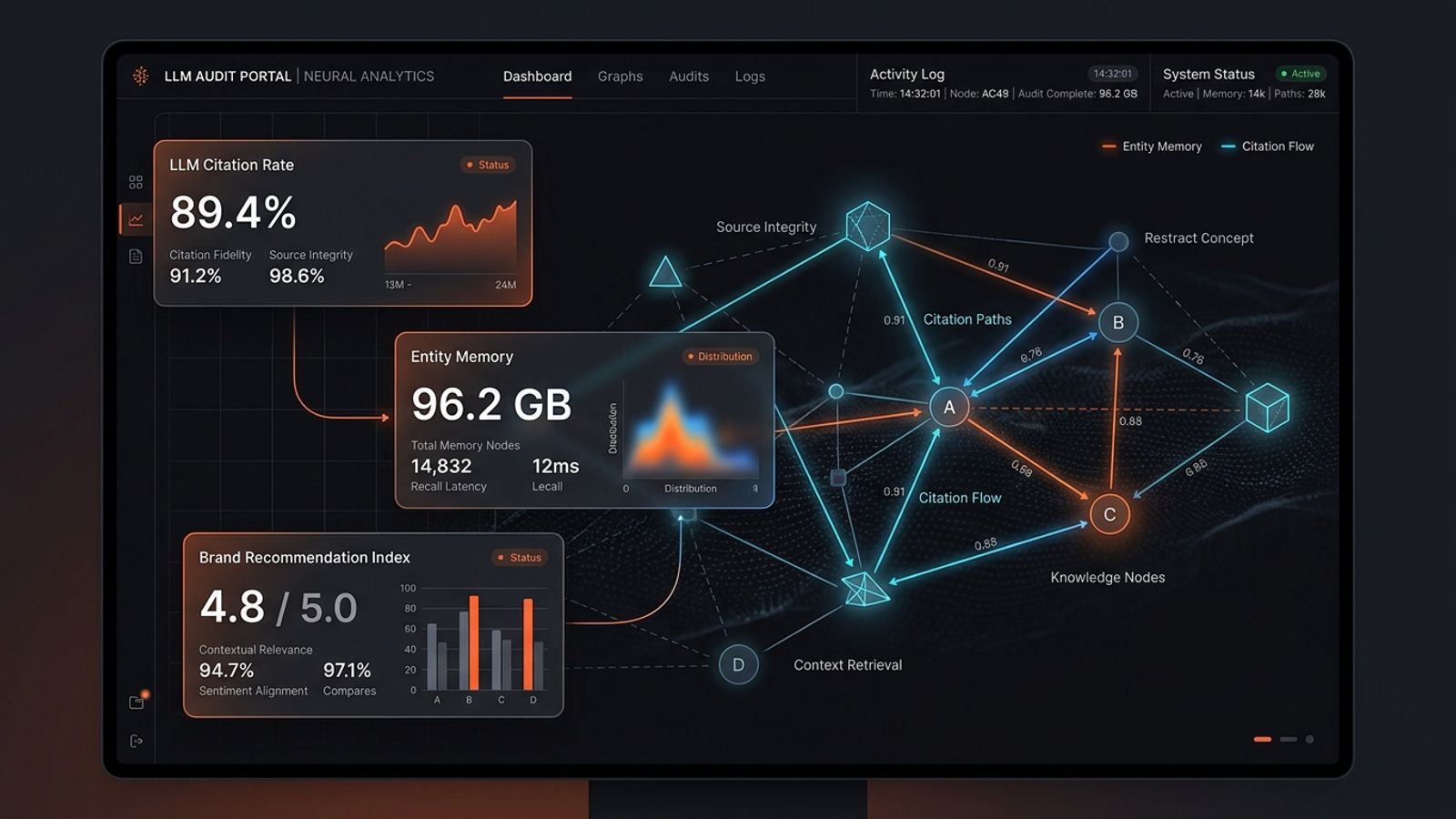
An LLM visibility audit checks whether Large Language Models (like ChatGPT, Claude, Gemini, and Perplexity) know, trust, and cite your brand. Key audit areas include entity disambiguation, answer chunkability, proprietary proof density, cross-web consensus signals, and technical AI crawler allowances.
Go to ChatGPT, Perplexity, or Claude right now. Type: 'What are the best tools for [your exact niche]?'
Does your product show up in the top three recommendations? Or does the model list your competitors, explain their features in detail, and completely ignore your existence?
Here is the brutal reality: you can rank on page one of Google for 50 keywords and still be completely invisible to Large Language Models. Traditional SEO measures how well Google's crawler ranks your blue link. An LLM visibility audit measures whether AI models actually remember, trust, and cite your brand when synthesizing answers.
What is an LLM visibility audit? An LLM visibility audit is a diagnostic review of how Large Language Models (like OpenAI GPT-4o, Anthropic Claude, Google Gemini, and Perplexity) discover, interpret, and recommend your brand. It inspects entity resolution, training data presence, real-time RAG extraction readiness, consensus signals, and technical crawler accessibility.
We already explained the broader strategic impact in our breakdown of the benefits of a GEO website audit. In this guide, we dive deep into the specific mechanics of how LLMs process your site and how to run a complete LLM audit step by step.
1. Why Google Rankings Do Not Guarantee LLM Citations
Traditional search engines and modern AI answer engines retrieve information in fundamentally different ways.
Google ranks individual URLs based on keyword relevance, backlinks, and user engagement signals. When a user clicks a blue link, Google's job is done. The user does the reading and parsing.
LLMs work backwards. When a user asks an AI engine a question, the model does not just serve a list of websites. It reads multiple sources, synthesizes the facts into a direct response, and decides which 2 or 3 sources are authoritative enough to cite as footnotes.
The extraction barrier: If your content is buried behind a 500-word intro of marketing fluff, written with vague hedging language, or trapped in complex JavaScript that AI scrapers skip, the LLM will simply cite a competitor whose page gives a direct, factual answer in the first two sentences.
2. The Two Paths: Parametric Memory vs. Real-Time RAG
To audit your visibility properly, you must understand the two distinct layers of how an LLM knows about your brand:
Path A: Parametric Memory (What the model was trained on). This is what the model 'knows' without browsing the web. If you ask an offline LLM 'What does [Your Brand] do?', can it answer accurately? Parametric visibility comes from high-authority training sources: Wikipedia, Wikidata, prominent GitHub repositories, open web directories, and massive Reddit discussions crawled prior to model training cutoffs.
Path B: Real-Time RAG (Retrieval-Augmented Generation). This is what happens when tools like Perplexity, ChatGPT with Search, or Google AI Overviews search the live web. The model executes targeted sub-queries, scrapes 5 to 10 web pages in milliseconds, chunks the text, and selects snippets to cite. Your RAG visibility depends entirely on content structure, schema clarity, and answer extractability.
A complete audit checks both paths. If you fail Path A, you are a ghost to offline models. If you fail Path B, live search models will cite third-party review sites or competitors instead of your domain.
3. The 5 Core Pillars of an LLM Visibility Audit
When we audit a website for LLM readiness at SavageAudit, we inspect five core technical and semantic pillars:
1. Entity Recognition and Disambiguation. Is your brand name unique, or does the model confuse you with a common word, an acronym, or a legacy brand? Check your Organization schema, Crunchbase profile, and Wikidata entities to ensure the model connects your product name to your specific category.
2. Answer Chunkability and Direct Statements. LLMs extract knowledge in chunks (typically 200–500 tokens). Every key page must feature crisp, declarative sentences: 'X is a tool that does Y for Z audience.' If your value proposition is a poetic metaphor, the model's parser cannot reliably extract it.
3. Proprietary Proof and Evidence Density. AI models prefer citing sources that provide unique data points, benchmarks, or original research. Generic summaries get rewritten without credit. Unique metrics, original case studies, and concrete numbers get cited as attributed sources.
4. Cross-Web Consensus Signals. LLMs do not trust what you say about yourself on your homepage unless third-party sources corroborate it. What does Reddit, Product Hunt, G2, and developer forums say about you? The model aggregates these consensus signals to decide whether your product is legitimate.
5. Technical AI Discoverability and Crawler Access. Are you accidentally blocking `GPTBot`, `ClaudeBot`, or `PerplexityBot` in your `robots.txt`? Do you have an updated `llms.txt` file providing a clean markdown roadmap of your core documentation and product features?
4. The 20-Point LLM Visibility Audit Rubric
Use this diagnostic scorecard to evaluate your website's readiness for modern LLMs and answer engines:
| Audit Area | What to Inspect | Pass / Fail Benchmark |
|---|---|---|
| Entity Clarity | Brand Disambiguation | Prompting 'What is [Brand]?' in ChatGPT produces an accurate, hallucination-free summary. |
| Entity Clarity | Structured Data Markup | Homepage and About pages feature valid Organization and Person JSON-LD with 'sameAs' URLs. |
| Entity Clarity | Knowledge Graph Footprint | Company is listed in Crunchbase, PitchBook, or industry-standard verified directories. |
| RAG Extractability | Direct Definitional Hooks | Target topic pages answer the primary query within the first 60 words under H1/H2. |
| RAG Extractability | Chunkable Headings | Headings clearly state the sub-topic rather than using vague, clever marketing puns. |
| RAG Extractability | Structured Table Usage | Comparison and pricing data is formatted in clean HTML tables, not buried in images. |
| Proof & Authority | Original Evidence Density | Pages cite proprietary benchmarks, real client numbers, or unique industry statistics. |
| Proof & Authority | Author Credibility Signals | Articles have clear author bylines linked to verified profiles with subject-matter expertise. |
| Consensus | Third-Party Validation | Product is actively discussed in unprompted Reddit, forum, or social conversations. |
| Consensus | Independent Review Sentiment | Third-party reviews reflect positive sentiment on core features and stability. |
| Technical | AI Bot Allowance | `robots.txt` explicitly allows `GPTBot`, `ClaudeBot`, and `PerplexityBot` to crawl content. |
| Technical | LLMs.txt Roadmap | A concise `/llms.txt` exists to provide markdown-formatted context for LLM agents. |
How to Run an LLM Visibility Audit in 30 Minutes
You do not need complex enterprise software to run an initial audit. Here is the fast heuristic workflow:
Step 1: Test baseline entity recall. Open three major LLMs (ChatGPT, Claude, Perplexity) in incognito sessions. Run three prompts: 'What is [Your Brand]?', 'Who are the top competitors to [Your Brand]?', and 'Compare [Your Brand] with [Leading Rival]'. Note whether the models understand your core features or hallucinate.
Step 2: Test category recommendation share. Run unbranded queries: 'What are the top 5 tools for [your niche]?' and 'Which software should I use if I need [specific feature]?' Record whether your brand appears in the recommendation list or if competitors take 100% of the answer real estate.
Step 3: Audit cited URLs in Perplexity and SearchGPT. Look at the footnotes when the model answers category questions. Which specific pages is it pulling from? Are they pulling from your blog, your documentation, or a third-party review site? If it's citing a competitor, inspect their page layout and note their information density.
Step 4: Check your crawler allowances and structured schema. Inspect your `robots.txt` file. Make sure you haven't blindly copy-pasted a template that disallows modern AI user-agents. Ensure your core pages have schema markup validating your company name, founders, and product capabilities.
To automate this audit alongside technical SEO, performance, UX, and conversion friction, run your site through our AI Visibility Audit Tool. We grade your site across the exact signals answer engines use to evaluate credibility.
Bottom Line
The search landscape has permanently bifurcated. Traditional search brings you users who want to browse links. LLM search brings you users who want immediate answers and trusted recommendations.
If your competitors are the ones being recommended in AI answers, you are losing high-intent customers before they ever make it to a search engine.
Audit your LLM visibility today. Format your content for extraction, build verifiable proof, and make sure when an AI engine searches for answers in your space, your brand is the obvious authority to cite.
Common questions
What is an LLM visibility audit?
An LLM visibility audit is a diagnostic review that measures how Large Language Models like ChatGPT, Claude, Gemini, and Perplexity understand, retrieve, and cite your brand. It analyzes entity recognition, RAG answer extractability, third-party consensus proof, and technical bot access.
How is an LLM audit different from an SEO audit?
A traditional SEO audit focuses on keyword rankings, backlinks, sitemaps, and Core Web Vitals for Google's search index. An LLM visibility audit assesses how AI models synthesize answers, whether they cite your domain in footnotes, and whether your content is structured for fast extraction by AI retrieval systems.
Why does my brand rank #1 on Google but not appear in ChatGPT?
Google ranks pages based on link equity and keyword signals, while LLMs synthesize answers using semantic information density, entity consensus, and clear definitions. If your page buries answers in long intros or lacks verified third-party consensus, the model will cite a more structured source.
What is the role of llms.txt in an LLM audit?
An llms.txt file is a markdown-formatted file placed at the root of your domain (/llms.txt) that provides AI agents with a concise, clean summary of your website's core pages, documentation, and product capabilities without HTML or script clutter.
Which AI search engines should I audit for visibility?
You should audit visibility across the major generative platforms: ChatGPT (with Search), Perplexity AI, Claude (for parametric entity recall), Google AI Overviews, and Microsoft Copilot.
Can SavageAudit score my site's LLM visibility?
Yes. SavageAudit audits websites across six core pillars, including AI visibility, AEO/GEO readiness, technical SEO, performance, copy clarity, and conversion friction, giving you actionable recommendations to improve your AI citation rate.
Keep the diagnosis moving
Run your own public presence audit
See how your website, search footprint, AI visibility, social proof, and conversion trust look from the outside.