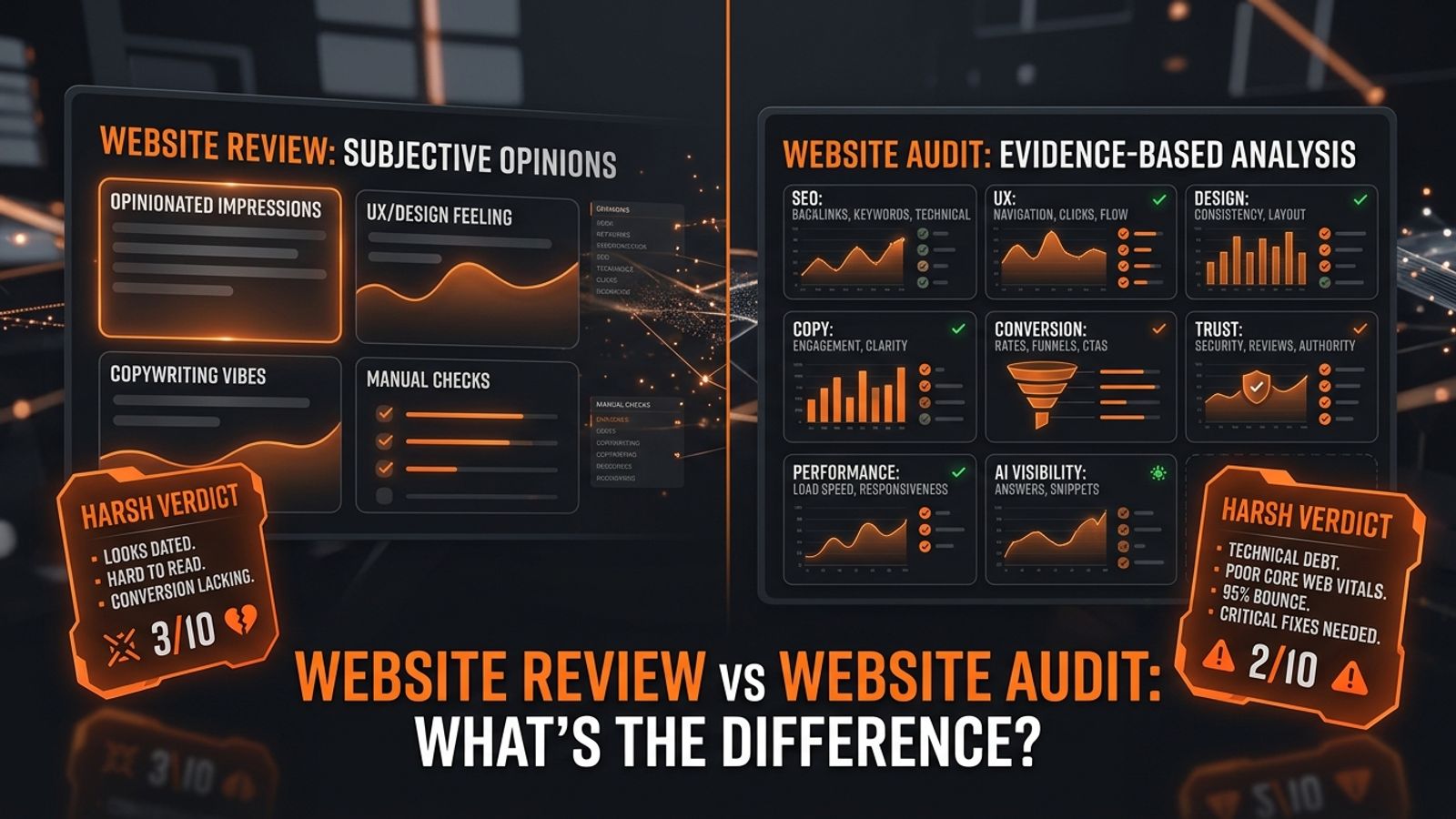
The key difference between a website review and a website audit is subjectivity vs. evidence. A **website review** is a subjective critique based on first impressions, taste, and experience. It provides directional feedback but lacks data and can be biased. A **website audit** is a systematic, evidence-based diagnosis that analyzes a site against a defined framework (e.g., SEO, UX, performance, copy, conversion). An audit's goal is to identify measurable problems and produce a prioritized, actionable plan. A review asks, "What do I think?" An audit asks, "What is actually broken and how do we fix it?"
You know something is off. Traffic is fine, but leads are weak. The team insists the homepage is clear, but customers are confused. You need a diagnosis, but picking the right tool is the first place most teams get sloppy.
They treat a website review and a website audit as the same thing. They aren't. A review is a subjective critique. An audit is an evidence-based diagnosis. For any founder, marketer, or operator trying to fix what’s broken, that difference is everything. The wrong input leads to the wrong solution.
A quick opinion has its place. But if you need a structured plan grounded in how your site actually performs across SEO, UX, copy, design, conversion, and speed, you need a real audit. SavageAudit bridges this gap, combining the blunt critique of a review with the hard evidence of an audit. We evaluate sites across six core categories to deliver a verdict that's sharp, not subjective.
The Shortest Possible Answer
Here’s the simple version of website review vs website audit:
- Website review = A subjective assessment, usually based on taste, experience, and first impressions.
- Website audit = A structured analysis, grounded in data, patterns, and prioritized fixes.
A review asks: “What do I think of this site?”
An audit asks: “What is this site actually doing, where is it failing, and what should we fix first?”
This isn’t a semantic difference. It’s the difference between an opinion and a diagnosis.
What a Website Review Delivers (and Where It Fails)
A website review is a critique, usually from a consultant or strategist offering a gut check on first impressions. Does the site look credible? Is the message clear? Does the layout feel dated? This feedback can be useful for surfacing obvious, high-level flaws—a weak positioning statement, awkward copy, an off-brand design. It tells you if your homepage feels rushed or confusing.
But that’s where its utility ends. A review is personality-driven and fundamentally limited.
- It's subjective. One person’s “clean design” is another’s “boring page.”
- It's anecdotal. The feedback is based on a glance at a few pages, not a systematic look at the user journey.
- It's biased. The critique is filtered through the reviewer’s personal taste.
- It's hard to prioritize. You get a list of opinions, not a data-backed action plan.
The output often sounds like “make it pop” or “tighten up the story.” At best, it's directional. At worst, it’s expensive noise that sends your team down a rabbit hole of subjective tweaks.
What a Real Website Audit Delivers
An audit isn't an opinion; it's a clinical diagnosis. A proper audit is a systematic, evidence-based process that examines your site against a defined framework to produce an actionable plan. It moves beyond gut feelings to answer specific questions about performance.
Websites rarely fail in just one way. A site can be fast but unclear, beautiful but invisible to search engines, or discoverable but unconvincing. A real audit has to expose the true shape of the problem. That's why the SavageAudit framework is built on six pillars: Performance, SEO, Design, Copy, UX, and Conversion. This approach reveals the misalignments between traffic, story, design, and revenue so you know exactly what to fix first.
A credible audit uses real signals, not vibes. It analyzes:
- Performance: Lighthouse metrics like LCP, CLS, and FCP.
- SEO: Crawlability, meta tags, heading hierarchy, and robots.txt.
- Design: Visual hierarchy, typography, contrast, and trust markers.
- Copy: Headline clarity, CTA strength, and messaging coherence.
- UX: Navigation depth, mobile layout, and user flow friction.
- Conversion: CTA placement, social proof, and other blockers.
This process creates clarity. It’s the difference between hearing “this page feels slow” and seeing “this page is slow because its LCP is 4.2s, the hero image is unoptimized, and you’re burning user attention before the CTA even loads.” One is an observation. The other is a diagnosis you can act on.
Why the Distinction Matters
Confusing a review with an audit is how teams end up redesigning pages that were never the real problem or tweaking copy when the site architecture is broken. You either overreact to taste-based feedback or underinvest in an evidence-based diagnosis.
A review might catch weak messaging on your homepage. But if that same weak messaging is baked into your pricing page, blog templates, and landing pages, you have a systemic issue that only a full-site audit will uncover. A single underperforming demo page might just need a surgical page audit, but if conversions are low across multiple entry points, the problem is bigger.
A review is directional. An audit is diagnostic. If your website is supposed to generate revenue, diagnostic beats directional every time.
Rule of thumb: Audit the smallest unit that explains the failure. If one page is the bottleneck, audit that page. If the issue repeats across templates, do a full-site audit.
Website Review vs Website Audit: Side by Side
| Feature | Website Review | Website Audit |
|---|---|---|
| **Primary Goal** | Expert opinion and strategic direction | Diagnose measurable problems and prioritize fixes |
| **Method** | Heuristic, experience-based, subjective | Systematic, evidence-based, structured |
| **Output** | Narrative feedback, opinions, quick takeaways | Structured report, issue rollup, prioritized actions |
| **Best For** | Early-stage sanity checks, messaging, taste | Technical issues, systemic problems, cross-functional fixes |
| **Main Risk** | Bias, vagueness, no data | Data overload if the audit has no prioritization |
Choosing the Right Diagnosis
The tool you need depends on the problem.
A website review is for a quick, subjective read. It's the right call when you're early-stage, the message is still wet clay, and you need an outsider’s gut reaction to your copy or design. Use it as a sanity check before you invest in deeper work, but don't mistake it for a complete diagnosis.
A website audit is for when you need an evidence-based plan. It's non-negotiable if your site is live but underperforming, issues repeat across pages, or you need a single source of truth for your entire team. An audit tells you what to fix first, not just what looks wrong.
When problems are systemic, you need a full website audit. This kind of audit samples representative pages—homepage, pricing, key landing pages, and major templates—to produce one site-wide verdict. It finds the recurring patterns and gives you a prioritized fix sequence for the whole team.
What a Modern Website Audit Should Cover
A website audit is not just an SEO audit. Rankings are important, but they don’t pay the bills on their own.
A modern audit must be comprehensive, covering:
- Performance: Is the site fast enough to hold attention?
- SEO: Can search engines crawl, understand, and rank the site?
- Design: Does the site look credible, professional, and trustworthy?
- Copy: Does the message clearly state the offer and its value?
- UX: Can users find what they need without friction or confusion?
- Conversion: Does the site effectively guide users toward taking action?
- AI Visibility: Is the content structured, extractable, and attributable so modern answer engines can use it as a source?
That last point is no longer optional. Vague, messy, or unsupported content is a liability for both humans and machines.
Where SavageAudit Fits
SavageAudit isn’t trying to be polite. It’s built to be useful.
Our tool combines the blunt critique of a seasoned reviewer with the hard evidence of a multi-point audit. The analysis pipeline uses visual analysis, Lighthouse data, and external context to produce a verdict that is clear, shareable, and oriented around a fix list.
You get a sharp read, not corporate fluff. You get real metrics, not vague encouragement. You get a prioritized plan, not a wall of observations. Many tools still treat SEO as the beginning and end of a website’s health. It’s not. A site can rank number one and still fail to explain itself, earn trust, or convert a single visitor. A real website audit has to be broader.
Final Take
The choice between a website review and a website audit comes down to this: do you need an opinion or a diagnosis?
A review gives you subjective feedback. It’s a gut check. An audit is what you use when the stakes are high and your site has to perform across search, trust, UX, and conversion. It delivers an evidence-based plan.
If you just want to know what someone thinks, get a review.
If you need to know what to fix, get an audit.
And if you want the bluntness of a review combined with the data and prioritization of a real audit, that’s what SavageAudit delivers.
Common questions
Is a website review the same as a website audit?
No. A review is subjective and opinion-based. A website audit should be a structured, evidence-based diagnosis with clear priorities.
Is a website audit always technical?
No. A comprehensive audit includes technical performance but must also cover design, copy, UX, and conversion. SavageAudit uses a six-category framework to ensure a holistic analysis.
Can a website review be useful?
Yes, for quick, subjective feedback on messaging or design. It’s just not sufficient if you need a defensible diagnosis or a site-wide action plan.
What’s better for a redesign?
A full website audit. Redesigns need to address systemic issues that repeat across templates and user journeys. A site-wide read is essential, which is what SavageAudit’s full-site audit provides.
Does an SEO audit cover everything?
No. An SEO audit focuses on search visibility. It won’t tell you if your site is persuasive, trustworthy, or optimized for conversion. A broader website audit is needed to cover those critical gaps.
Keep the diagnosis moving
Run your own public presence audit
See how your website, search footprint, AI visibility, social proof, and conversion trust look from the outside.