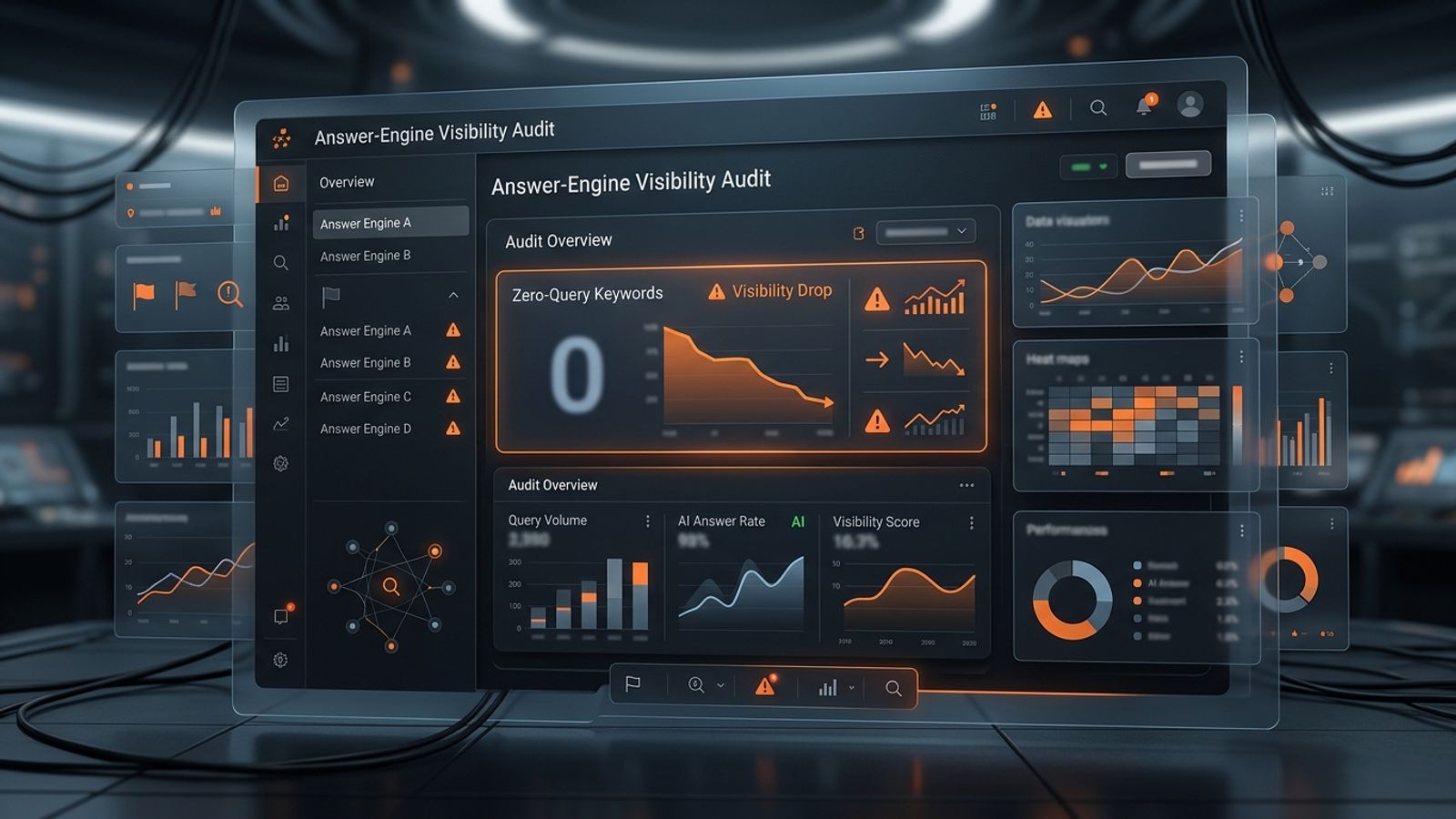
A 0/0 AEO dashboard means your reporting setup found no measurable answer-engine visibility for the selected queries, platforms, and date range. Check tracking setup first, then audit SEO access, prompt-to-page alignment, extractability, proof, mentions, citations, and competitor inclusion before rewriting pages.
AEO Queries 0/0 This Week: What It Means and What to Audit Next
If your AEO report says “AEO queries 0/0 this week vs last week,” the short version is this: your AI search reporting tool didn’t find anything it could count. No tracked query activity. No visible mentions. No citations. No measurable AI search visibility for the period you’re looking at.
That can feel like a punch in the teeth, especially if you’ve been putting work into SEO, content, or AI visibility. But a 0/0 report does not always mean your brand is doomed or invisible everywhere.
Sometimes the setup is wrong. Sometimes the prompts are too narrow. Sometimes the date range is off. Sometimes your pages aren’t indexed. Sometimes your content is too vague for AI tools to pull a clean answer from. And sometimes, yes, your brand simply doesn’t have enough public proof yet for answer engines to trust it.
So before you panic, audit the basics: tracking, indexability, page clarity, evidence, and off-site mentions.
That’s where the real answer usually is.
Who this is for
This is for founders, marketers, and SEO teams staring at an AEO dashboard that says absolutely nothing helpful.
Maybe your regular SEO traffic looks okay, but your AI search dashboard shows zero AEO queries.
Maybe your team is trying to report on answer engine optimization metrics, but the trend line is completely dead.
Or maybe you searched “aeo queries 0/0 this week vs last week” because your tool gave you a number and no explanation.
That’s the problem with a lot of AI search reporting dashboards.
They show the symptom. They don’t tell you what caused it.
A zero-query report might mean your brand is not appearing in AI-generated answers. But it could also mean your tracking is misconfigured, your prompt set is too narrow, the reporting window is too short, or your content simply isn’t written in a way that machines can easily extract.
So don’t spiral. But don’t shrug it off either.
A 0/0 report is a signal to audit.
What “AEO queries 0/0 this week” actually means
In plain English, “0/0 this week vs last week” means the system found zero measurable AEO activity in the current period and zero in the comparison period.
That sounds simple, but there’s a catch.
Different tools define “AEO queries” differently.
Depending on the platform, it might mean:
- Tracked prompts
- Query impressions
- Detected AI-generated answers
- Brand mentions
- Citations
- Prompt coverage
- Some other visibility event the tool has decided to count
That’s why the first move is not rewriting your homepage.
The first move is understanding what your tool actually counts as an AEO query.
AEO reporting is not the same as classic rank tracking.
Traditional SEO reporting asks things like:
- Did we rank?
- Did we get impressions?
- Did we get clicks?
- Did our average position improve?
AEO reporting asks a different set of questions:
- Did an answer engine mention us?
- Did it cite us?
- Did it use our content to help form an answer?
- Did it recommend a competitor instead?
- Did it understand what we do?
- Did it trust the available evidence enough to include us?
That last question matters more than people think.
AI systems are not just looking for a page with the right keyword on it. They pull from indexed pages, structured and unstructured web content, citations, reviews, comparisons, summaries, brand mentions, and other public signals.
So if your brand has thin proof, vague copy, and barely any off-site presence, your AEO metrics can stay flat even if your SEO dashboard looks fine.
What to check first when your AEO dashboard shows 0/0
Go in this order.
Seriously.
Skipping straight to schema, plugins, or “AI content hacks” is how teams waste three weeks fixing the wrong problem.
1. Confirm the AEO reporting setup
Before blaming the website, make sure the report is measuring what you think it’s measuring.
Check:
- Is the date range correct?
- Is the comparison period correct?
- Are you looking at the right project or domain?
- Are all brand name variations included?
- Are product names included?
- Are founder names included if they matter?
- Are common misspellings included?
- Are the tracked prompts actually active?
- Are the right pages attached to the report?
- Is the tool tracking mentions, citations, prompts, or something else?
- Is the platform clearly defined, such as ChatGPT, Perplexity, Claude, Google AI Overviews, or another AI search surface?
A 0/0 report can be real. It can also be a boring configuration issue.
Start there.
3. Check whether your pages answer the actual prompt
This is where a lot of brands get exposed.
A buyer asks:
What is the best AI search audit tool for finding AEO and SEO gaps?
Your page says:
We empower modern teams to unlock scalable digital growth through strategic intelligence.
That is not an answer.
That is fog in a blazer.
For AEO, your content needs to be extractable. The answer should show up early, clearly, and in language that matches how people actually ask questions.
Look at your priority pages and ask:
- Does the first section answer the main question directly?
- Are the headings specific?
- Can a reader understand the page without decoding marketing language?
- Are definitions clear?
- Are comparisons clear?
- Are use cases stated plainly?
- Are claims supported?
- Are trust signals visible before the reader gets tired?
If your copy buries the point, don’t expect an answer engine to dig it out with a shovel.
4. Check proof and corroboration
AEO and GEO are closely related, but they are not the same thing.
SEO audits look at rankings, crawlability, and organic search performance.
AEO audits look at whether your content can be extracted as a direct answer.
GEO audits look at whether generative AI systems can identify, verify, and cite your brand using public evidence.
That means your website alone may not be enough.
If every claim about your company only appears on your own site, AI systems have less to corroborate. Public mentions, citations, comparisons, reviews, roundups, interviews, and industry references can all influence whether your brand looks like a credible answer or just another company describing itself as “leading.”
This is why a zero-query AEO report often points to a proof problem, not just a page problem.
5. Separate mention gaps from citation gaps
Don’t lump every AEO problem into one bucket.
There are two different issues:
Mention gap: The AI answer talks about your category, but your brand is not included.
Citation gap: The AI answer includes your brand, but does not cite your website or use your page as a source.
Those require different fixes.
A mention gap usually means your brand footprint is too weak. You may need clearer positioning, stronger category association, more public proof, and better off-site visibility.
A citation gap usually means your site may not be the clearest or strongest source for the answer. You may need better page structure, clearer definitions, stronger evidence, and more directly answerable content.
AEO reporting checklist and audit framework
Use this framework when your AEO reporting shows 0/0, flat visibility, or drops nobody on the team can explain.
Step 1: Define the query and prompt set
Don’t track random keywords and call it AEO.
Build prompts around actual buyer intent.
For example:
- Category prompts, like “best AI search audit tools”
- Problem prompts, like “why is my AEO dashboard showing zero queries”
- Comparison prompts, like “AEO audit tool vs SEO audit tool”
- Trust prompts, like “is [brand] legitimate”
- Use-case prompts, like “how to audit AI visibility for a B2B website”
If your prompt set is too narrow, you may report zero visibility even when potential buyers are asking nearby questions.
You may not have no visibility. You may just be looking in the wrong place.
Step 2: Map prompts to pages
Every important prompt should have a page that can answer it.
Ask:
- Which page should answer this prompt?
- Is that page indexed?
- Is the answer obvious?
- Does the page use language similar to the prompt?
- Does the page explain who the product or service is for?
- Does it say when it is not the right fit?
- Does it include proof?
If there is no page mapped to the prompt, your AEO dashboard may be measuring a gap you haven’t actually filled yet.
Step 3: Audit the first 100 words
For AEO, the opening matters.
You don’t need a long, dramatic intro. You need a direct answer, fast.
Check whether the page:
- Defines the topic quickly
- Answers the main query directly
- Names the audience
- States the practical takeaway
- Avoids generic filler
- Uses specific nouns instead of empty adjectives
If the answer starts halfway down the page, rewrite the opener.
No need to make it complicated.
Step 4: Audit headings for extraction
Headings are not decoration.
They help humans scan the page, and they help systems understand what the page is actually about.
Weak headings:
- “Overview”
- “Our solution”
- “Why it matters”
- “Unlock growth”
- “The future of visibility”
Stronger headings:
- “Why your AEO dashboard shows 0/0”
- “What to check first in AEO reporting”
- “How to tell a mention gap from a citation gap”
- “When to audit SEO, AEO, GEO, UX, and copy together”
Specific headings make the page easier to extract.
They also make it easier to read, which is kind of the whole point.
Step 5: Audit evidence density
Look for unsupported claims.
If your page says you are:
- The best
- Trusted
- Leading
- Powerful
- AI-ready
- Enterprise-grade
- Built for growth
Then the obvious question is: prove it.
Evidence can include:
- Clear product details
- Specific use cases
- Examples
- Customer language
- Comparisons
- Documentation
- Public references
- Citations
- Relevant data points
Don’t invent authority. Don’t stuff random sources onto a page just to look credible.
Just stop making claims your page does not support.
Step 6: Audit off-site brand footprint
AEO reporting should not stop at your own domain.
Look for whether your brand appears in:
- Industry articles
- Comparison pages
- Partner pages
- Review sites
- Podcasts or interviews
- Communities
- Social discussions
- Roundups
- Relevant directories
The goal is not vanity mentions. The goal is corroboration.
If AI systems need public evidence to understand and trust your brand, then your footprint outside your website matters.
Step 7: Compare against competitors
If your AEO queries are 0/0, someone else may still be showing up.
Check which competitors are named in AI answers for your target prompts.
Then compare:
- Are their pages clearer?
- Do they answer faster?
- Do they have stronger public mentions?
- Are they cited more often?
- Do they have better category pages?
- Do they have more useful comparison content?
- Do they explain use cases more clearly?
- Do they have stronger proof?
Don’t copy them blindly.
Use the gap to understand what the answer engine can see from them that it can’t see from you.
Common mistakes when diagnosing 0/0 AEO reports
Mistake 1: Treating 0/0 as only a content problem
Sometimes it is content. Sometimes it is tracking. Sometimes it is indexing. Sometimes it is weak brand proof. Sometimes it is a prompt problem.
If you rewrite pages before checking the reporting setup, you may spend a lot of time fixing the wrong thing.
Mistake 2: Obsessing over schema first
Schema can help search engines understand parts of a page.
But it is not a magic AEO switch.
If your content is vague, unsupported, and buried under brand fluff, markup will not turn it into a strong answer.
Fix clarity first. Fix evidence. Fix structure. Then worry about enhancements.
Mistake 3: Reporting only on rankings
AEO metrics are not traditional rankings.
You need to look at:
- Mentions
- Citations
- Prompt coverage
- Competitor inclusion
- Answer quality
- Source selection
- How your brand is described
A brand can rank in Google and still fail to appear in AI-generated answers.
The reverse can also happen.
Different surface. Different measurement.
Mistake 4: Ignoring the difference between visibility and clicks
AI answers do not always produce clicks.
That is frustrating, but it does not make AEO irrelevant.
AEO reporting is partly about brand presence and narrative control.
If a high-intent buyer asks an AI tool for recommendations in your category, you want to know:
- Whether your brand appears
- How it is described
- Whether competitors appear instead
- Which sources get cited
- What claims the answer engine repeats
That may not show up as a clean traffic spike in analytics.
It still matters.
Mistake 5: Tracking prompts no buyer would ask
If your prompt set is built around internal jargon, your dashboard may be technically accurate and strategically useless.
Use the language buyers actually use.
Track category, problem, comparison, trust, and use-case prompts.
If you sell to founders and marketers, write prompts the way founders and marketers actually ask questions.
Not the way your internal positioning deck describes them.
How Savage Audit fits naturally
A basic AI search dashboard can tell you your AEO queries are zero.
That is useful.
But it is not enough.
The real question is: why?
Savage Audit is built for that next layer. It looks across SEO, AEO, GEO, UX, and copy to find the gaps that make a website hard to understand, hard to extract, or hard to trust.
That includes issues like:
- Pages that do not answer the query quickly
- Weak or generic headings
- Buried trust signals
- Thin proof
- Confusing positioning
- Missing answer assets
- Poor prompt-to-page alignment
- SEO problems weakening the AEO foundation
- UX and copy issues making the value proposition harder to parse
- Off-site proof gaps that make the brand harder to corroborate
Savage Audit is not there to make a vanity score look nicer.
It is there to turn “0/0 this week” into a real punch list.
What needs rewriting? What needs proof? Which pages are not mapped to buyer prompts? Where is the brand missing from public evidence? Where are competitors being selected instead? Which fixes actually matter first?
That is the useful work.
If your AI search reporting dashboard keeps showing zero visibility and your team is guessing at fixes, Savage Audit gives you the brutally honest audit layer between:
We have no data.
And:
Here is what to fix next.
Final takeaway
A 0/0 AEO report is not a strategy. It is a warning light.
Start with reporting setup, then check SEO access, prompt-to-page alignment, extractability, proof, and competitor visibility. If the dashboard only tells you that visibility is flat, the audit should tell you why — and what to fix first.
Common questions
Why does my AEO reporting show 0/0 this week vs last week?
It means your reporting system did not detect measurable AEO query activity for the current period or the comparison period. Check the date range, query set, tracked platforms, brand variants, and reporting configuration first. Then audit indexing, page extractability, evidence, and off-site brand mentions.
Is 0/0 in an AEO dashboard always bad?
Not always. It may be a setup issue, a narrow prompt set, or a reporting limitation. But if the setup is correct, 0/0 usually means your brand is not being detected, mentioned, cited, or extracted for the prompts you care about. That deserves an audit.
Do I need special schema to fix AEO metrics?
Do not start there. Your page still needs to be indexed, accessible, clear, and useful. Schema may support understanding, but it will not rescue vague copy, weak proof, or unsupported claims.
What is the difference between AEO reporting and SEO reporting?
SEO reporting usually focuses on rankings, impressions, clicks, and traffic. AEO reporting focuses on whether answer engines mention your brand, cite your pages, extract your content, and include you in generated answers for buyer prompts.
When should I use Savage Audit?
Use Savage Audit when your AEO reporting shows flat or zero visibility and you need to know what to fix. It is especially useful when the issue may involve more than SEO, including weak copy, poor UX, missing proof, unclear positioning, or gaps in AI visibility and GEO corroboration.
Keep the diagnosis moving
Run your own public presence audit
See how your website, search footprint, AI visibility, social proof, and conversion trust look from the outside.