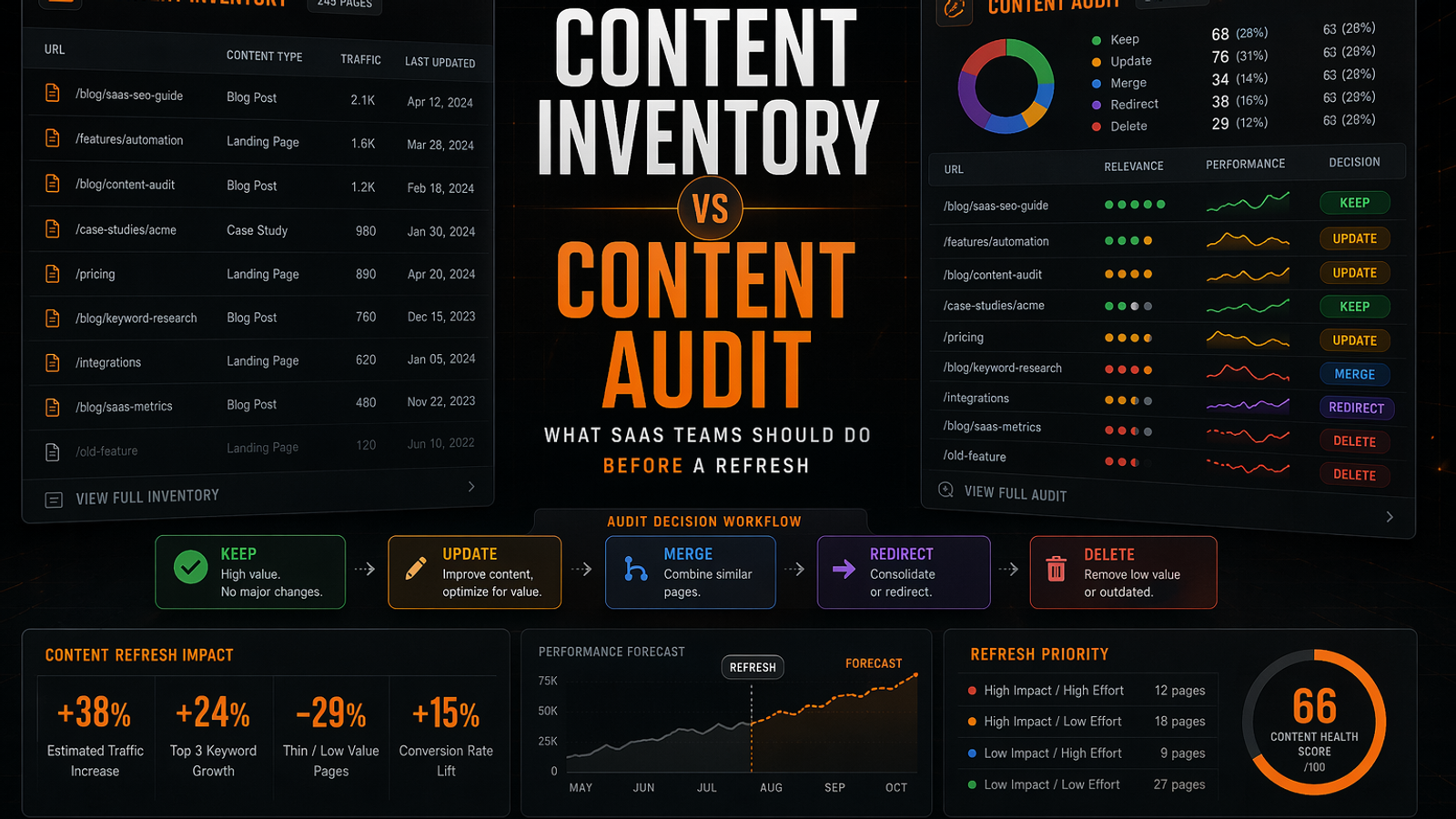
A content inventory is a quantitative catalog of your website's URLs, metadata, and performance metrics. It tells you what exists. A content audit is a qualitative evaluation that diagnoses performance, intent match, and conversion friction. It tells you what is hurting growth. SaaS teams need an inventory to establish a baseline, but they must run an audit to make ruthless decisions about what to keep, update, merge, delete, or redirect before starting a content refresh.
Too many content refresh projects are essentially spreadsheet cosplay. Someone exports 600 URLs, color-codes the rows, pulls in organic traffic numbers, schedules a few review calls, and calls it a strategy. A few weeks later, the team updates publish dates, rewrites a handful of intros, swaps out old screenshots, and wonders why nothing meaningful changes in pipeline or revenue.
The core issue is a misunderstanding of the work. A content inventory tells you what exists on your website. A content audit tells you what is actively hurting your growth.
If you are a SaaS team planning a refresh, you need both, but you do not need them equally. You need the inventory to stop guessing about your footprint. You need the audit to make ruthless decisions about what to rewrite, merge, delete, redirect, or turn into answer-ready content. That decision layer is where a refresh project actually becomes useful.
The Difference That Matters
A content inventory is a structured, quantitative catalog of your digital footprint. It answers foundational questions about what pages exist, where they live, what format they take, and who owns them. It captures the metadata, tags, templates, and raw metrics attached to every URL. As the Nielsen Norman Group points out, capturing digital content at the page or asset level is a critical first step, but it will not tell you much about the content’s quality or how to improve it.
That requires an audit. An audit demands judgment. It forces you to look at that inventory and ask if a page is actually useful to a buyer, if it ranks for the right queries, or if it is secretly competing with a more important page. The Province of British Columbia frames this well, describing a content audit as the process of reviewing each page and asset for accuracy, duplication, and relevance to determine what needs to be updated, replaced, archived, merged, or kept as-is.
If your team only has a URL list with a few traffic columns, you do not have a refresh strategy. You just have a table.
Why SaaS Teams Confuse Inventory With Strategy
Inventories often masquerade as strategy because they feel highly productive. Building a massive spreadsheet makes a chaotic website look managed, giving leadership the illusion that a major business problem is being solved simply because 842 URLs have been mapped.
The hard work is not finding old content. The hard work is deciding what deserves company time and resources.
A SaaS content refresh comes with real tradeoffs. Refreshing a single stale feature page might generate more revenue than updating dozens of top-of-funnel blog posts. Merging two overlapping guides will often outperform rewriting both. Removing the wrong URL can inadvertently destroy a critical conversion path, while updating copy without addressing underlying UX or positioning issues leaves the actual business problem untouched.
SavageAudit’s website audit approach evaluates Performance, SEO, Design, Copy, UX, and Conversion specifically because content decay is rarely just a writing problem. A page can target the exact right keyword and still fail if the messaging is vague, the primary call-to-action is buried, or the mobile experience is frustrating.
What a Content Inventory Should Include
A content inventory should be functional. The goal is not to build a 90-column monster that nobody will ever maintain, but to capture enough data to identify, group, and evaluate your content.
Start with basic page data: URL, meta title, meta description, H1, content type, template type, publish date, and current status. Then, classify the business role of the content. SavageAudit’s content audit workflow uses specific page role labels to prioritize fixes by business value. These include Money pages (product, feature, pricing, demo, comparison), Proof pages (case studies, testimonials, customer stories), Education pages (blog posts, guides, glossaries), Support pages (docs, help center, onboarding), and Bridge pages (use cases or templates that move readers from education to product evaluation).
Pair this with baseline SEO data like indexability, canonical URLs, organic clicks, impressions, CTR, average position, and target keyword clusters.
Finally, capture governance details. Product facts rot quickly in SaaS. Feature names change, integrations launch or disappear, and pricing models shift. You need to know the owner, product area, target persona, and any expiration dates to prevent pages from becoming liabilities.
When a Content Inventory Is Enough
You do not always need a full audit. An inventory is sufficient when the decisions you are making are purely operational.
If you are preparing for a CMS migration, redesigning your site navigation, or trying to understand the sheer volume of an inherited website, an inventory helps you identify orphaned pages, assign ownership, and map product areas to existing URLs. When a product marketing manager asks which help docs still mention a retired Slack integration, or an engineer needs to know which URLs require redirects before a site migration, those are inventory tasks.
But when leadership asks which pages the marketing team should rewrite this quarter to improve qualified pipeline, you have crossed into audit territory.
What a Content Audit Adds
A content audit layers diagnosis and action over your raw data. If your inventory simply states that a 2021 blog post about workflow automation exists, the audit exposes that the post is ranking near page two for a commercial query, overlapping with your core workflow automation feature page, using outdated UI screenshots, and burying the actual product use case.
A strong audit evaluates performance by looking at what the page is actually doing in the wild. It examines whether traffic is growing or flat, if the page is getting thousands of impressions but suffering from a weak click-through rate, or if a weaker page is cannibalizing the intended URL. It evaluates quality by asking uncomfortable questions about accuracy and usefulness.
It also evaluates intent match to ensure a page aligns with what the user actually wants. SavageAudit’s Google Search Console framework recommends classifying queries as branded, commercial, informational, comparison, or navigational, and then mapping those specific queries to current ranking URLs and the best target URLs.
Finally, a SaaS audit must diagnose conversion. You have to look for weak CTA placement, dead ends, missing product tie-ins, and a lack of proof near decision points.
When to Run a Full Content Audit
You need a full content audit when your decisions involve rankings, conversions, product accuracy, or brand credibility.
This usually happens when organic traffic starts declining, or when content production has outpaced your team's ability to govern it. An audit is necessary when sales complains that marketing materials are outdated, when product pages no longer reflect what the software actually does, or when multiple pages target the exact same query. It is also required when you notice your brand is being misrepresented in AI search answers.
The workflow is straightforward: complete the inventory first to establish your baseline and understand the broad implications of your footprint, then use the audit to act quickly and decisively.
SavageAudit’s Content Audit Decision Framework
Before rewriting a single sentence, every important page needs a diagnosis of what is broken and a clear next step. SavageAudit’s content audit workflow classifies pages by their role, their content status, the problem type, and the required action.
Start by assigning a status label like Fresh (accurate, useful, performing), Stale (old examples, outdated screenshots), Thin (shallow or low-value), Overlapping (competing with another page), Outdated (factually wrong), Underperforming (has potential but weak results), Wrong intent (ranks for queries it does not satisfy), or Conversion leak (gets attention but fails to move users forward).
Once you identify the status and the specific problem—such as weak intent match, vague messaging, weak proof, poor answer extraction, or conversion friction—you must assign a concrete action.
Keep a page when it is accurate, useful, aligned with search intent, and performing well enough to protect. Do not refresh content just because the publish date is old; some pages are stable and authoritative.
Update a page when it is strategically useful but suffers from freshness, clarity, proof, structure, or conversion issues. This might involve rewriting the intro, adding direct answers near the top, replacing stale screenshots, or adding FAQ and comparison sections.
Merge pages when multiple URLs compete for the same intent and split your topical authority. Consolidate the best material into the strongest URL, and redirect the weaker pages to that new destination.
Delete thin pages that have no strategic value, no meaningful traffic, no backlinks, and no relevance to the current product, ensuring you check for internal links before pruning.
Finally, redirect a page when it should no longer remain live but its historical value needs to be preserved, such as when a topic has been consolidated or a feature renamed.
How Google Search Console Should Guide Refresh Decisions
Google Search Console is the best tool for exposing bad assumptions. SavageAudit’s approach extracts queries and pages from the Performance report to find specific refresh opportunities based on impressions, CTR, position, and indexing status.
Pages with high impressions and low CTR are visible but not compelling, meaning you likely need to audit the title tag, query intent match, and page angle. Pages ranking near the bottom of page one or the top of page two are in striking distance. If a feature page is sitting at position 11 for "workflow automation software," adding 300 words of fluff will not help. A better fix is to add a direct comparison section, clarify the specific use case, and build internal links from related posts. For a deeper look at this process, use the Google Search Console website audit.
Crucially, prioritize business value over sheer impression count. A glossary post with massive traffic and no logical path to your product is often less valuable than a comparison page with low volume but intense buyer intent.
How AEO and GEO Change the Content Audit Process
The rise of answer engines changes the criteria for a successful page. Content must now be clear, credible, and structured enough to be extracted accurately.
SavageAudit’s AEO approach emphasizes replacing retired integrations, old case studies, and outdated statistics with current, verifiable information. It demands clear declarative language, standalone definitions, descriptive headings, and paragraphs that actually answer direct questions. A page may not need more words; it may just need more extractable facts.
You must evaluate category clarity, feature accuracy, pricing accuracy, and use-case specificity. SavageAudit’s SaaS content audit perspective emphasizes citation-ready facts, extractability, attribution, entity clarity, and public evidence anchors for AI visibility. If your page is vague, stale, and proof-free, answer engines will ignore it. To prepare for this, start with the content freshness audit for AEO.
Turn Audit Findings Into a Refresh Plan
An audit without an execution plan is just a list of complaints. Prioritize your assigned actions using three criteria: business impact, confidence, and effort.
Evaluate whether a page influences pipeline, supports a high-intent query, or reduces friction before a demo. Assess if you actually know what is wrong with the page and if search data supports the opportunity. Determine if the fix is a simple title update or a full rewrite requiring design and engineering support.
Sort the work ruthlessly to fix blockers first, prioritizing high-impact, low-effort changes on high-intent conversion paths. Batch the lower-impact maintenance cleanup for later. For the execution layer, use the website audit action plan. For the operational sequence of managing the team through this process, read the content audit workflow for content teams. If you need to evaluate software to help, see the best content audit tool for SaaS.
Stop Cataloging. Start Deciding.
A content inventory is a necessary catalog of your digital footprint, but a content audit is where actual business value is generated. It exposes the friction points, the overlapping topics, and the stale messaging that holds your product back.
Do the inventory to establish your baseline, keep it lean, and then move quickly into a ruthless decision system. Keep what works, update what has potential, merge what competes, and delete the rest. That is how a refresh project stops being a spreadsheet exercise and starts driving revenue.
Common questions
What is the difference between a content inventory and a content audit?
A content inventory catalogs what exists on your website, giving you a baseline of your digital footprint. A content audit evaluates whether that content is accurate, useful, visible, and worth keeping.
Do you need a content inventory before a content audit?
Usually, yes. The inventory provides the URL baseline required to make decisions. Completing it first helps you understand the scope of the project and speeds up the execution of your audit decisions.
Is a content inventory enough for a SaaS content refresh?
No, not if the refresh is intended to improve rankings, conversions, or pipeline. An inventory helps you organize pages, but it will not tell you which pages are stale, competing, or leaking conversions.
Which pages should SaaS teams refresh first?
Start with high-impact pages like product, pricing, feature, use case, comparison, and case study pages. Next, prioritize pages with strong Google Search Console opportunity signals, such as high impressions with low CTR or striking-distance rankings.
When should you merge content instead of updating it?
Merge content when multiple pages serve the exact same intent, target the same query cluster, or split your topical authority. Build one stronger page, preserve the best material from the others, and redirect the weaker URLs.
How does AI search change content audits?
AI search makes vague, fluffy content a liability. Pages now need clear definitions, current facts, descriptive headings, extractable answers, and credible proof. An AEO-focused audit emphasizes verifiable information and standalone sections that can directly answer user questions.
Keep the diagnosis moving
Run your own public presence audit
See how your website, search footprint, AI visibility, social proof, and conversion trust look from the outside.