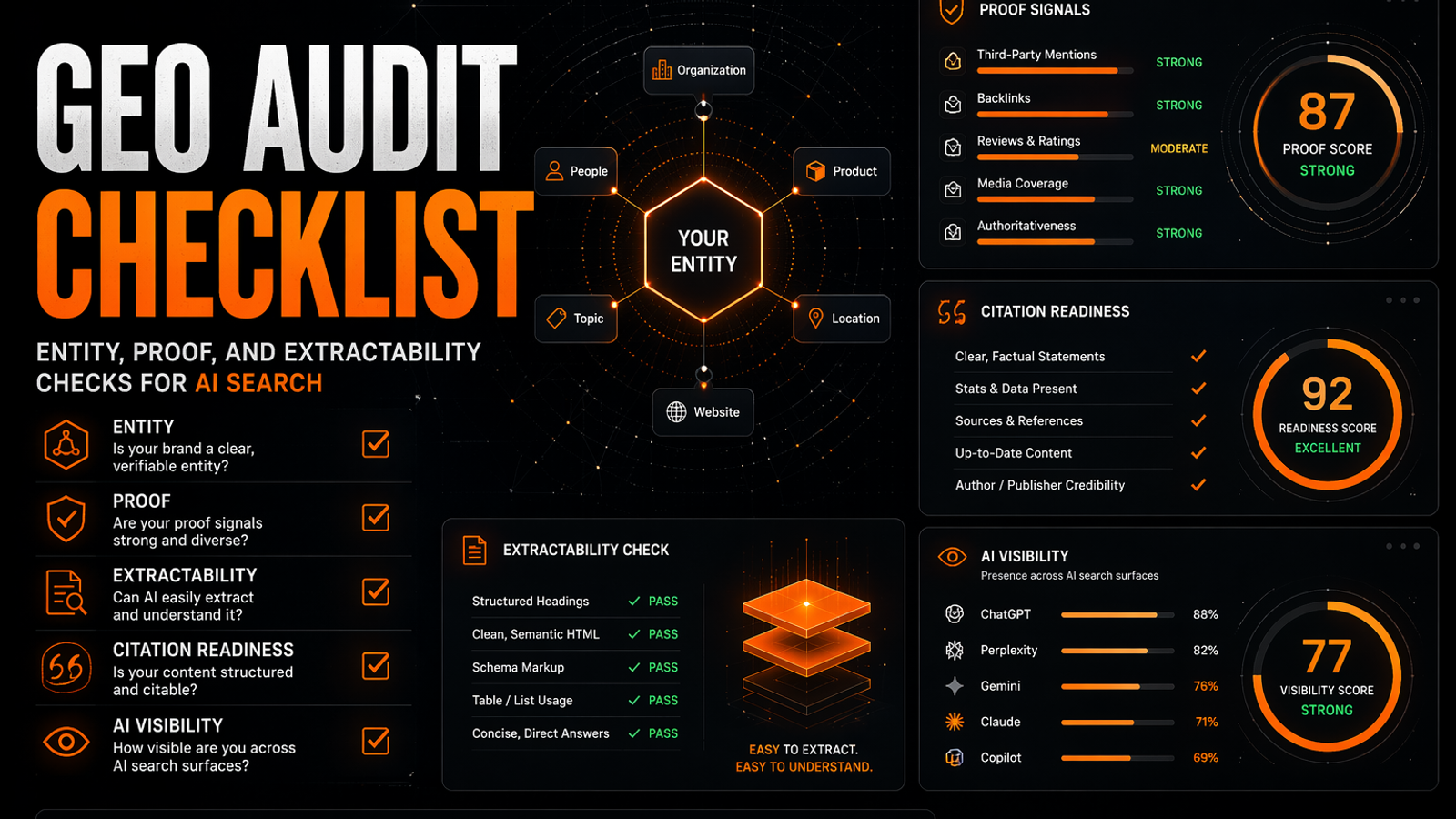
A functional GEO audit evaluates whether your brand provides clear, verifiable, and extractable data for large language models. It moves beyond vanity metrics by inspecting entity clarity, brand proof, answer extractability, AI citation readiness, structured content, freshness, and third-party corroboration. By fixing entity clarity first, layering in proof, and cleaning up site structure, you ensure generative engines have the exact evidence they need to confidently cite your brand in AI search answers.
Do not assume AI search will cite your brand just because you exist. Generative engines do not owe you visibility, and they certainly do not owe you a citation simply because you published a landing page.
Most teams treat generative engine optimization as a vanity metric by typing their brand name into an AI tool, screenshotting the output, and calling it a strategy. Outcome checking tells you what happened today without diagnosing why it happened or how to secure it tomorrow.
At SavageAudit, we view a geo audit as a rigorous evidence inspection. It answers a structural question: does your website give AI search systems enough clear, verifiable, extractable data to understand what your brand is, who it serves, why it should be trusted, and when it deserves to be cited?
This geo audit checklist zeroes in on exactly that evidence architecture. The mechanics of running a GEO audit tool or understanding the difference between AEO, GEO, and SEO audits are foundational, but they only matter if your inputs are sound. When you are ready to identify missing content opportunities, you can pair this checklist with our broader guide on how to audit AI search visibility and AEO gaps. Right now, the focus is on inspecting entity clarity, brand proof, extractability, AI citations, structured content, freshness, and third-party corroboration.
---
What Does a GEO Audit Actually Check?
A functional GEO audit evaluates whether your brand is clear, credible, structured, and cite-ready for large language models and generative search experiences. Conducting an AI search visibility audit means looking for specific structural signals. You need entity clarity so the system knows exactly what category your product belongs to. You must verify brand proof to ensure your marketing claims are supported by visible, nearby evidence. The audit also tests extractability, checking whether a clean, useful answer can be pulled from your pages without an AI system having to dig through paragraphs of vague marketing copy.
Beyond that, the process involves checking AI citation readiness to see if you have dedicated pages that naturally support specific answer types. Freshness matters because stale claims and outdated examples degrade trust. Finally, third-party corroboration ensures that outside sources describe your brand consistently with your own site. Vague, stale, unsupported, or poorly structured websites force AI systems to infer what you do. Inference is a terrible visibility strategy.
---
The Hierarchy of Audit Fixes
You can score each item on this checklist as a Pass, Partial, or Fail. A "Pass" means the element is clear, visible, specific, current, and easy to extract. A "Partial" means the information is present but buried, inconsistent, or unsupported. A "Fail" means the data is missing entirely or actively contradictory.
When it comes time to execute fixes, follow a strict order of operations:
- Fix entity clarity first. Piling on customer testimonials will not save a page if your brand cannot be understood by a machine.
- Layer in the proof. Unsupported claims are incredibly weak citation material for an AI trying to provide a factual answer.
- Clean up extractability. Good evidence buried inside terrible site structure is practically useless.
- Strengthen corroboration. Once your owned properties are pristine, work on aligning your external footprint.
- Test your prompts. Always test AI outputs after improving your inputs, never the other way around.
---
1. Entity Clarity Checks
Entity clarity forms the foundation of all AEO, GEO, and SEO alignment. Your digital footprint must make it immediately obvious what your company is, what category it occupies, who buys it, and why it exists.
Check 1: The Homepage Jargon Test
Your homepage needs to answer basic commercial questions immediately. Visitors and crawlers alike need to know your brand name, your software or service category, your target audience, and the specific problem you solve. Far too many B2B sites use positioning like, “The next-generation platform for modern teams.” That phrasing is entirely devoid of entity data. It could describe HR software, a project management tool, a cybersecurity suite, or a corporate catering service.
Contrast that with, “SavageAudit helps founders and SEO teams audit whether AI search can understand and cite their brand.” The latter is dense with entity signals, naming the exact audience, function, and outcome. Copy the first 200 words of your homepage into a blank document and strip away the logo and the design. Rewrite the copy before worrying about advanced optimization tactics if a stranger cannot identify your category and use case in ten seconds.
Check 2: Brand Description Consistency
AI search does not experience your company as a single, perfectly polished sales deck. It scrapes fragments from your homepage, your pricing page, blog author bios, help documentation, LinkedIn profiles, and marketplace listings. You need absolute consistency across these touchpoints. An AI system faces deep ambiguity when your homepage calls you an SEO platform, your LinkedIn calls you an AI visibility tool, and a partner directory calls you a content intelligence suite. Ensure your brand name, product titles, category language, and core use cases are unified everywhere they appear.
Check 3: Schema-to-Entity Alignment
Structured data will never rescue vague positioning, but it acts as a powerful reinforcing layer for the entity information already visible on your page. Audit your JSON-LD to ensure you are using appropriate schema types. An Organization or WebSite tag is standard, but you should also apply SoftwareApplication or Product where relevant. Use Person schema to establish the credibility of founders or authors. Pay special attention to your sameAs links by pointing them exclusively to official, highly recognized profiles like a verified LinkedIn company page or a major review platform. Never use sameAs as a dumping ground for random corporate mentions.
Check 4: AEO, GEO, and SEO Taxonomy
Many brands now stuff AEO, GEO, and SEO into the same paragraphs without defining the relationship between them. This creates semantic confusion and ruins extractability. Maintain a stable working taxonomy across your site. Treat SEO as improving visibility in traditional search results, AEO as optimizing for direct answer experiences, and GEO as securing visibility and citations in generative AI environments. You do not have to explain all three concepts on every single page, but you do need to use them consistently. Search your site for these acronyms and flag any pages where the terms are undefined or used interchangeably.
---
2. Brand Proof Checks
A marketing claim is not proof. A generative engine optimization audit must heavily scrutinize whether your site actually supports the answers it wants AI to generate. AI search engines prioritize verifiable information over empty boasting.
Check 5: Proximity of Evidence to Claims
Most commercial websites are packed with massive claims and microscopic evidence. You will routinely see phrases like “Trusted by leading teams,” “Built for enterprise scale,” or “The most accurate audit tool.” These claims do no work when the evidence is missing, vague, or located three clicks away. Pick your five strongest marketing claims and audit their immediate surroundings. Outcome claims require nearby case studies, trust claims require nearby testimonials, and methodology claims require nearby documentation. Fix the layout whenever the proof is not adjacent to the claim.
Check 6: Structural Social Proof
A horizontal strip of gray client logos is a design element, not a proof strategy. It functions as mere decoration unless the surrounding text explains exactly why those logos are there. Strong social proof provides immediate context by telling the reader and the crawler who used the product, what specific problem they faced, and what measurable outcome was achieved. Testimonials should highlight a real business challenge instead of just offering generic praise. When auditing your site's credibility signals, review our deep dive into social proof and AI visibility to ensure your customer success stories are actually structured for extraction.
Check 7: Category-to-Proof Matching
There is often a severe mismatch between the category a brand wants to own and the proof they actually display. AI systems will associate you with generic SEO consulting wins if you want to be cited as an authority on "geo audits" but your case studies only highlight traditional SEO. Your evidence must reinforce your target category. Securing AI citations for AI search visibility requires case studies, methodology pages, and tool documentation specifically about that topic. Your positioning has outpaced your evidence anytime your target category requires deep technical proof but your site only offers high-level thought leadership.
---
3. Extractability Checks
Extractability is where content teams frequently lose the plot. They write sprawling pages, bury their core definitions in the fourth paragraph, and hide actionable steps behind clever introductions. Then they wonder why a competitor with a simpler page wins the AI citation.
Check 8: Direct Answer Placement
When a page targets a specific question or concept, it needs to deliver the answer immediately. Avoid opening paragraphs that start with sweeping statements about the rapidly changing digital landscape. Nobody needs those sentences, and they actively delay the extraction of facts. A better approach is to state directly what the concept is in the opening lines. Ensure your pages answer their main premise within the first 150 words.
Check 9: Utility Over Cleverness in Headings
Clever headings are terrible audit signals. Titles like "The new frontier" or "Think bigger" provide zero semantic value to an extraction engine. Headings should act as a functional outline of the page. Use descriptive, literal titles like "What a GEO Audit Checks" or "How to Improve Answer Extractability." Strip away the body copy and read only your H2s and H3s. Rewrite them entirely if you cannot understand the precise narrative of the page from the headings alone.
Check 10: Semantic HTML Integrity
Your formatting choices must match the type of information being presented. Headings are not styling hacks to make text larger; they are structural markers. Use standard semantic HTML to organize your data. Ordered lists <ol> should be used for sequential workflows, while unordered lists <ul> work for criteria or features. Compare two concepts using a <table> rather than burying the comparison data inside a dense paragraph. Strip the CSS from your page and look at the raw HTML. Your underlying structure is weak if the content hierarchy becomes confusing without design elements.
Check 11: Citation-Worthy Content Blocks
A citation-worthy block is a concise, self-contained section of content that perfectly supports a specific query. AI citations are far more likely to occur when a single section of your page directly answers the prompt, rather than forcing the system to stitch an answer together from six scattered paragraphs. Audit your strategic pages to ensure they feature clear definition blocks, step-by-step checklists, comparison matrices, or summary boxes. Make the information dense, accurate, and easy to lift.
---
4. AI Citation Readiness Checks
Your homepage alone cannot carry your entire AI search strategy. Securing citations for specific, high-value topics requires dedicated pages built to perform specific citation jobs.
Check 12: Aligning Pages to Citation Jobs
A citation job is the functional reason an AI answer would reference your URL. Different queries require different types of supporting evidence. You need a glossary or concept page when a user asks for a definition. A step-by-step methodology page is required when they ask for a workflow. Tool recommendations require a dedicated product or feature page. Look at the queries you care about and verify whether you actually have a page designed to serve as the definitive source for that specific answer.
Check 13: Topical Mapping via Internal Links
Internal linking is much more than traditional SEO plumbing. It is how you teach AI systems about the relationship between your concepts. Relevant supporting pages must be connected using highly descriptive anchor text. Do not use "click here" or "read more." Connect your high-level guides to your granular tutorials using exact, descriptive phrasing. Ensure your tool pages link out to the methodology content that explains how the tools work, and cross-link your blog posts to relevant commercial pages. A tight, descriptive internal link graph makes your entire entity easier to parse.
Check 14: Strict Content Freshness
Not every page on your site requires constant updating. However, pages discussing fast-moving topics like AI search, generative engine optimization, prompt testing, and ranking factors can become stale in a matter of months. An AI system will pull citations from a fresher source if it detects that your page references outdated software versions or treats AI search as a futuristic experiment rather than a current reality. Run a routine content freshness audit for AEO to systematically identify and update stale claims, old screenshots, and deprecated positioning.
---
5. Third-Party Corroboration Checks
Your website is the core of your evidence graph, but it is not the entirety of it. Your position is inherently weak if your domain is the only place on the internet claiming you are a market leader. Generative engines look for external consistency to validate internal claims.
Check 15: External Profile Alignment
Audit your brand's presence on third-party platforms. This includes your LinkedIn company page, major software review platforms, partner directories, app marketplaces, and company databases. The goal here is not to spam directories for backlinks, but to establish data consistency. Verify that your brand name is spelled correctly, the website URL is accurate, and the company description matches your current positioning. Replace old boilerplate text that references discontinued products or outdated target audiences.
Common questions
What is a GEO audit?
A GEO (Generative Engine Optimization) audit is a rigorous inspection of your website's evidence architecture. It checks whether your site gives AI search systems enough clear, verifiable, and extractable data to understand and cite your brand.
What is the difference between a GEO audit and an SEO audit?
While an SEO audit focuses on traditional ranking factors and crawler accessibility, a GEO audit specifically evaluates entity clarity, answer extractability, and brand proof to secure citations in AI-generated answers.
How do I improve content extractability for AI search?
Improve extractability by placing direct answers within the first 150 words of a page, using descriptive and literal headings, maintaining semantic HTML integrity, and creating concise, citation-worthy content blocks.
Why is entity clarity important in a GEO audit?
Entity clarity ensures that large language models understand exactly what your company is, what category it occupies, and who it serves. Without it, AI systems are forced to infer your purpose, which drastically reduces your chances of being cited accurately.
Keep the diagnosis moving
Run your own public presence audit
See how your website, search footprint, AI visibility, social proof, and conversion trust look from the outside.