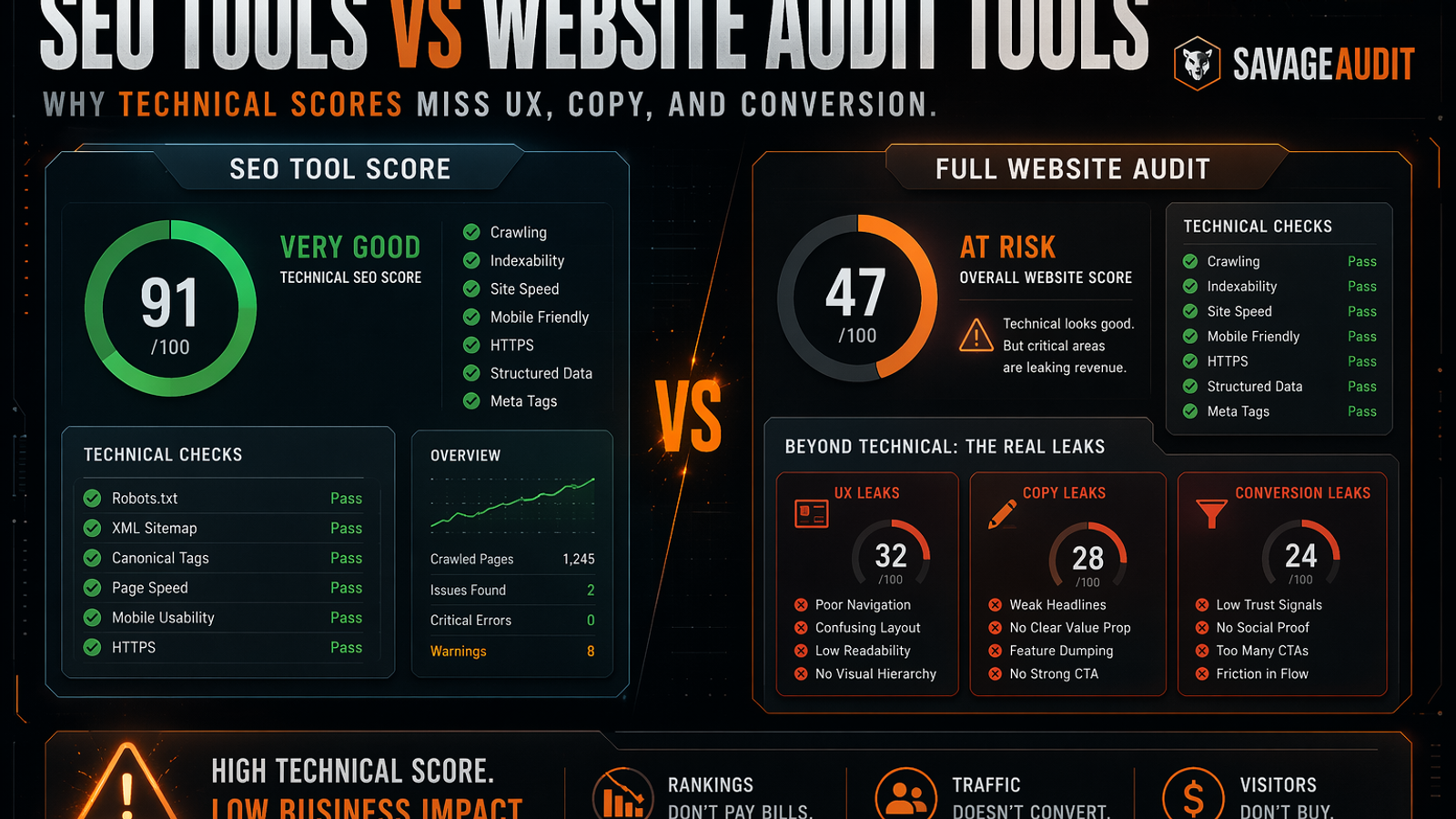
SEO audit tools are built to evaluate technical infrastructure, finding crawl blockers, indexation errors, and missing metadata. However, they cannot measure whether a page is persuasive or user-friendly. Website audit tools evaluate the full commercial experience, including UX friction, copy clarity, design hierarchy, and conversion readiness. While SEO tools ensure search engines can access your site, website audit tools ensure human buyers actually trust and act on your pages.
Most seo audit tools are good at telling you your site is technically messy. They are much worse at telling you the scarier truth: your page may be perfectly readable to a crawler and still completely useless to a buyer.
This is the difference between capturing traffic and actually converting it. A 97/100 score can feel reassuring, but it is often a polished little lie if your headline is vague, your CTA is buried, your offer sounds generic, and your signup flow feels like homework.
This is the gap between SEO audit tools and real website audit tools. One category checks whether search engines can parse and evaluate your site. The other evaluates whether humans understand, trust, and act on it.
Quick answer: SEO audit tools vs website audit tools
You need SEO audit tools to flag infrastructure issues—things like crawl blockers, indexation errors, missing metadata, broken internal links, and technical performance gaps.
However, a website audit tool is required to determine whether the page actually works as a business asset. That means evaluating the clarity of the message, the strength of the UX, the persuasiveness of the copy, the credibility of the proof, and the friction in the conversion flow.
The mistake teams make is treating a technical SEO score as a complete website verdict. A crawler will not warn you when your hero section says nothing specific or your pricing page creates anxiety. A page can technically rank while emotionally collapsing.
SavageAudit approaches website auditing across six dimensions: Performance, SEO, Design, Copy, UX, and Conversion, enhanced with live brand and internet context. The point is not to replace technical checks, but to stop pretending they represent the whole picture.
For a deeper dive into the strategic difference, read Website Audit vs SEO Audit: Why Rankings Aren’t Enough.
Why this comparison matters right now
Thousands of teams search for "seo audit tools" every month. It is a mature, well-understood software category. But there is a distinct, growing demand for solutions centered around automated website audits and AI-driven analysis.
That shift in search behavior points to a real realization among founders, marketers, and product leads: another technical report won't explain why a page fails to convince anyone. They need an audit that critiques the human experience. Buying a crawler when you have a messaging problem is the wrong purchase.
What SEO audit tools are built to catch
Good SEO audit tools are valuable. Let’s not be childish about this. Industry standards like Ahrefs Site Audit, Semrush’s SEO Checker, and the Screaming Frog SEO Spider exist for a reason. They crawl website pages at scale, flag technical and on-page SEO issues, and produce prioritized to-do lists alongside overall health scores.
Most technical SEO audit tools are built to find structural problems. They hunt down crawlability blockers, indexation errors, broken links, redirect chains, and missing or duplicate metadata. They analyze heading structures, thin content signals, XML sitemap errors, and Core Web Vitals.
If your site has 2,000 pages, you need this software. A human is not manually checking every URL for status code problems unless your budget includes ritual suffering. A crawler is the right tool for scale, consistency, and technical hygiene.
But a crawler is not a buyer.
Where SEO audit tools usually stop
Teams get into trouble when they confuse "search engine accessible" with "market ready." A page can be technically optimized and still fail because the offer is weak or unclear.
An SEO audit software will gladly flag a missing meta description, but it won't point out that your above-the-fold copy reads like it was written by a committee trying not to offend procurement. It measures page speed, yet fails to evaluate whether the first screen wastes that speed advantage by forcing users to decode what the product actually does. Finding broken links is helpful, but crawlers cannot tell you if the live links are sending people to low-intent, low-trust pages at exactly the wrong moment.
This is the central boundary of the category: technical SEO audit tools measure structure better than persuasion.
The problem is not that these tools exist. The problem is when teams use them as if they are UX, copy, brand, and conversion audits wrapped into one.
What website audit tools should evaluate instead
A serious website audit tool inspects the full page experience. Because a page fails as a cohesive system, the audit should reflect that reality.
Search visibility might bring the visitor in, but confusing design, slow UX, missing proof, and premature CTAs will drive them away. A website audit tool should expose those failures together. SavageAudit tackles this by utilizing a 5-agent AI workflow that includes visual analysis, Lighthouse data, external context gathering, roast writing, and quality checking. This combination matters because the page experience is not a single, isolated metric.
UX audit: can people actually use the page?
A UX audit asks whether the path makes sense in a practical, commercial way. It evaluates whether the navigation is obvious, if users can tell what to do next, and if CTAs are visible at the right moments. The review looks at whether the form is too demanding, if the layout matches user intent, and if the page creates unnecessary cognitive load.
SavageAudit’s conversion-related review specifically targets UX clarity, navigation friction, form friction, and landing page flow. UX is not decoration; it is the measure of whether users can move from interest to action without being punished by your interface. If your trial signup is buried under three vague buttons and a massive carousel, your problem is not "SEO health." It is friction.
Copy audit: does the page say anything useful?
A copy audit checks whether the words are doing commercial work. Most weak SaaS pages suffer from the same predictable flaws: vague headlines, abstract subheads, feature blocks with no outcomes, and generic social proof. A strong copy audit cuts through the filler to ask the hard questions. Who is this for? What problem does it solve? Why should anyone believe it? What is the promised outcome, and what proof supports that promise?
SavageAudit critiques the human experience of reading the page. A crawler can see that text exists, but it takes a qualitative audit to tell you that the text is spineless.
Conversion audit: is the page built to produce action?
A conversion audit asks whether the page actually earns the click, signup, demo request, or purchase. This is where a pure SEO score becomes especially misleading. You can rank, get traffic, and still waste every bit of it.
SavageAudit’s framework emphasizes that rankings are not enough because conversions and trust signals matter just as much. It evaluates CTA placement, the clarity of post-click steps, and the presence of verifiable proof like testimonials, client logos, case studies, and security claims near decision points. Conversion problems often look like CTAs appearing before value is established, vague pricing pages, or forms asking for too much information upfront. If your site has these issues, fixing another canonical tag is not going to save you.
Comparison table: SEO audit tools vs website audit tools
| Evaluation area | SEO audit tools | Website audit tools |
|---|---|---|
| Crawlability | Strong | Should include basics |
| Indexation | Strong | Usually secondary |
| Metadata | Strong | Should include SEO layer |
| Technical errors | Strong | Should include important blockers |
| Performance metrics | Often strong | Should connect speed to UX and conversion |
| Design critique | Usually limited | Core capability |
| Copy clarity | Usually shallow | Core capability |
| UX friction | Limited or indirect | Core capability |
| Trust signals | Usually limited | Core capability |
| Conversion readiness | Usually weak | Core capability |
| Buyer persuasion | Usually not built for it | Should be central |
| Best user | SEO teams, technical marketers, agencies | Founders, marketers, SaaS teams, product teams |
The practical answer is not to choose one category forever. Select the tool based on the question you need answered. If you want to know if search engines can crawl your site, rely on SEO audit tools. If you want to know why people are not converting, turn to website audit tools.
Why technical scores create false confidence
Scores are seductive because they compress complexity into a single number, which is exactly why they are dangerous.
A high technical score can make a weak page look fixed. Teams chase green checkmarks because ticking off technical boxes is easier than confronting the fact that the product story is unclear. A technical SEO score does not feel awkward in a marketing meeting, whereas a blunt copy critique does.
This dynamic causes teams to over-index on technical audits. They produce clean tickets for developers to fix title tags, compress images, and update robots.txt files. You should absolutely do those things. But eventually, someone has to ask the uncomfortable questions: Does the hero section make a specific promise? Is the layout guiding attention or scattering it? Does this page sound like a real company or a template?
Most SEO audit tools go quiet at this stage. SavageAudit is built for that gap. It delivers a fast, blunt audit that critiques the actual page experience. It is not an API-first technical crawler; it is a page-level roast focused on why a site feels weak, confusing, slow, untrusted, or unconvincing.
The case for technical crawlers
Rely on seo audit tools when you need technical visibility at scale.
They are the right choice for managing a large site and diagnosing crawl budget issues through recurring scans. If you are preparing for a site migration, monitoring SEO health over time, or hunting down broken links across thousands of pages, a crawler is non-negotiable. Developers and SEO teams need these tools to generate issue lists with specific URLs and status codes. When dealing with massive scale, you need the machine to find machine-readable problems.
When qualitative website feedback is required
Switch your focus to website audit tools when the page needs to persuade humans.
These tools become critical when launching a new landing page, redesigning a homepage, or trying to improve demo request volume. If you need fast feedback before turning on paid traffic, or if stakeholders disagree about whether a redesign actually improved the site, qualitative checks resolve the debate.
SavageAudit delivers a fast, no-signup audit with a data-backed verdict and screenshots. It provides concrete criticism and "fix it" guidance rather than a decorative dashboard. For founders specifically, it frames the audit around how a skeptical buyer experiences the site: whether the value proposition is quickly understood, outcomes are concrete, credibility is visible, and the page is conversion-ready.
Related reading: Best Website Audit Tool for Founders: Get Honest Feedback.
The best workflow: crawl first, critique second
The strongest teams do not turn this into a fake rivalry. They use the right audit layer at the right time.
Step 1: Run a technical SEO crawl
Use your preferred site audit tool to find obvious technical blockers like crawl errors, missing metadata, duplicate tags, and indexation problems. Fix the basics so you are not making Google fight your site just to understand it.
Step 2: Run a website audit
Once the infrastructure is clean, audit the page like a buyer sees it. Check if the headline makes sense in five seconds, if the visual hierarchy is obvious, and if proof is visible near decision points. SavageAudit combines speed, SEO, UX, design, copy, and conversion analysis in one report, tying issues back to business outcomes rather than just reporting a speed score.
More on the combined approach: Speed, UX & SEO Audit Tool: A Combined Website Review.
Step 3: Compare competing versions
If you are choosing between a current page and a redesign, do not argue in Slack for three days. Compare them objectively. SavageAudit Compare provides a side-by-side, six-category comparison of two URLs. It delivers score deltas and category-level contrasts across SEO, UX, performance, copy, design, and conversion. This is highly useful for redesign validation and competitor analysis.
What about AI website audit tools?
AI website audit tools add real value when they evaluate the page as an experience rather than simply repackaging the same technical checks in friendlier language.
The better ones analyze copy clarity, message-market fit, trust signals, design hierarchy, and conversion logic. SavageAudit’s AI workflow gathers visual analysis, Lighthouse metrics, and external context to write a comprehensive roast. This matters because good feedback requires both objective data and interpretive judgment. A metric can tell you the page is slow. A stronger audit tells you the page is slow, the first screen wastes attention, the CTA does not match the promise, and the proof is too vague to reduce risk.
For a broader category breakdown, read Best AI Website Audit Tools Compared.
What about site audit APIs?
A site audit API is valuable when you need to run checks at scale, integrate audit data into a proprietary platform, or automate reporting across a large portfolio.
But scope matters here, too. SavageAudit does not operate as an API-first technical crawler. It is a blunt website audit focused on the actual page experience. If you need raw crawl data at scale, use an API-style technical solution. If you need to know why a page feels unconvincing, use a tool built for qualitative critique.
More here: Site Audit API vs SavageAudit: Why Technical Checks Aren’t Enough.
How to choose the right audit software
The decision rule is straightforward.
Focus on SEO audit tools if your main problem is visibility infrastructure. That means pages are not being indexed, search visibility dropped after a migration, technical debt is growing, or your SEO team needs deep crawl diagnostics.
Alternatively, lean on website audit tools if your main problem is performance after the click. This applies when traffic exists but leads are weak, paid traffic is not converting, users bounce from key pages, or the homepage fails to explain the product. You need sharper copy, UX, and conversion feedback to fix these issues.
Use both if you care about revenue. Technical SEO gets people to the door. The website experience gets them to trust you enough to act. One without the other is incomplete.
Common questions
Are SEO audit tools and website audit tools the same thing?
No. SEO audit tools focus mainly on search visibility, crawlability, metadata, technical health, and on-page SEO. Website audit tools evaluate the broader commercial experience, including UX, copy, design, trust signals, performance, and conversion readiness.
Can an SEO audit tool improve conversions?
Indirectly, sometimes. Faster pages and cleaner site structure can reduce bounce rates, but an SEO audit tool will not fix vague copy, confusing navigation, or weak calls-to-action that actively kill conversions.
When should I use a technical SEO audit tool?
Use technical SEO audit tools when managing a large site, diagnosing crawl budget issues, preparing for a site migration, or hunting down broken links and indexation errors across thousands of pages.
Why is a high technical SEO score misleading?
A high technical score only means a search engine crawler can easily read and index your page. It does not mean a human buyer will understand your product, trust your brand, or click your call-to-action.
Keep the diagnosis moving
Run your own public presence audit
See how your website, search footprint, AI visibility, social proof, and conversion trust look from the outside.