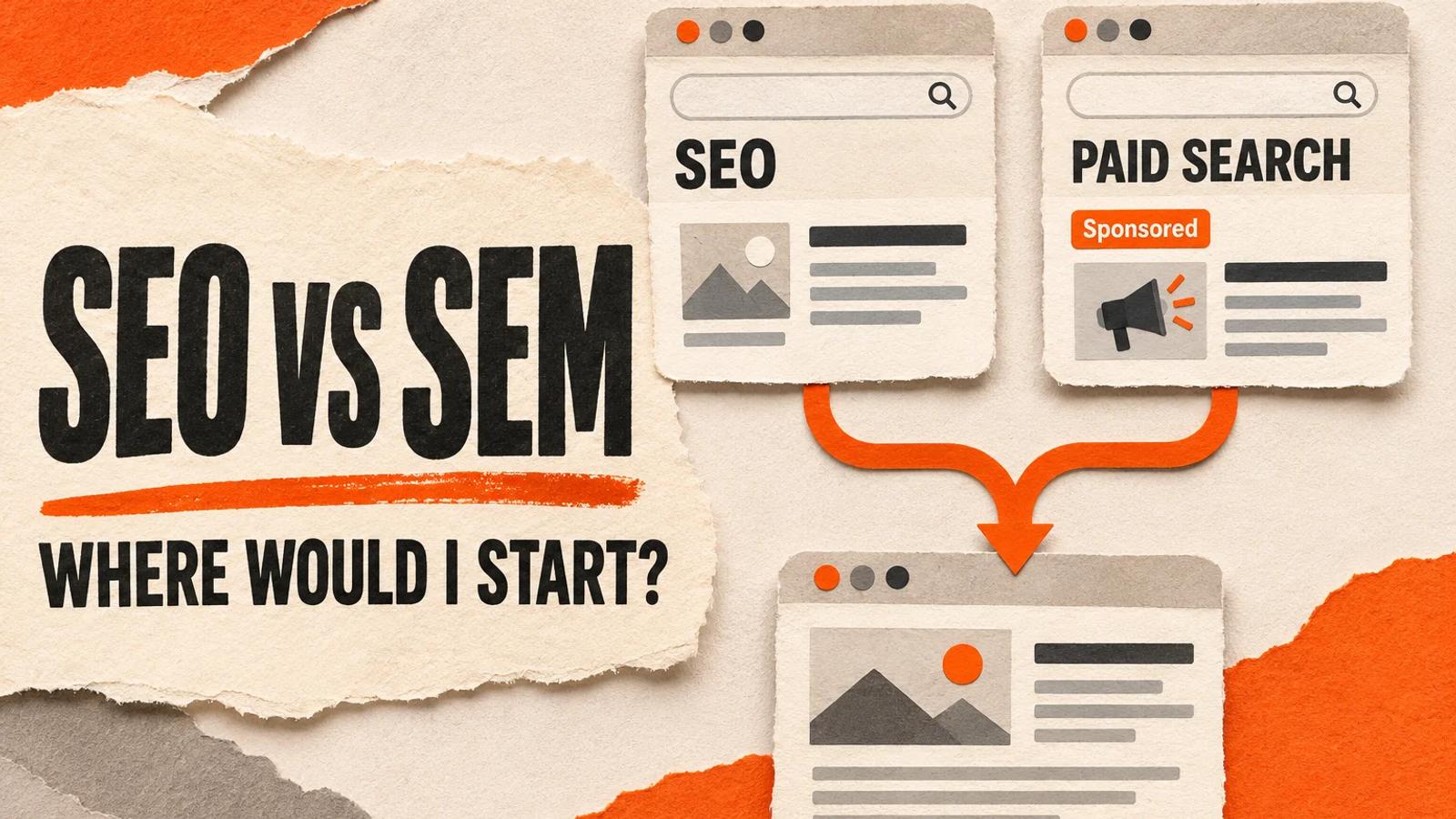
SEO aims to improve organic search visibility. SEM can mean all search marketing, but this article uses its common paid-search meaning when comparing the channels. Choose the next step from search demand, the page’s readiness, the business timeline and measurable outcomes. The INR budget model is illustrative, not an observed campaign or a forecast. Buying ads does not buy organic rankings, and organic traffic still requires time and resources.
If I had ₹18,000 to spend on getting a new website noticed, I wouldn’t start by picking a winner between SEO and SEM.
I’d open the page I wanted people to visit. Can someone understand the offer? Is there a useful next step? Do I know what I’ll count as a good inquiry?
Until I can answer those questions, I can spend the whole budget and still learn very little. More traffic would give me a bigger number to explain.
That’s how I’d approach this decision: check the demand, the destination and the cost of learning. Then choose where to put the next bit of time or money. I’ll use a fictional budget example below so the tradeoffs are visible. The numbers are assumptions, not results from a SavageAudit campaign.
First, I’d agree on what we mean by SEM
SEO is work that helps a website appear in organic search. In this article, I use SEM to mean paid search advertising.
There is a terminology problem worth clearing up. SEM stands for search engine marketing. Some people use it as the umbrella for both organic SEO and paid search. Others use it for paid search alone. Google’s current SEM guide acknowledges the older broad definition and the common paid-search usage.
If an agency says it offers SEM, I’d ask what the work includes. Google Ads management? Organic content? Technical SEO? A combined service? The name alone doesn’t tell me what I’m buying.
PPC means pay per click, a payment model used in much search advertising. It also appears outside search, so PPC and SEM aren’t perfect synonyms in every context. Here, the comparison concerns organic search and paid search campaigns.
| Question I’m asking | SEO | Paid-search SEM |
|---|---|---|
| What am I working on? | Useful pages and the site conditions that support organic discovery | Campaigns, ads, targeting, bids and the destination experience |
| Am I paying Google for the organic placement? | No | Ad spend buys eligible advertising opportunities, not an organic position |
| Can I choose which page I promote? | I can build and improve a relevant page; the search engine decides what to surface | I choose an advertising destination within the platform’s requirements |
| What does it cost me? | Content, technical work, design, tools and time | Media spend plus setup, management, creative, page work and measurement |
| What would I inspect? | Relevant organic visibility, visits and useful outcomes | Relevant searches, ad costs, visits and useful outcomes |
That clears up what the work includes. Now I can look at whether it suits the business.
I’d check whether the right people are searching
A big search-volume number can hide several different tasks. Someone learning what a product category means may need an explanation. Someone comparing two services may need proof, scope and price. Sending both people to the same generic homepage can make the channel look worse than it is.
For example, a person searching “how to improve a landing page” might want a practical guide. A person searching for a particular landing-page audit service might be closer to choosing help. Those are illustrative interpretations. I’d check the actual results in the relevant market before designing a page or campaign around them.
The task behind the search goes in my notes first. Then I’d open the competing results and ask whether my page gives that person a useful answer.
For paid search, the actual matched searches matter too. Google’s keyword matching documentation makes clear that match types can include related searches. Naming a keyword in an account doesn’t guarantee that every visitor used the exact phrase I had in mind.
With SEO, another spelling of a question wouldn’t persuade me to publish another page. The existing page may already answer it. We cover that issue in the keyword cannibalization guide.
If people aren’t searching for the problem in a way that fits the offer, I’d question the search strategy before arguing about organic versus paid.
When I’d put SEO first
SEO makes sense to me when the business has questions worth answering on useful, maintainable pages, and can support work that takes time to assess.
Suppose I’m working on a specialist service with recurring questions about the process, price and suitability. I’d want those answers on the site anyway. A clear service page, a useful comparison and an explanation of the buying decision can help prospective customers understand the offer while giving search engines relevant material to discover.
The service and its buyers’ questions would come first. Twenty loosely related articles are hard to justify when the service page still leaves people guessing.
Before adding more content, I’d check discovery and indexing, then look at the searches and pages appearing in Search Console. The site may have a specific problem to fix before it needs another article.
Google’s SEO Starter Guide describes changes taking different amounts of time to show an effect and gives no guarantee of a noticeable result. I wouldn’t promise that a new page will rank next month or keep its position indefinitely.
The commitment I’d make is to the work I can inspect: a useful page, clear internal routes, accessible content and a sensible way to evaluate it. The ranking itself remains outside my control.
When I’d consider a paid search test first
I’d consider a limited paid search test when I have a specific offer, a relevant destination and a question I can afford to investigate.
For example, imagine I’m launching a narrowly defined service in one market. I want to learn whether people searching for that service understand the offer and send suitable inquiries. Paid search may let me reach eligible searches sooner than waiting for a new organic page to establish visibility.
That still depends on campaign approval, eligibility, budget and the auctions I enter. Launching an ad is not a promise of useful traffic or profitable sales.
The test needs to be focused enough that I can explain what happened afterward: the market, intended searches, ad promise, qualification rule and review point.
And the highest bid doesn’t automatically win. Google’s Ad Rank documentation includes ad and landing-page quality, context and other factors alongside the bid. The displayed Quality Score is a diagnostic, not the number directly entered into an auction.
Before increasing the bid, I’d inspect whether the destination delivers what the ad promised.
The ₹18,000 example I’d work through before spending
Here is a deliberately simple model. I’m assuming ₹18,000 in media spend and an average cost per click of ₹60. That would buy 300 clicks in the model.
Neither number is a market benchmark. I haven’t launched a campaign for this example, and an actual campaign’s average CPC and results could differ.
For this example, a qualified lead means an inquiry that meets an agreed buyer and service-fit rule. I wouldn’t count a contact-button click as that inquiry, or an inquiry as a completed sale.
| Hypothetical qualified-lead rate from clicks | Modeled clicks | Expected qualified leads | Media cost per qualified lead |
|---|---|---|---|
| 1% | 300 | 3 | ₹6,000 |
| 2% | 300 | 6 | ₹3,000 |
| 4% | 300 | 12 | ₹1,500 |
The arithmetic uses the same CPC and budget in each row. The lead rate changes. These are expected values under the assumptions, not outcomes I can promise for one campaign.
Now I have a useful business question: would a lead at ₹3,000 be worth pursuing?
To answer that, I’d need to know how many suitable inquiries become customers, what those customers are worth after relevant costs, and how long the sale takes. Six leads would not mean six customers, and the media cost per lead would not tell me the acquisition cost per customer.
The rest of the bill matters: setup, management, creative, page work, tracking, lead handling and applicable tax. I’d ask for those costs before using the figure in a business decision.
Now I know which assumptions need evidence. If the real test produces expensive clicks and unsuitable inquiries, I’d inspect the matched searches, the offer and the page before scaling it. If the tracking is unreliable, I’d fix that before interpreting the rate.
I wouldn’t call SEO free either
There is no payment to Google for an organic listing. There is still work to fund.
If I write the page myself, my time has a cost. If I pay someone, there is a bill. Technical fixes, illustrations, page design and future updates also use resources.
Suppose I put the same ₹18,000 toward organic content and site work. I couldn’t turn that into an honest first-month visitor forecast just by dividing the budget by a target number of clicks. I’d need evidence about the site, the search demand and the pages involved.
I’d record what the work cost, what changed and what the page produced over a suitable period. Updates and support belong in the calculation too, even when the original article is already paid for.
I’d be cautious with a channel comparison that puts one week of paid leads beside all organic leads from pages built over several years. Both figures may be real, but the time periods and costs answer different questions.
For an allocation decision, I’d want to understand the next useful action. Does the existing organic page have a specific gap I can fix? Does the paid campaign have an identifiable opportunity worth testing? That is more useful than declaring one channel permanently cheaper.
I’d inspect the whole path, not stop at the click
An ad can promise a particular service while its destination talks about the company in general. An organic guide can answer the initial question and then leave the reader without a relevant next step. Both deserve attention.
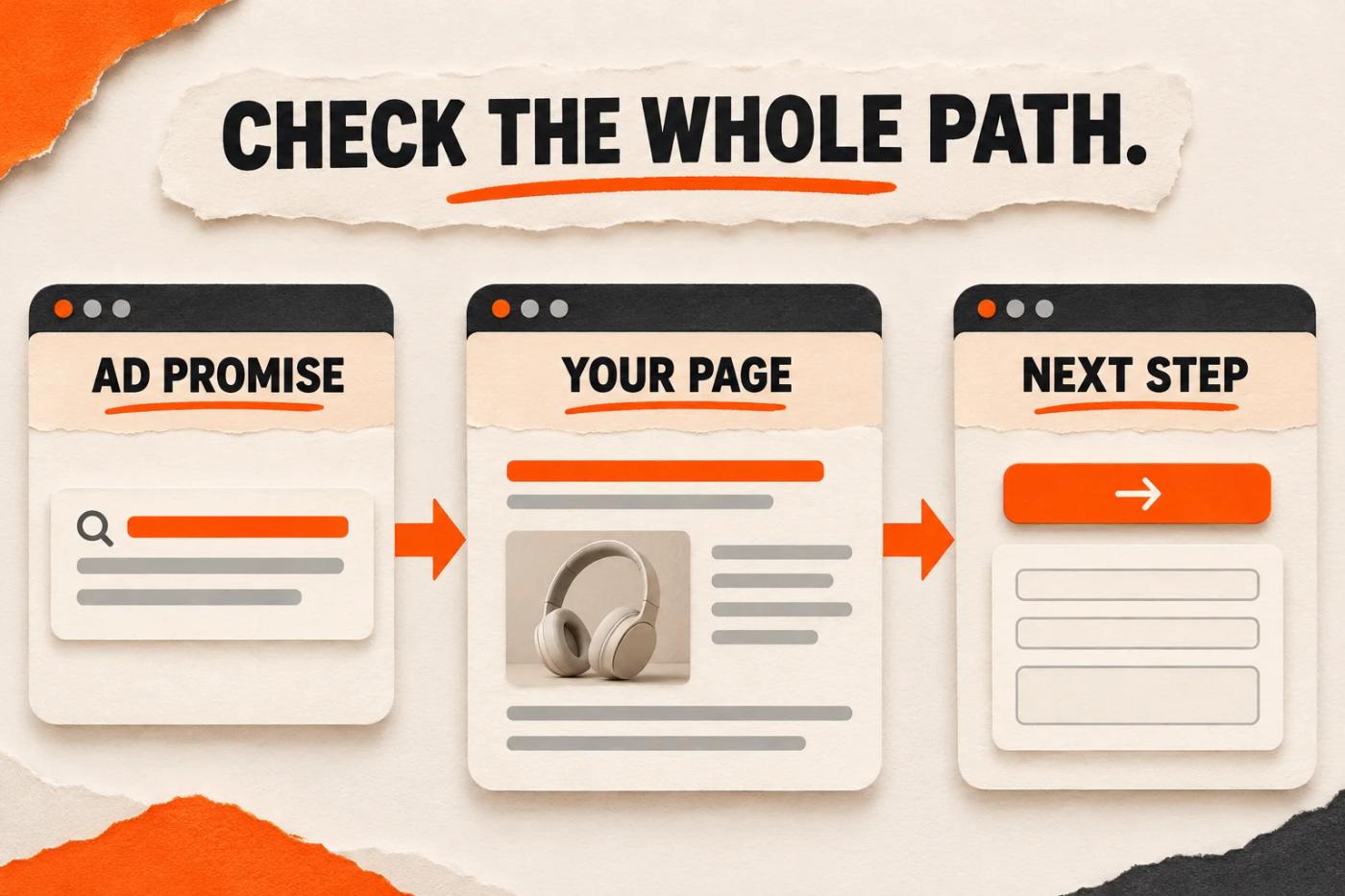
My check would follow the search task and the ad, if there is one, into the destination on a phone. Can I find the offer? Are the important conditions visible before I inquire? Does the button describe the step it opens?
For a service, I’d look for enough detail to judge fit: what is included, who it suits and what information the visitor needs to provide. For a product, the relevant questions might concern its capabilities, price, delivery or trial conditions.
Then I’d go through the next step. A form that looks fine but fails to confirm submission can leave both the visitor and the team uncertain. A “Watch demo” button that starts an unexplained sales request sets the wrong expectation.
Our call to action examples follow that handoff. I’d use those checks on a destination before attributing poor results entirely to SEO or ads.
For this part, SavageAudit can help review the page and flag copy, UX, trust and conversion friction. I’d verify the campaign, collection and actual business outcomes in the tools that own those records. A page audit alone cannot tell me that a marketing channel is profitable.
How I’d use SEO and SEM together
A small budget doesn’t need an equal split just so I can say I’m doing both. Each piece of work needs a purpose.
One possible approach is a focused paid test for a specific offer while improving the organic pages that explain the same buyer questions. Another is to improve an organic page already receiving relevant impressions before paying to bring more visitors into a weak journey.
The sequence depends on the evidence. If the page cannot explain the service, I’d start there. If the site has a useful page but limited visibility, I’d investigate the relevant searches and possible routes to reach them. If suitable visitors arrive but no one completes the next step, I’d inspect that transition.
Paid search terms may suggest questions worth researching for organic content. I’d check that the task also fits organic results before turning an ad query into a blog brief. An ad result alone doesn’t establish that a long-form article is the right answer.
And buying ads doesn’t buy an organic ranking. Google states that advertising and organic search rankings are independent. The two channels can share useful research and page improvements without that becoming a claim that ad spend boosts SEO.
What I’d measure before deciding to spend more
The outcome comes first. Then I can choose the records that would show whether it happened.
| Question | Evidence I’d use | Limitation I’d keep visible |
|---|---|---|
| Are relevant people finding the organic page? | Search Console queries, impressions and clicks, alongside the page itself | An impression is visibility, not a visit or inquiry |
| Which paid searches are bringing visitors? | Search terms, campaign delivery, clicks and cost | A click doesn’t establish buyer fit |
| What happens after arrival? | Appropriate analytics events and the actual journey | Collection and event definitions need checking |
| Are inquiries useful? | Lead records checked against an agreed qualification rule | Platform conversion totals may count different actions |
| Are customers profitable? | Deduplicated customer, revenue and relevant cost records | Leads and attributed conversions aren’t interchangeable with completed sales |
Search Console helps me understand organic search visibility. Analytics and advertising reports describe other parts of the journey. I wouldn’t add their totals together and call the sum unique customers.
For manually tagged incoming links, our UTM guide explains how to find the matching campaign fields in GA4. Advertising integrations and auto-tagging need their own checks; I wouldn’t replace a working setup with manual labels just to make a table look tidy.
Alongside the comparison, I’d record the date range, market, timezone, costs and outcome definition. For a longer sales cycle, I’d allow for the delay between the visit, inquiry and customer decision. A recent campaign can have incomplete outcome data.
The first plan I’d make
For the initial plan, I’d choose something small enough to review.
One offer, a set of relevant search tasks, and a destination I’ve checked. That’s where I’d begin. The next step is verifying how I’ll measure the outcome, before using the numbers to justify more work.
After that, I’d choose a piece of SEO work or a bounded paid test. I’d write down the cost I’m prepared to incur, the question I want answered and the evidence I’ll need at the review. That avoids turning a few early numbers into a reason to keep spending by default.
If I choose SEO, the first review can check whether I completed the intended work and whether Google can discover the page. A later review can look at relevant visibility and useful visits. I wouldn’t treat an early lack of clicks as a complete verdict on a new page.
If I choose paid search, I’d check what the campaign actually reached and how the journey worked before interpreting its totals. A few clicks cannot settle the long-term economics, but they can expose a wrong destination or a measurement defect.
So my answer to “SEO or SEM?” starts with the site and the decision in front of me. I’d use SEO for useful, maintainable organic pages, consider paid search for a defined opportunity I can afford to test, and check the result before expanding either one.
Common questions
What is the main difference between SEO and SEM?
SEO works on organic search visibility. In the common paid-search use of SEM, a business uses an advertising platform to reach eligible searches. This article uses that paid-search meaning for the comparison, while recognizing that SEM can also mean the broader field including SEO.
Does SEM include SEO?
It can. SEM has a broad definition covering search marketing and a common narrower meaning covering paid search. I’d ask which services and channels someone includes before comparing a proposal, budget or result.
Should a new website start with SEO or SEM?
I’d first check the offer, relevant search demand, destination and measurement. Useful organic pages can support a longer-term search strategy. A focused paid test may suit a defined offer when the business can fund it and evaluate the outcomes. Neither choice guarantees traffic or sales.
Is SEO cheaper than paid search?
There is no universal answer. Organic listings do not require payment to Google, but content, technical work and maintenance cost time or money. Paid search adds media costs to its other operating costs. Compare relevant periods and clearly defined useful outcomes.
Do Google Ads improve organic SEO rankings?
Buying Google Ads does not improve organic rankings. A business may use research from advertising to inform page work, but that is different from paying for an organic position.
How much should I spend on SEM?
I’d set an affordable test around a specific offer, market and measurable outcome. Estimate the economics using your own inputs and include costs beyond media. The ₹18,000 example here is an illustrative calculation, not a recommended budget or forecast for your business.
Run your own public presence audit
See how your website, search footprint, AI visibility, social proof, and conversion trust look from the outside.